## Flowchart: Software Development Process Pipeline
### Overview
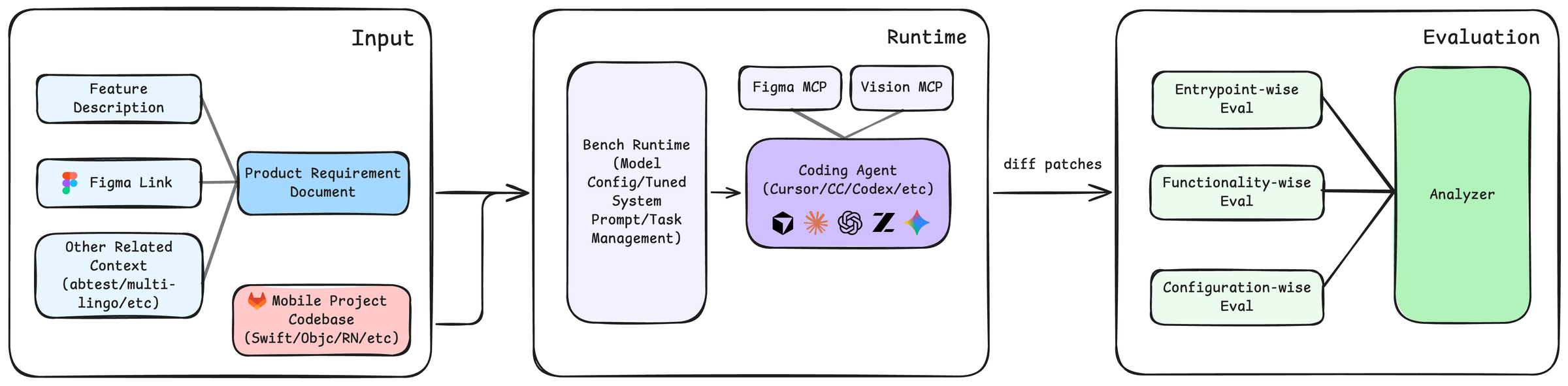
The flowchart illustrates a three-stage pipeline for software development: Input → Runtime → Evaluation. Each stage contains specialized components with directional flow indicated by arrows. The diagram uses color-coded boxes to differentiate sections and includes technical terminology related to mobile development and AI systems.
### Components/Axes
**Input Section (Left)**
- Blue box: "Product Requirement Document" (central hub)
- Connected elements:
- "Feature Description" (text box)
- "Figma Link" (icon with 4 colored dots)
- "Other Related Context (abtest/multi-lingo/etc)" (text box)
- Pink box: "Mobile Project Codebase (Swift/Objc/RN/etc)" (bottom-left)
**Runtime Section (Center)**
- Large purple box: "Coding Agent (Cursor/CC/Codex/etc)"
- Sub-components:
- "Bench Runtime (Model Config/Tuned System Prompt/Task Management)" (top-left)
- "Figma MCP" (top-right)
- "Vision MCP" (bottom-right)
- Arrows connect all Runtime components to the Coding Agent
**Evaluation Section (Right)**
- Green box: "Analyzer" (central)
- Three evaluation types connected via arrows:
- "Entrypoint-wise Eval" (top-left)
- "Functionality-wise Eval" (top-right)
- "Configuration-wise Eval" (bottom-left)
- "diff patches" arrow connects Runtime to Evaluation
### Detailed Analysis
**Input Section**
- All elements feed into the Product Requirement Document
- Mobile Project Codebase specified with concrete technologies (Swift, Objective-C, React Native)
**Runtime Section**
- Bench Runtime handles model configuration and system tuning
- Two specialized MCPs (Model Control Points) for Figma and Vision
- Coding Agent integrates multiple AI tools (Cursor, CC, Codex)
**Evaluation Section**
- Three-dimensional evaluation framework covering:
- Code entrypoints
- Functional behavior
- Configuration parameters
- Analyzer processes all evaluation types
### Key Observations
1. Color coding emphasizes section separation (blue/purple/green)
2. Technical specificity in tool naming (Cursor, Codex, React Native)
3. Evaluation framework suggests comprehensive quality checking
4. "diff patches" indicates version control integration
5. Multiple AI tools listed suggest comparative analysis capability
### Interpretation
This flowchart represents a modern software development workflow combining:
1. **Requirement Gathering**: Structured input collection with design (Figma) and feature documentation
2. **Development Execution**: AI-assisted coding with specialized runtime environments
3. **Quality Assurance**: Multi-faceted evaluation system targeting code structure, functionality, and configuration
The diagram suggests an integrated development environment where:
- Requirements directly inform coding decisions
- Multiple AI tools compete/cooperate in code generation
- Evaluation is systematic rather than ad-hoc
- Version control (diff patches) is central to the process
The presence of both design (Figma) and codebase elements indicates a full-stack development perspective, while the AI components suggest automation of coding tasks. The three-stage evaluation implies rigorous quality control before deployment.