TECHNICAL ASSET FINGERPRINT
8b922f10b4d9fe8acece6db2
Click to view fullscreen
Press ESC or click to close
FOUND IN PAPERS
EXPERT: healer-alpha-free VERSION 1
RUNTIME: free/openrouter/healer-alpha
INTEL_VERIFIED
\n
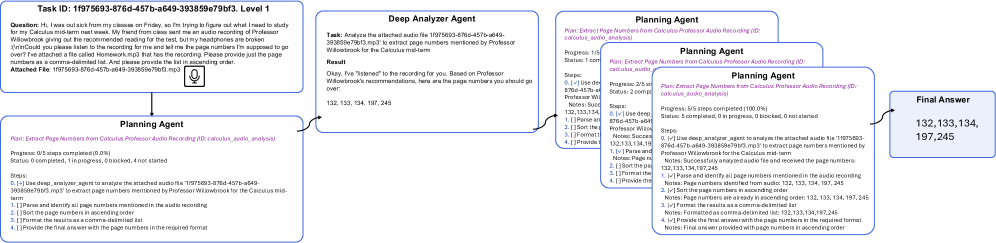
## Diagram: Multi-Agent Task Processing Workflow
### Overview
The image is a flowchart diagram illustrating a multi-agent system designed to process a specific task. The workflow involves a "Deep Analyzer Agent" and multiple "Planning Agent" instances collaborating to extract page numbers from an audio recording file. The diagram shows the flow of information, task decomposition, and the progression toward a final answer.
### Components/Axes
The diagram consists of several rectangular boxes (nodes) connected by directional arrows, indicating the flow of data and instructions. The primary components are:
1. **Task Input Box (Top-Left):**
* **Label:** `Task ID: 1f975693-876d-457b-a649-393839e79b3f, Level 1`
* **Content:** A user query asking for help studying for a Calculus midterm, specifically requesting page numbers mentioned by "Professor Willowsnag" in an attached audio recording file (`1f975693-876d-457b-a649-393839e79b3f.wav`).
2. **Deep Analyzer Agent Box (Center):**
* **Label:** `Deep Analyzer Agent`
* **Task:** `Analyze the attached audio file 1f975693-876d-457b-a649-393839e79b3f.wav and extract all page numbers mentioned by Professor Willowsnag for the Calculus midterm.`
* **Result:** `Okay, I've listened to the recording for you. Based on Professor Willowsnag's recommendations, here are the page numbers you should go over: 132, 133, 134, 197, 245`
3. **Planning Agent Boxes (Multiple):** There are four distinct boxes labeled "Planning Agent," each representing a stage or instance of planning.
* **Box 1 (Bottom-Left):**
* **Plan:** `Extract Page Numbers from Calculus Professor Audio Recording (ID: calculus_audio_analysis)`
* **Progress:** `5% (1/20 steps complete)`
* **Steps:** Lists 4 steps: 1. Parse audio, 2. Identify page numbers, 3. Format as comma-delimited list, 4. Provide final answer.
* **Box 2 (Center-Right, connected to Deep Analyzer):**
* **Plan:** `Extract Page Numbers from Calculus Professor Audio Recording (ID: calculus_audio_analysis)`
* **Progress:** `25% (5/20 steps complete)`
* **Steps:** Shows a more detailed, 5-step plan. Step 2 is marked as `✓` (complete) and notes: `Successfully analyzed audio file and identified the page numbers: 132, 133, 134, 197, 245`.
* **Box 3 (Top-Right):**
* **Plan:** `Extract Page Numbers from Calculus Professor Audio Recording (ID: calculus_audio_analysis)`
* **Progress:** `55% (11/20 steps complete)`
* **Steps:** Shows a 4-step plan. Step 1 is marked as `✓` and notes: `Successfully analyzed audio file and identified the page numbers: 132, 133, 134, 197, 245`.
* **Box 4 (Far Right, connected to Final Answer):**
* **Plan:** `Extract Page Numbers from Calculus Professor Audio Recording (ID: calculus_audio_analysis)`
* **Progress:** `100% (20/20 steps complete)`
* **Steps:** Shows a 4-step plan. Step 4 is marked as `✓` and notes: `Final answer provided with page numbers in the required format.`
4. **Final Answer Box (Far Right):**
* **Label:** `Final Answer`
* **Content:** `132,133,134,197,245`
### Detailed Analysis
The diagram maps a specific process flow:
1. **Initiation:** A user task is received (extract page numbers from an audio file).
2. **Analysis:** The "Deep Analyzer Agent" performs the core extraction, outputting the raw list: `132, 133, 134, 197, 245`.
3. **Planning & Orchestration:** Multiple "Planning Agent" instances are shown, likely representing different views or stages of the same planning process. They break down the overall task into sub-steps (parse, identify, format, deliver). The progress percentage increases across the boxes (5% → 25% → 55% → 100%), indicating forward momentum.
4. **Execution & Verification:** The planning steps reference the successful completion of the analysis (e.g., "Successfully analyzed audio file...").
5. **Output:** The process culminates in a "Final Answer" box containing the extracted page numbers in a comma-separated format without spaces: `132,133,134,197,245`.
**Spatial Grounding:** The flow generally moves from left to right. The initial task is on the far left. The Deep Analyzer is central. Planning agents are positioned below and to the right of the analyzer, with arrows showing information flow. The final answer is isolated on the far right.
### Key Observations
* **Redundancy in Planning Agents:** The diagram shows four "Planning Agent" boxes with similar but not identical content. This may illustrate the agent's internal state updates, different abstraction levels, or simply be a visual representation of iterative planning.
* **Consistency of Core Data:** The extracted page numbers (`132, 133, 134, 197, 245`) are consistent across the Deep Analyzer's result and all Planning Agent notes where mentioned.
* **Progress Tracking:** The planning agents explicitly track progress with a step count (e.g., "5/20 steps complete"), suggesting a granular, measurable workflow.
* **Format Transformation:** The final answer (`132,133,134,197,245`) differs slightly in formatting (no spaces after commas) from the initial result provided by the Deep Analyzer (`132, 133, 134, 197, 245`), indicating a final formatting step was applied.
### Interpretation
This diagram is a technical schematic of an AI agent system's internal workflow for a information extraction task. It demonstrates a **modular, multi-agent architecture** where specialized components (Analyzer, Planner) collaborate.
* **What it suggests:** The system is designed for **task decomposition and verification**. The Deep Analyzer handles the complex perceptual task (audio processing), while the Planning Agent manages goal-oriented step sequencing, progress monitoring, and output formatting. The multiple Planning Agent views emphasize the importance of **state tracking and iterative refinement** in autonomous systems.
* **Relationships:** The arrows define a clear **hierarchical and sequential relationship**. The user task triggers the Analyzer, whose output feeds into the Planner, which orchestrates steps to produce the final, formatted answer. The Planner acts as both a project manager and a quality control checkpoint.
* **Notable Patterns:** The workflow exhibits a **"sense-plan-act"** paradigm common in robotics and AI. The "sense" (analyze audio) is done by a dedicated agent, the "plan" is managed by another, and the "act" is delivering the final answer. The increasing progress percentages visually reinforce the concept of **deterministic, step-by-step execution** toward a goal. The slight formatting change in the final answer highlights that **post-processing and adherence to output specifications** are explicit steps in the process.
DECODING INTELLIGENCE...