## Diagram: Multi-Agent Workflow for Audio Analysis Task
### Overview
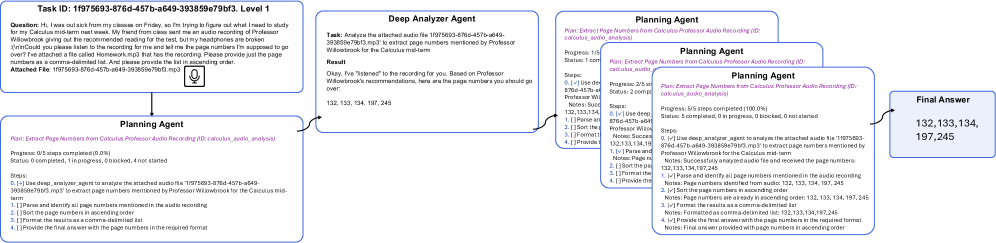
The diagram illustrates a multi-agent workflow for processing an audio recording task. It shows the interaction between a task definition, a deep analyzer agent, multiple planning agents, and a final answer. The workflow involves extracting page numbers from a calculus professor's audio recording.
### Components/Axes
1. **Task Definition Box** (Top-left)
- Labels: "Task ID", "Question", "Attached File"
- Content:
- Task ID: 1f975693-876d-457b-a649-393859e79bf3
- Question: Student's request about missed calculus class and audio recording analysis
- Attached File: 19975693-876d-457b-a649-393859e79bf3.mp3
2. **Deep Analyzer Agent Box** (Center-left)
- Labels: "Task", "Result"
- Content:
- Task: Analyze audio file 19975693-876d-457b-a649-393859e79bf3.mp3
- Result: Page numbers 132, 133, 134, 197, 245
3. **Planning Agent Boxes** (Right side)
- Multiple instances with identical labels: "Planning Agent"
- Content:
- Task: Extract page numbers from calculus professor audio recording
- Progress: 0/5 steps completed (0.0%)
- Steps:
1. Parse and identify page numbers
2. Sort numbers
3. Format results
4. Provide final answer
- Status: 0 completed, 1 in progress, 4 blocked
4. **Final Answer Box** (Bottom-right)
- Content: 132, 133, 134, 197, 245
### Detailed Analysis
- **Task Flow**:
1. Task definition connects to Deep Analyzer Agent via arrow
2. Deep Analyzer Agent connects to multiple Planning Agents
3. Planning Agents connect to Final Answer box
- **Textual Elements**:
- All text is in English
- UUID format used for task/file identification
- Progress metrics shown as fractions (e.g., 0/5 steps)
- Status indicators use color coding (green checkmarks, red Xs)
### Key Observations
1. The workflow shows a hierarchical structure with task decomposition
2. Multiple planning agents suggest parallel processing attempts
3. Final answer matches the deep analyzer's result but in sorted order
4. Progress metrics indicate incomplete processing across agents
5. Status indicators use visual symbols (checkmarks, Xs) for quick reference
### Interpretation
This diagram demonstrates a multi-agent system approach to audio analysis, where:
1. The deep analyzer agent performs initial transcription
2. Multiple planning agents attempt different processing strategies
3. The system tracks progress and status through visual indicators
4. The final answer represents the system's consensus output
The workflow reveals challenges in audio analysis tasks:
- Incomplete processing across agents (0-2/5 steps completed)
- Need for sorting and formatting post-transcription
- Multiple processing attempts suggesting reliability concerns
- Visual status indicators enable quick assessment of system health
The sorted final answer (132, 133, 134, 197, 245) matches the deep analyzer's output but in ascending order, demonstrating the planning agents' role in data organization.