## Diagram: Visual Question Answering (VQA) Grounding Analysis
### Overview
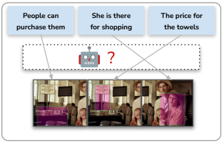
The image is a conceptual diagram illustrating the performance of a Visual Question Answering (VQA) model. It displays three distinct natural language queries paired with corresponding visual "grounding" results. The diagram demonstrates how an AI model associates specific text inputs with regions of interest within an image, highlighting both successful and unsuccessful associations.
### Components/Axes
* **Header (Top Row):** Three light-blue rectangular text boxes containing natural language queries.
* **Central Region:** A dashed-line box containing a stylized robot icon and a question mark ("?"), representing the AI model or the query-processing engine.
* **Main Content (Bottom Row):** Three identical image panels showing a store interior. Each panel features a purple-tinted overlay (bounding box) highlighting a specific region of the image.
* **Connectors:** Thin gray arrows originating from the text boxes in the header and pointing to the corresponding image panels in the bottom row.
### Detailed Analysis
The diagram is organized into three vertical segments, each representing a specific query-to-image mapping:
1. **Left Segment:**
* **Text:** "People can purchase them"
* **Visual Grounding:** The arrow points to the left image panel. The purple overlay highlights the lower-left area of the image, which appears to be a shelf or display of products (towels).
* **Status:** This appears to be a correct or logical association.
2. **Middle Segment:**
* **Text:** "She is there for shopping"
* **Visual Grounding:** The arrow points to the middle image panel. The purple overlay highlights a vertical area in the center-left of the image, likely a sign or a shelf display.
* **Status:** This appears to be a plausible association, linking the concept of "shopping" to the store environment.
3. **Right Segment:**
* **Text:** "The price for the towels"
* **Visual Grounding:** The arrow points to the right image panel. The purple overlay highlights the person/baby in the foreground.
* **Status:** This is a clear **misalignment**. The text refers to "towels," but the model has grounded the query on the person in the image.
### Key Observations
* **Visual Consistency:** All three image panels appear to be the same base photograph, with different regions highlighted in purple.
* **Grounding Failure:** The right-most segment demonstrates a failure in the model's attention mechanism or object detection capability. The model failed to identify the "towels" and instead focused on the person, despite the query explicitly asking about the price of the towels.
* **Structural Logic:** The diagram uses a "one-to-one" mapping structure, where each query is forced to map to a single visual region, making the error in the third panel highly visible.
### Interpretation
This diagram is likely an excerpt from a technical research paper or a model evaluation report concerning **Visual Question Answering (VQA)** or **Explainable AI (XAI)**.
The primary purpose of this graphic is to demonstrate **model failure modes**. By visualizing the "attention" or "grounding" of the model, the authors are exposing that the AI is not correctly interpreting the semantic relationship between the query ("price for the towels") and the visual content.
* **Peircean Investigative View:** The diagram acts as an indexical sign. The arrows are indices pointing from the text (the signifier) to the image (the signified). The breakdown in the third panel serves as a critique of the model's "intelligence," proving that it does not truly "understand" the scene but rather relies on flawed pattern matching. It highlights the difference between *correlation* (the model seeing a person and associating it with a query) and *causation/understanding* (the model identifying the specific object requested).