## Diagram: Shopping Scenario Flowchart with Photographic Context
### Overview
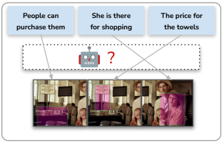
The image is a composite diagram combining a simple flowchart with a photographic scene. It appears to be an educational or illustrative graphic, likely from a language learning or logic exercise, presenting a central question with three potential textual answers or scenarios, supported by a visual context photograph.
### Components/Axes
The diagram has two primary components arranged vertically:
1. **Upper Flowchart Section:**
* **Central Element:** A large, black question mark (`?`) is positioned in the center.
* **Surrounding Text Boxes:** Three light-blue rectangular boxes with black text are arranged around the question mark.
* **Top-Left Box:** Contains the text "People can purchase them".
* **Top-Center Box:** Contains the text "She is there for shopping".
* **Top-Right Box:** Contains the text "The price for the towels".
* **Connecting Lines:** Thin, black lines connect each of the three text boxes to the central question mark, indicating they are all potential answers or related statements to the posed question.
2. **Lower Photographic Section:**
* A rectangular color photograph is placed directly below the flowchart.
* The photo depicts the interior of a retail store, likely a home goods or department store.
* **Visible Elements:**
* **People:** Several individuals are visible. In the foreground, a woman with dark hair wearing a pink top is looking towards the right. Another person is partially visible to her left. In the background, other shoppers and possibly staff can be seen.
* **Environment:** The store has bright lighting. Shelves stocked with various products are visible in the background. A prominent purple display or signage is on the left side. The overall color tone of the photograph has a slight purple/magenta cast.
* **Text in Photo:** Some text is visible on store signage and product packaging, but it is too small and blurry to be legibly transcribed from this image resolution.
### Detailed Analysis
* **Text Transcription (Exact):**
1. "People can purchase them"
2. "She is there for shopping"
3. "The price for the towels"
* **Spatial Relationships:** The three text boxes are positioned in a triangular formation above the question mark, suggesting they are parallel options. The photograph is positioned as the foundational context or subject matter for the question posed by the flowchart above it.
* **Visual Trend/Flow:** The diagram's flow is non-linear. The lines from the text boxes converge on the question mark, implying a "which of these is correct?" or "what is the question?" relationship. The photograph below provides the scene to which the textual statements might apply.
### Key Observations
1. **Ambiguity of the Central Question:** The core of the diagram is the unresolved question mark. The three statements are declarative, not interrogative. This suggests the exercise might be to formulate a question to which these are possible answers, or to identify which statement best describes the scene.
2. **Specificity of Statements:** The statements are specific: "purchase **them**," "**She** is there," "price for the **towels**." This implies the photograph should contain identifiable elements matching these specifics (e.g., a female shopper, towels for sale).
3. **Photographic Context:** The store photo provides a real-world setting. The woman in the pink top is the most prominent figure and could be the "She" referenced in the center text box. The shelves in the background could contain towels, relating to the right-hand text box.
### Interpretation
This diagram is most likely a **language learning or critical thinking exercise**. Its purpose is to connect abstract textual statements to a concrete visual scene.
* **What it demonstrates:** The graphic tests the viewer's ability to interpret a scene and match it to descriptive language. It presents a scenario (the photo) and three potential captions or conclusions, asking the viewer to resolve the ambiguity (the question mark).
* **Relationship between elements:** The photograph is the primary data source. The three text boxes are hypotheses or descriptions about that data. The question mark represents the analytical task: "Which of these statements is supported by the visual evidence?" or "What question would have these statements as possible answers?"
* **Notable Anomalies:** The slight purple tint of the photograph is unusual for a standard retail photo and might be an artifact of the image source or a deliberate choice to make the "purple" display stand out. The illegibility of background text limits a full analysis of the store's products.
* **Underlying Logic:** The exercise encourages deductive reasoning. For example:
* To validate "The price for the towels," one must look for towels and a price tag in the photo.
* To validate "She is there for shopping," one must identify a female subject engaged in shopping behavior.
* To validate "People can purchase them," one must identify purchasable items ("them") in the scene.
The viewer must cross-reference the specific nouns and pronouns in the text with objects and people in the image.