## Diagram: Shopping Context Analysis System
### Overview
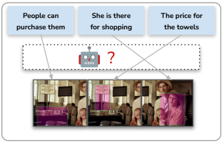
The diagram illustrates a conceptual system where a robotic entity processes shopping-related contextual information. It combines textual statements, visual imagery, and a central query mechanism represented by a robot with a question mark. The system appears to analyze relationships between consumer behavior, product availability, and pricing information.
### Components/Axes
1. **Top Section (Textual Context)**
- Three labeled boxes with statements:
- "People can purchase them" (left)
- "She is there for shopping" (center)
- "The price for the towels" (right)
- Positioning: Horizontal alignment above the central robot component
2. **Central Component (Query Mechanism)**
- Robot icon with question mark (?) in red
- Positioning: Center of the diagram, acting as processing node
3. **Bottom Section (Visual Context)**
- Collage of four images showing:
- Retail environment (leftmost)
- Shoppers interacting with products (second from left)
- Product display with pricing (third from left)
- Close-up of shoppers examining items (rightmost)
- Positioning: Below the central robot component, connected via dotted lines
4. **Connectivity**
- Dotted lines connecting the robot to all textual boxes and image elements
- Positioning: Creates network of relationships between components
### Detailed Analysis
- **Textual Elements**:
- All statements use English language
- Focus on consumer actions ("purchase"), shopper presence ("shopping"), and product pricing
- No numerical values or specific quantities provided
- **Visual Elements**:
- Images depict sequential shopping experience:
1. Store environment
2. Product interaction
3. Pricing information
4. Consumer decision-making
- Color coding:
- Pink elements in images may indicate price tags or promotional materials
- No explicit legend for color coding
- **Connectivity Pattern**:
- Robot's question mark serves as central node
- All textual and visual elements connect to the query mechanism
- No explicit flow direction indicated (bidirectional processing implied)
### Key Observations
1. The system emphasizes contextual analysis rather than quantitative data
2. The question mark suggests uncertainty or need for clarification in shopping scenarios
3. Visual elements provide concrete examples of abstract textual concepts
4. No explicit temporal or spatial relationships shown between components
5. Missing explicit labels for image content despite clear visual context
### Interpretation
This diagram represents a cognitive architecture for shopping scenario analysis. The robot's question mark indicates an AI system processing multi-modal data (text and images) to resolve shopping-related queries. The lack of explicit flow suggests the system simultaneously evaluates:
- Consumer purchasing capabilities
- Shopper presence and behavior
- Product pricing information
- Visual context of shopping environments
The absence of numerical data implies the system focuses on qualitative relationships rather than quantitative analysis. The pink elements in images likely represent price points or promotional materials, though this requires confirmation from additional documentation. The bidirectional connections suggest the system can both analyze existing shopping scenarios and predict potential outcomes based on contextual factors.