## Mathematical Commutative Diagram: Mapping Between Curve Spaces
### Overview
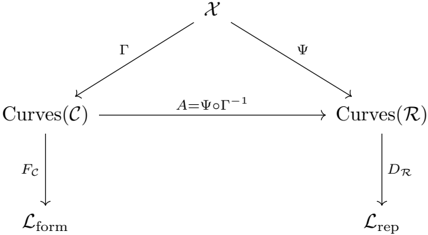
The image displays a commutative diagram from mathematics, likely within the fields of algebraic geometry, category theory, or moduli theory. It illustrates relationships between abstract spaces (objects) and mappings (morphisms) between them. The diagram is structured hierarchically, with a central object at the top mapping to two intermediate spaces, which are then connected by a derived mapping and further map to two lower-level spaces.
### Components/Axes
The diagram consists of five primary objects (nodes) and six labeled arrows (morphisms).
**Objects (Nodes):**
1. **𝒳** (Calligraphic X): Positioned at the top center.
2. **Curves(𝒞)** (Curves of 𝒞): Positioned at the middle-left.
3. **Curves(ℛ)** (Curves of ℛ): Positioned at the middle-right.
4. **ℒ_form** (ℒ subscript form): Positioned at the bottom-left.
5. **ℒ_rep** (ℒ subscript rep): Positioned at the bottom-right.
**Morphisms (Arrows):**
1. **Γ** (Greek capital Gamma): An arrow from **𝒳** down-left to **Curves(𝒞)**.
2. **Ψ** (Greek capital Psi): An arrow from **𝒳** down-right to **Curves(ℛ)**.
3. **A = Ψ ∘ Γ⁻¹**: A horizontal arrow from **Curves(𝒞)** to **Curves(ℛ)**. This defines a mapping `A` as the composition of `Ψ` with the inverse of `Γ`.
4. **F_𝒞** (F subscript 𝒞): An arrow from **Curves(𝒞)** down to **ℒ_form**.
5. **D_ℛ** (D subscript ℛ): An arrow from **Curves(ℛ)** down to **ℒ_rep**.
### Detailed Analysis
The diagram defines a specific mathematical structure through its commutative property. The core relationship is encapsulated in the horizontal arrow: the mapping `A` from `Curves(𝒞)` to `Curves(ℛ)` is explicitly constructed as `A = Ψ ∘ Γ⁻¹`. This implies that the diagram "commutes" for this path: starting from `Curves(𝒞)`, applying `Γ⁻¹` (the inverse of `Γ`) to go "up" to `𝒳`, and then applying `Ψ` to go "down" to `Curves(ℛ)` is equivalent to applying `A` directly.
The vertical arrows suggest further operations or functors applied to the curve spaces:
* `F_𝒞` maps from the space of curves over `𝒞` to an object `ℒ_form`.
* `D_ℛ` maps from the space of curves over `ℛ` to an object `ℒ_rep`.
The notation `Curves(𝒞)` and `Curves(ℛ)` typically denotes a moduli space or category of curves defined over some base objects or fields `𝒞` and `ℛ`, respectively. `ℒ_form` and `ℒ_rep` likely represent spaces of "forms" and "representations" associated with these curves.
### Key Observations
1. **Symmetry and Asymmetry**: The top half of the diagram (𝒳, Γ, Ψ, Curves(𝒞), Curves(ℛ), A) is symmetric in structure but asymmetric in content, as the horizontal map `A` is defined via a specific composition involving an inverse.
2. **Hierarchical Flow**: The overall flow is top-down, from the abstract space `𝒳` to the more concrete spaces `ℒ_form` and `ℒ_rep`, mediated by the intermediate curve spaces.
3. **Notation Specificity**: The use of distinct subscripts (`𝒞` vs. `ℛ`) and function names (`F` vs. `D`) indicates that the operations on the left and right branches are fundamentally different, even if structurally parallel.
### Interpretation
This diagram is a formal, visual representation of a mathematical construction or theorem. It asserts the existence of a well-defined mapping `A` between two spaces of curves, derived from a common source `𝒳` via maps `Γ` and `Ψ`. The commutativity of the top triangle (`A = Ψ ∘ Γ⁻¹`) is a key property, ensuring consistency in the relationships.
The diagram suggests a process of **parameterization or classification**. The space `𝒳` may be a parameter space that, through `Γ` and `Ψ`, induces families of curves over `𝒞` and `ℛ`. The map `A` then provides a way to compare or translate between these two families of curves. The final mappings to `ℒ_form` and `ℒ_rep` suggest that these curve spaces are used to construct or study more specific objects, such as spaces of differential forms or representation varieties.
In essence, the diagram encodes a precise algebraic or geometric relationship, showing how different mathematical objects are interconnected through defined operations. Its value lies in providing a clear, visual summary of a complex logical structure, allowing a reader to grasp the dependencies and constructions at a glance.