## Diagram: Mathematical Relationship Between Curves and Transformations
### Overview
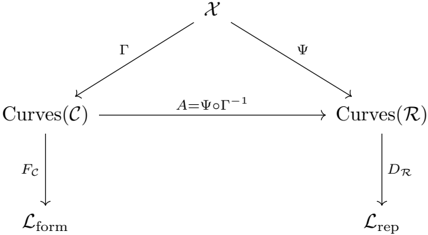
The diagram illustrates a bidirectional relationship between two curve sets, **Curves(C)** and **Curves(R)**, mediated by transformations **Γ** and **Ψ**. It also shows mappings to loss functions **L_form** and **L_rep**, suggesting a framework for comparing or transforming curves through mathematical operations.
---
### Components/Axes
1. **Nodes**:
- **Curves(C)**: Left curve set.
- **Curves(R)**: Right curve set.
- **X**: Central node connecting to both curve sets.
- **L_form**: Loss function derived from **Curves(C)**.
- **L_rep**: Loss function derived from **Curves(R)**.
2. **Arrows/Relationships**:
- **Γ**: Transformation from **X** to **Curves(C)**.
- **Ψ**: Transformation from **X** to **Curves(R)**.
- **A=Ψ∘Γ⁻¹**: Bidirectional relationship between **Curves(C)** and **Curves(R)**, defined as the composition of **Ψ** and the inverse of **Γ**.
- **F_C**: Mapping from **Curves(C)** to **L_form**.
- **D_R**: Mapping from **Curves(R)** to **L_rep**.
---
### Detailed Analysis
- **Transformations**:
- **Γ** and **Ψ** are functions that map the central node **X** to distinct curve sets, implying **X** acts as a shared input or latent space.
- The bidirectional arrow **A=Ψ∘Γ⁻¹** indicates that **Curves(R)** can be derived from **Curves(C)** via the inverse of **Γ** followed by **Ψ**, and vice versa. This suggests a reversible or invertible relationship between the two curve sets.
- **Loss Functions**:
- **L_form** and **L_rep** are terminal nodes, likely representing objectives for optimization (e.g., minimizing reconstruction error or divergence between curves).
---
### Key Observations
1. **Bidirectional Symmetry**: The relationship **A=Ψ∘Γ⁻¹** implies that transformations between **Curves(C)** and **Curves(R)** are invertible, assuming **Γ** and **Ψ** are bijective.
2. **Loss Function Dependencies**: Both loss functions depend on their respective curve sets, suggesting separate optimization paths or dual objectives.
3. **Central Node Role**: **X** serves as a unifying source for both curve sets, potentially representing a shared parameter space or input distribution.
---
### Interpretation
This diagram likely represents a mathematical or computational framework for:
- **Curve Transformation**: Using **Γ** and **Ψ** to map between curve sets, with **A** enabling reversible operations.
- **Loss Optimization**: **L_form** and **L_rep** could correspond to tasks like curve reconstruction, alignment, or divergence minimization.
- **Shared Input Space**: **X** might represent a latent variable or input distribution that generates both curve sets, enabling comparative analysis.
The absence of numerical values or empirical data suggests this is a theoretical or architectural diagram, possibly from a paper on curve analysis, generative models, or optimization frameworks. The bidirectional relationship **A** highlights the importance of invertibility in the transformations, which could be critical for tasks requiring consistency or reversibility (e.g., data augmentation, error correction).