## Diagram: Illustration of EWC, L2, and No Penalty in Relation to Error Landscapes
### Overview
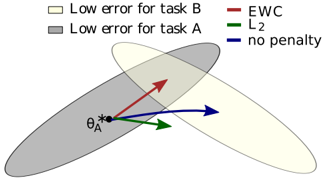
The image is a diagram illustrating the concepts of Elastic Weight Consolidation (EWC), L2 regularization, and no penalty in the context of two tasks, A and B. It shows overlapping regions representing low error for each task, along with arrows indicating the direction of parameter updates under different regularization schemes.
### Components/Axes
* **Regions:**
* Light gray region: "Low error for task A"
* Light yellow region: "Low error for task B"
* **Arrows:**
* Red arrow: "EWC"
* Green arrow: "L2"
* Blue arrow: "no penalty"
* **Point:**
* Black asterisk labeled "ΘA*"
### Detailed Analysis
The diagram shows two overlapping elliptical regions, representing areas of low error for task A (light gray) and task B (light yellow). The intersection of these regions represents a parameter space where both tasks can be performed with relatively low error.
The black asterisk labeled "ΘA*" is located within the "Low error for task A" region, near the intersection with the "Low error for task B" region. This point likely represents the optimal parameters for task A before considering task B.
The arrows emanating from "ΘA*" represent the direction of parameter updates under different regularization schemes:
* **EWC (Red Arrow):** The red arrow points towards the intersection of the two regions, suggesting that EWC encourages parameter updates that maintain performance on both tasks.
* **L2 (Green Arrow):** The green arrow points in a direction that is a compromise between optimizing for task A and task B, but not as strongly towards the intersection as EWC.
* **No Penalty (Blue Arrow):** The blue arrow points away from the intersection, suggesting that without regularization, the model may drift away from the optimal parameters for task A when learning task B.
### Key Observations
* EWC appears to guide the parameter updates towards a region where both tasks can be performed well.
* L2 regularization provides a compromise between the two tasks.
* Without regularization, the model may drift away from the optimal parameters for the initial task.
### Interpretation
The diagram illustrates how different regularization techniques affect the learning process in a multi-task setting. EWC, by penalizing deviations from important parameters for previous tasks, encourages the model to find a solution that performs well on both tasks. L2 regularization provides a more general form of regularization, while no penalty can lead to catastrophic forgetting of the initial task. The diagram visually represents the trade-offs between maintaining performance on previous tasks and learning new tasks.