## Line Chart: Mean Error over Time
### Overview
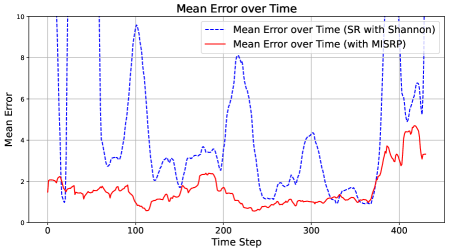
The chart compares two methods of tracking mean error over time: "SR with Shannon" (blue dashed line) and "MISRP" (solid red line). The x-axis represents time steps (0–400), and the y-axis represents mean error (0–10). The blue line exhibits sharp, periodic spikes, while the red line shows smoother, smaller fluctuations.
### Components/Axes
- **X-axis (Time Step)**: Labeled "Time Step," ranging from 0 to 400 in increments of 100.
- **Y-axis (Mean Error)**: Labeled "Mean Error," ranging from 0 to 10 in increments of 2.
- **Legend**: Located in the top-right corner, with two entries:
- Blue dashed line: "Mean Error over Time (SR with Shannon)"
- Solid red line: "Mean Error over Time (with MISRP)"
### Detailed Analysis
- **Blue Line (SR with Shannon)**:
- Sharp spikes occur at approximately time steps 0, 100, 200, 300, and 400, reaching near-peak values of **~10**.
- Between spikes, the line dips to troughs of **~0.5–1**.
- Intermediate fluctuations (e.g., ~2–4) occur at irregular intervals.
- **Red Line (MISRP)**:
- Smooth, gradual fluctuations between **~0.5–3**.
- No sharp spikes; maximum peak observed near time step 400 at **~4.5**.
- Troughs consistently near **~0.5–1**.
### Key Observations
1. **SR with Shannon** exhibits periodic, high-magnitude errors (spikes up to ~10), suggesting instability or sensitivity to specific time steps.
2. **MISRP** maintains lower, more consistent errors (~0.5–4.5), indicating robustness.
3. Both methods share similar trough values (~0.5–1), but SR with Shannon’s spikes dominate its behavior.
### Interpretation
The data suggests that **MISRP significantly reduces mean error variability** compared to SR with Shannon. The periodic spikes in the blue line may reflect systemic issues (e.g., data collection artifacts, algorithmic instability) at specific time steps. MISRP’s smoother trend implies improved error mitigation, though its performance degrades slightly toward the end (time step 400). The shared troughs suggest both methods perform comparably during stable periods, but SR with Shannon’s spikes render it less reliable overall. This could highlight the importance of error-handling mechanisms like MISRP in dynamic systems.