## Diagram: Dimensions of Evolving Agents
### Overview
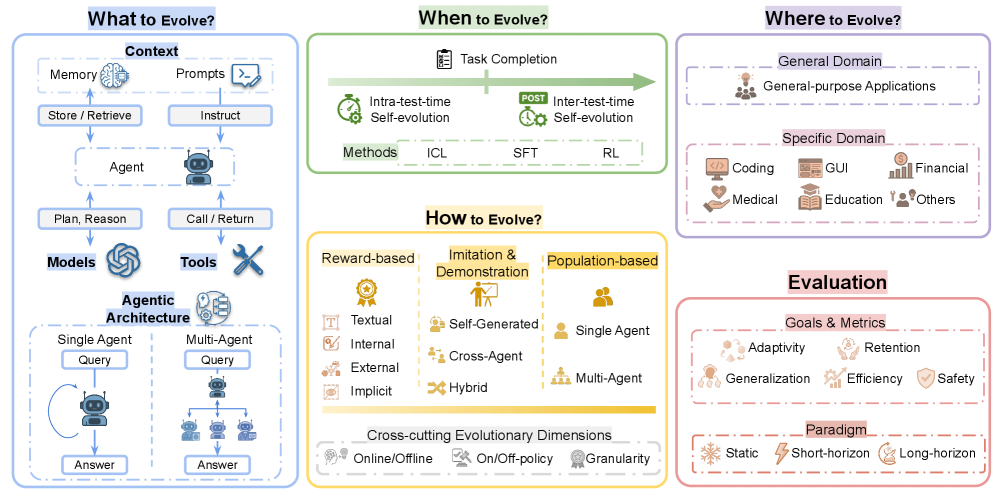
The image is a diagram outlining key dimensions to consider when evolving agents. It is structured around four central questions: "What to Evolve?", "When to Evolve?", "Where to Evolve?", and "How to Evolve?". Each question is associated with a set of related concepts and categories, providing a framework for understanding the evolution of agents. The diagram also includes a section on "Evaluation" to assess the results of the evolution.
### Components/Axes
* **Main Titles:**
* What to Evolve? (Top-left, blue box)
* When to Evolve? (Top-center, green box)
* Where to Evolve? (Top-right, purple box)
* How to Evolve? (Center, yellow box)
* Evaluation (Bottom-right, pink box)
* **"What to Evolve?" (Blue Box):**
* Context: Memory, Prompts
* Agent
* Models, Tools
* Agentic Architecture: Single Agent, Multi-Agent
* Flow: Store/Retrieve (from Memory to Agent), Instruct (from Prompts to Agent), Plan/Reason (from Agent to Models), Call/Return (from Agent to Tools), Query (to Agent), Answer (from Agent)
* **"When to Evolve?" (Green Box):**
* Task Completion (represented by a checklist icon)
* Intra-test-time Self-evolution (represented by a clock icon)
* Inter-test-time Self-evolution (represented by a clock icon)
* Methods: ICL, SFT, RL
* **"Where to Evolve?" (Purple Box):**
* General Domain: General-purpose Applications
* Specific Domain: Coding, GUI, Financial, Medical, Education, Others
* **"How to Evolve?" (Yellow Box):**
* Reward-based: Textual, Internal, External, Implicit
* Imitation & Demonstration: Self-Generated, Cross-Agent, Hybrid
* Population-based: Single Agent, Multi-Agent
* Cross-cutting Evolutionary Dimensions: Online/Offline, On/Off-policy, Granularity
* **"Evaluation" (Pink Box):**
* Goals & Metrics: Adaptivity, Retention, Generalization, Efficiency, Safety
* Paradigm: Static, Short-horizon, Long-horizon
### Detailed Analysis or Content Details
* **"What to Evolve?" (Blue Box):**
* The "Context" section includes "Memory" (represented by a brain icon) and "Prompts" (represented by a text input icon).
* The "Agent" is represented by a robot icon.
* "Models" is represented by a swirling pattern icon, and "Tools" is represented by a wrench and screwdriver icon.
* The "Agentic Architecture" section shows a single agent querying and answering, and a multi-agent system with a central agent distributing queries to multiple agents and collecting answers.
* **"When to Evolve?" (Green Box):**
* The timeline progresses from "Intra-test-time Self-evolution" to "Inter-test-time Self-evolution".
* Methods listed are ICL, SFT, and RL.
* **"Where to Evolve?" (Purple Box):**
* The "Specific Domain" includes icons representing coding, GUI, financial, medical, education, and a generic "others" category.
* **"How to Evolve?" (Yellow Box):**
* "Reward-based" includes "Textual" (represented by a text icon), "Internal" (represented by a document icon), "External" (represented by a globe icon), and "Implicit" (represented by a speech bubble icon).
* "Imitation & Demonstration" includes "Self-Generated" (represented by a person icon), "Cross-Agent" (represented by multiple people icon), and "Hybrid" (represented by a wrench icon).
* "Population-based" includes "Single Agent" (represented by a single person icon) and "Multi-Agent" (represented by multiple people icon).
* "Cross-cutting Evolutionary Dimensions" includes "Online/Offline" (represented by a computer icon), "On/Off-policy" (represented by a switch icon), and "Granularity" (represented by a badge icon).
* **"Evaluation" (Pink Box):**
* "Goals & Metrics" includes "Adaptivity" (represented by a gear icon), "Retention" (represented by hands holding an object icon), "Generalization" (represented by a network icon), "Efficiency" (represented by a graph icon), and "Safety" (represented by a shield icon).
* "Paradigm" includes "Static" (represented by a snowflake icon), "Short-horizon" (represented by a lightning bolt icon), and "Long-horizon" (represented by a clock icon).
### Key Observations
* The diagram provides a structured overview of the different dimensions involved in evolving agents.
* Each dimension is broken down into specific categories and concepts, providing a detailed framework for analysis.
* The use of icons helps to visually represent the different concepts and categories.
* The flow diagrams in the "What to Evolve?" section illustrate the interactions between different components of the agentic architecture.
### Interpretation
The diagram serves as a comprehensive guide for researchers and practitioners interested in evolving agents. It highlights the key considerations and dimensions that need to be taken into account when designing and implementing evolutionary algorithms for agents. The framework encourages a holistic approach, considering not only the "how" but also the "what," "when," and "where" of agent evolution. The inclusion of an "Evaluation" section emphasizes the importance of assessing the performance and characteristics of evolved agents. The diagram suggests that successful agent evolution requires careful consideration of the context, methods, domains, and evaluation metrics.