\n
## Diagram: Agent Evolution Framework
### Overview
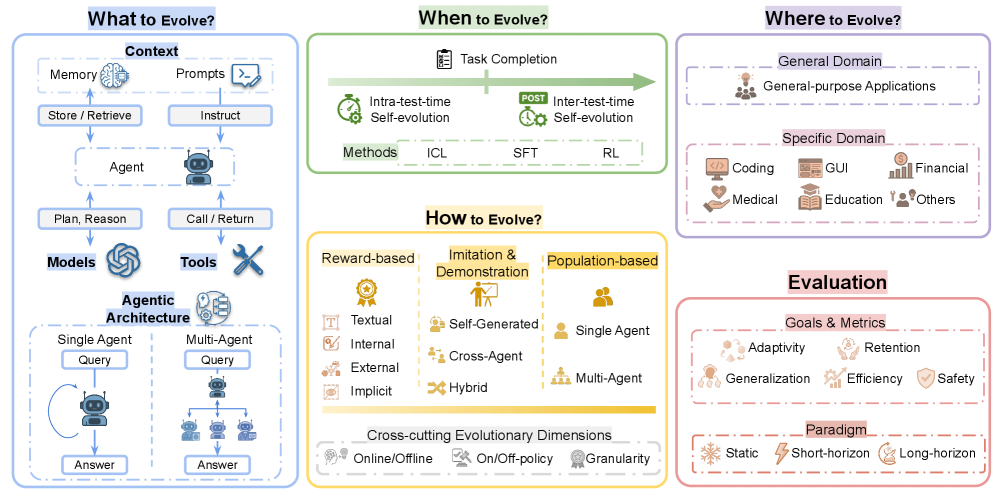
The image presents a diagram outlining a framework for agent evolution. It's structured around four key questions: "What to Evolve?", "When to Evolve?", "Where to Evolve?", and "How to Evolve?". The diagram uses a combination of icons, text, and arrows to illustrate the relationships between different components and concepts within this framework. The bottom section details "Cross-cutting Evolutionary Dimensions" and "Evaluation" metrics.
### Components/Axes
The diagram is divided into four main quadrants, each addressing one of the central questions.
* **What to Evolve?**: Includes components like "Context" (Memory, Prompts), "Agent" (Plan, Reason, Call/Return), "Models", and "Tools".
* **When to Evolve?**: Focuses on "Task Completion" and "Self-evolution" with methods like "ICL", "SFT", and "RL".
* **Where to Evolve?**: Categorizes evolution domains into "General Domain" and "Specific Domain" (Coding, GUI, Financial, Medical, Education, Others).
* **How to Evolve?**: Presents "Reward-based", "Imitation & Demonstration", and "Population-based" approaches.
* **Cross-cutting Evolutionary Dimensions**: Includes "Online/Offline", "On/Off-policy", and "Granularity".
* **Evaluation**: Lists "Goals & Metrics" such as Adaptivity, Retention, Generalization, Efficiency, and Safety, and "Paradigm" (Static, Short-horizon, Long-horizon).
### Detailed Analysis or Content Details
**What to Evolve?**
* **Context**: A light blue box with two sub-components: "Memory" (Store/Retrieve) and "Prompts" (Instruct). An arrow points from "Prompts" to "Agent".
* **Agent**: A robot icon representing the agent. It has two actions: "Plan, Reason" and "Call/Return". Arrows connect "Agent" to "Models" and "Tools".
* **Models**: A box labeled "Models".
* **Tools**: A box labeled "Tools" with a crossed-out icon.
* **Agentic Architecture**: Two sub-sections: "Single Agent Query" and "Multi-Agent Query", each with a robot icon and an "Answer" output.
**When to Evolve?**
* **Task Completion**: A green box with an arrow pointing to "Self-evolution".
* **Self-evolution**: A light green box with two sub-categories: "Intra-test-time" and "Inter-test-time". A "POST" label is placed between them.
* **Methods**: Three boxes: "ICL", "SFT", and "RL".
**Where to Evolve?**
* **General Domain**: A light purple box containing "General-purpose Applications".
* **Specific Domain**: A purple box containing icons and labels for: "Coding", "GUI", "Financial", "Medical", "Education", and "Others".
**How to Evolve?**
* **Reward-based**: A pink box with sub-categories: "Textual", "Internal", "External", and "Implicit".
* **Imitation & Demonstration**: An orange box with sub-categories: "Self-Generated", "Cross-Agent", and "Hybrid".
* **Population-based**: A yellow box with sub-categories: "Single Agent", "Multi-Agent".
**Cross-cutting Evolutionary Dimensions**:
* "Online/Offline"
* "On/Off-policy"
* "Granularity"
**Evaluation**:
* **Goals & Metrics**: Icons representing: "Adaptivity", "Retention", "Generalization", "Efficiency", and "Safety".
* **Paradigm**: "Static", "Short-horizon", and "Long-horizon".
### Key Observations
* The diagram emphasizes a cyclical process of agent evolution, starting with context and leading to evaluation.
* The "Self-evolution" component is highlighted as a key aspect of the "When to Evolve?" quadrant.
* The "Where to Evolve?" quadrant demonstrates the versatility of agent evolution across various domains.
* The "How to Evolve?" quadrant presents different strategies for driving agent improvement.
* The "Cross-cutting Evolutionary Dimensions" suggest considerations that apply across all stages of the evolution process.
### Interpretation
This diagram illustrates a comprehensive framework for developing and improving intelligent agents. It moves beyond simple task completion to incorporate continuous self-evolution, suggesting a focus on agents that can learn and adapt over time. The categorization of evolution domains ("Where to Evolve?") highlights the potential for applying this framework to a wide range of applications. The inclusion of "Cross-cutting Evolutionary Dimensions" and "Evaluation" metrics emphasizes the importance of considering broader factors and measuring progress effectively.
The diagram suggests a shift towards more sophisticated agent architectures ("Agentic Architecture") capable of handling complex queries and providing meaningful answers. The different "How to Evolve?" approaches (Reward-based, Imitation, Population-based) represent different learning paradigms, offering flexibility in how agents are trained and improved.
The "POST" label between "Intra-test-time" and "Inter-test-time" self-evolution suggests a potential iterative process of testing and refinement. The diagram doesn't provide specific data or numerical values, but rather a conceptual model for understanding the key components and relationships involved in agent evolution. It's a high-level overview intended to guide research and development in this field.