## Diagram: Framework for Agent Evolution
### Overview
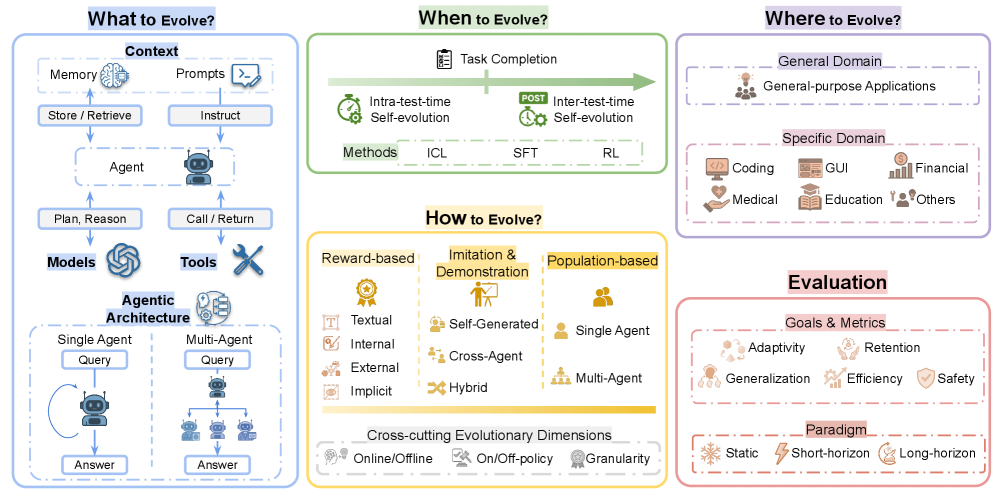
The image presents a structured framework for agent evolution, divided into six interconnected sections: "What to Evolve?", "When to Evolve?", "Where to Evolve?", "How to Evolve?", and "Evaluation". Each section outlines key components, methods, and considerations for evolving agents in technical systems.
---
### Components/Axes
#### Section 1: What to Evolve?
- **Context**:
- Memory (brain icon)
- Prompts (speech bubble)
- Store/Retrieve (file icon)
- Instruct (arrow)
- **Agent**:
- Plan, Reason, Call/Return (robot icon)
- **Models & Tools**:
- Models (cogwheel icon)
- Tools (wrench icon)
- **Agentic Architecture**:
- Single Agent (robot with query/answer flow)
- Multi-Agent (hierarchical robots with query/answer flow)
#### Section 2: When to Evolve?
- **Task Completion**:
- Intra-test-time Self-evolution (clock icon)
- Inter-test-time Self-evolution (clock with arrow)
- **Methods**:
- ICL (In-Context Learning)
- SFT (Supervised Fine-Tuning)
- RL (Reinforcement Learning)
#### Section 3: Where to Evolve?
- **General Domain**:
- General-purpose Applications (lightbulb icon)
- **Specific Domain**:
- Coding (computer icon)
- GUI (monitor icon)
- Financial (currency icon)
- Medical (heart icon)
- Education (book icon)
- Others (person icon)
#### Section 4: How to Evolve?
- **Reward-based**:
- Textual (trophy icon)
- Internal (checkmark icon)
- External (camera icon)
- Implicit (question mark icon)
- **Imitation & Demonstration**:
- Self-Generated (person icon)
- Cross-Agent (two people icon)
- Hybrid (person with gear icon)
- **Population-based**:
- Single Agent (person icon)
- Multi-Agent (group of people icon)
- **Cross-cutting Evolutionary Dimensions**:
- Online/Offline (clock icon)
- On/Off-Policy (clock with arrow)
- Granularity (magnifying glass icon)
#### Section 5: Evaluation
- **Goals & Metrics**:
- Adaptivity (person with gear icon)
- Retention (person with checkmark icon)
- Generalization (person with globe icon)
- Efficiency (clock icon)
- Safety (shield icon)
- **Paradigm**:
- Static (snowflake icon)
- Short-horizon (clock icon)
- Long-horizon (clock with arrow icon)
---
### Detailed Analysis
1. **What to Evolve?**
- Focuses on **contextual elements** (memory, prompts, tools) and **agentic capabilities** (planning, reasoning).
- Distinguishes between **single-agent** and **multi-agent architectures**, emphasizing hierarchical interactions.
2. **When to Evolve?**
- Highlights **evolution timing** (intra-test vs. inter-test) and **methods** (ICL, SFT, RL) for iterative improvement.
3. **Where to Evolve?**
- Categorizes domains into **general-purpose** and **domain-specific** applications (e.g., coding, finance).
4. **How to Evolve?**
- Outlines **evolution strategies**:
- **Reward-based**: Textual, internal/external feedback.
- **Imitation**: Self-generated, cross-agent, hybrid approaches.
- **Population-based**: Single/multi-agent collaboration.
- Cross-cutting dimensions (online/offline, policy, granularity) suggest adaptability across environments.
5. **Evaluation**
- Metrics prioritize **adaptivity, retention, generalization, efficiency, and safety**.
- Paradigms (static, short/long-horizon) define temporal and operational constraints.
---
### Key Observations
- **Hierarchical Structure**: The framework progresses from defining **what** to evolve (context/agent) to **how** and **where** to evolve, culminating in **evaluation**.
- **Cross-cutting Dimensions**: Online/offline and policy considerations imply flexibility in deployment and learning strategies.
- **Domain Specificity**: Specific domains (medical, education) suggest tailored evolution paths for specialized applications.
- **Evaluation Emphasis**: Safety and efficiency are critical, indicating a focus on robust, real-world applicability.
---
### Interpretation
This framework provides a **comprehensive roadmap** for evolving agents, balancing technical rigor (e.g., ICL, RL) with practical considerations (e.g., safety, domain specificity). The integration of **reward-based and population-based methods** suggests a hybrid approach to optimization, while cross-cutting dimensions (online/offline, granularity) address scalability and adaptability. The emphasis on **evaluation metrics** (safety, efficiency) underscores the importance of real-world performance over theoretical gains. Notably, the absence of explicit numerical data implies a conceptual rather than empirical framework, prioritizing strategic alignment over quantitative validation.