## Radar Chart: Evaluation on MARBLE Benchmark
### Overview
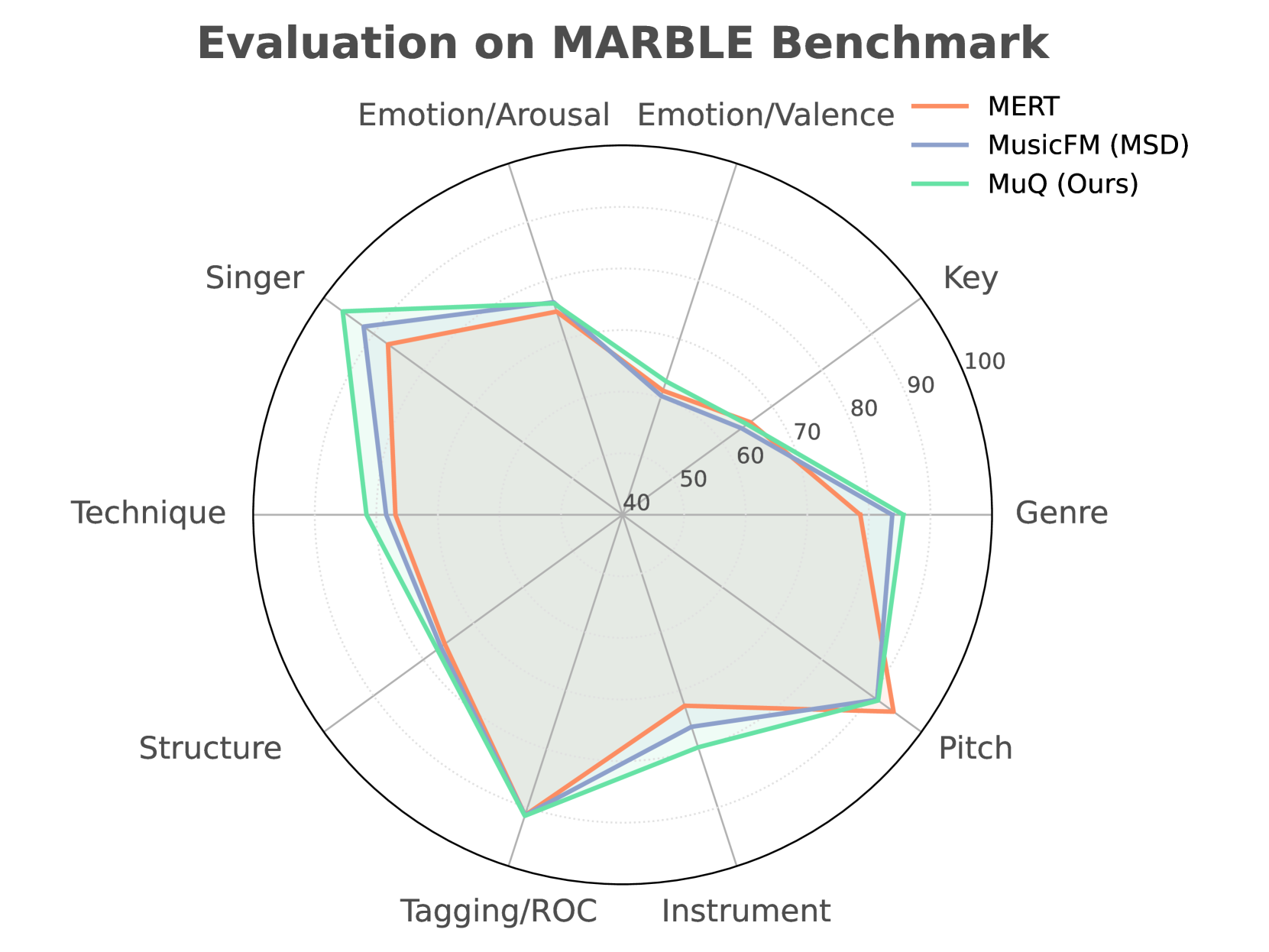
The radar chart compares the performance of three models (MERT, MusicFM [MSD], and MuQ [Ours]) across seven evaluation dimensions on the MARBLE benchmark. The chart uses a circular layout with axes representing evaluation categories and radial distance indicating performance scores (0–100). Three colored lines represent the models, with MuQ (green) consistently outperforming others in specific categories.
### Components/Axes
- **Axes (Categories)**:
1. Emotion/Arousal
2. Emotion/Valence
3. Key
4. Genre
5. Pitch
6. Instrument
7. Tagging/ROC
- **Legend**:
- MERT (orange)
- MusicFM (MSD) (blue)
- MuQ (Ours) (green)
- **Axis Markers**:
- Radial scale from 0 to 100 (increments of 10).
- Axial labels positioned clockwise around the perimeter.
### Detailed Analysis
- **MERT (orange line)**:
- Peaks at **Tagging/ROC (90)** and **Pitch (85)**.
- Lowest in **Emotion/Valence (60)**.
- Moderate performance in **Genre (70)** and **Instrument (75)**.
- **MusicFM (MSD) (blue line)**:
- Highest in **Singer (85)**.
- Lowest in **Emotion/Valence (65)**.
- Strong in **Genre (80)** and **Pitch (85)**.
- **MuQ (Ours) (green line)**:
- Dominates **Tagging/ROC (95)** and **Singer (90)**.
- Slight dip in **Emotion/Valence (70)**.
- Strong in **Genre (85)** and **Instrument (80)**.
### Key Observations
1. **MuQ (Ours)** achieves the highest scores in **Tagging/ROC (95)** and **Singer (90)**, suggesting superior performance in these categories.
2. **MERT** excels in **Tagging/ROC (90)** but struggles with **Emotion/Valence (60)**.
3. **MusicFM (MSD)** performs best in **Singer (85)** but has notable weaknesses in **Emotion/Valence (65)** and **Instrument (70)**.
4. All models show variability in **Emotion/Arousal** (MERT: 75, MusicFM: 70, MuQ: 80), indicating inconsistent emotional analysis.
### Interpretation
The chart highlights **MuQ (Ours)** as the most robust model overall, particularly in **Tagging/ROC** and **Singer**, where it outperforms others by margins of 5–15 points. **MERT** demonstrates balanced but suboptimal performance, while **MusicFM (MSD)** excels in singer-related tasks but falters in emotional valence and instrument recognition. The disparity in **Emotion/Valence** scores across models suggests a critical area for improvement in affective computing applications.
The data implies that model selection should prioritize **MuQ** for tasks requiring tagging or singer identification, while **MusicFM** may be preferable for genre/pitch analysis despite its emotional valence limitations.