## Diagram: Syntactic Dependency Visualization
### Overview
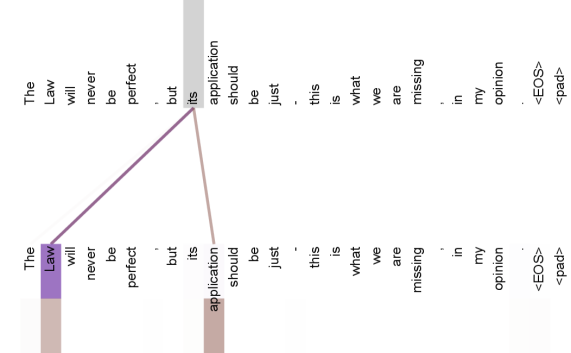
The image displays a diagram visualizing the syntactic or semantic relationships between words in a single English sentence. The sentence is presented twice in a spaced-out, horizontal format. Colored lines connect specific words, indicating a grammatical or conceptual dependency between them. The background is a plain, light gray.
### Components/Axes
* **Text Content:** The identical sentence is displayed in two parallel rows.
* **Connecting Lines:** Two colored lines form a V-shape, originating from words in the bottom row and converging on a word in the top row.
* **Purple Line:** Connects the word "Law" (bottom row) to the word "its" (top row).
* **Brown/Taupe Line:** Connects the word "application" (bottom row) to the same word "its" (top row).
* **Spatial Layout:** The text is centered. The connecting lines are drawn in the space between the two rows of text. The word "its" in the top row is the focal point of the connections.
### Detailed Analysis
**1. Text Transcription:**
The sentence, with exact spacing and punctuation, is:
`The Law will never be perfect , but its application should be just . this is what we are missing . in my opinion <EOS> <pad>`
* **Language:** English.
* **Note:** The tags `<EOS>` (End Of Sequence) and `<pad>` (padding) at the end are common in natural language processing (NLP) contexts, indicating this text may be from a model's input or output sequence.
**2. Connection Mapping:**
* **Source Word 1:** "Law" (bottom row, 2nd word). A purple line extends upward and rightward from this word.
* **Source Word 2:** "application" (bottom row, 9th word). A brown line extends upward and leftward from this word.
* **Target Word:** "its" (top row, 7th word). Both the purple and brown lines terminate at this word.
* **Visual Trend:** The lines create a clear visual dependency, suggesting that both "Law" and "application" are antecedents or modifiers for the possessive pronoun "its."
### Key Observations
1. **Dual Presentation:** The sentence is shown twice, which is atypical for a simple text display. This could be for visual clarity in showing the connections or might represent two different states (e.g., input vs. output, or original vs. annotated).
2. **Specific Word Focus:** The diagram isolates and highlights the relationship between three specific words: "Law," "application," and "its." All other words in the sentence are present but not annotated.
3. **NLP Artifacts:** The presence of `<EOS>` and `<pad>` tokens strongly suggests this image is a visualization from a computational linguistics or machine learning context, likely illustrating how a model parses or attends to relationships within a sentence.
4. **Color Coding:** The use of distinct colors (purple and brown) for the two connecting lines clearly differentiates the two separate dependency relationships being shown, even though they share the same target word.
### Interpretation
This diagram is a **dependency parse visualization**. It illustrates the grammatical structure of the sentence by showing that the possessive pronoun "its" refers back to two distinct nouns: "Law" and "application."
* **What it demonstrates:** The core message is that the "application" of "the Law" is the subject of critique. The diagram makes explicit that "its" is not ambiguous; it possesses both the Law and the application of the Law. This reinforces the sentence's argument: while the Law itself may be unattainably perfect, the practical *application* of it is where justice is (or is not) enacted.
* **Why it matters:** In NLP, accurately resolving such pronoun references (coreference resolution) is crucial for understanding meaning. This visualization likely serves as an explanatory tool or a debug output from a model, showing that it has correctly identified the antecedents for "its."
* **Notable Insight:** The diagram emphasizes the sentence's central contrast between an abstract ideal ("the Law will never be perfect") and a concrete action ("its application should be just"). By graphically linking "application" to "its," it underscores that the responsibility for justice lies in human action and interpretation, not in the theoretical text of the law alone.