\n
## Diagram: Finite Annotated Control State
### Overview
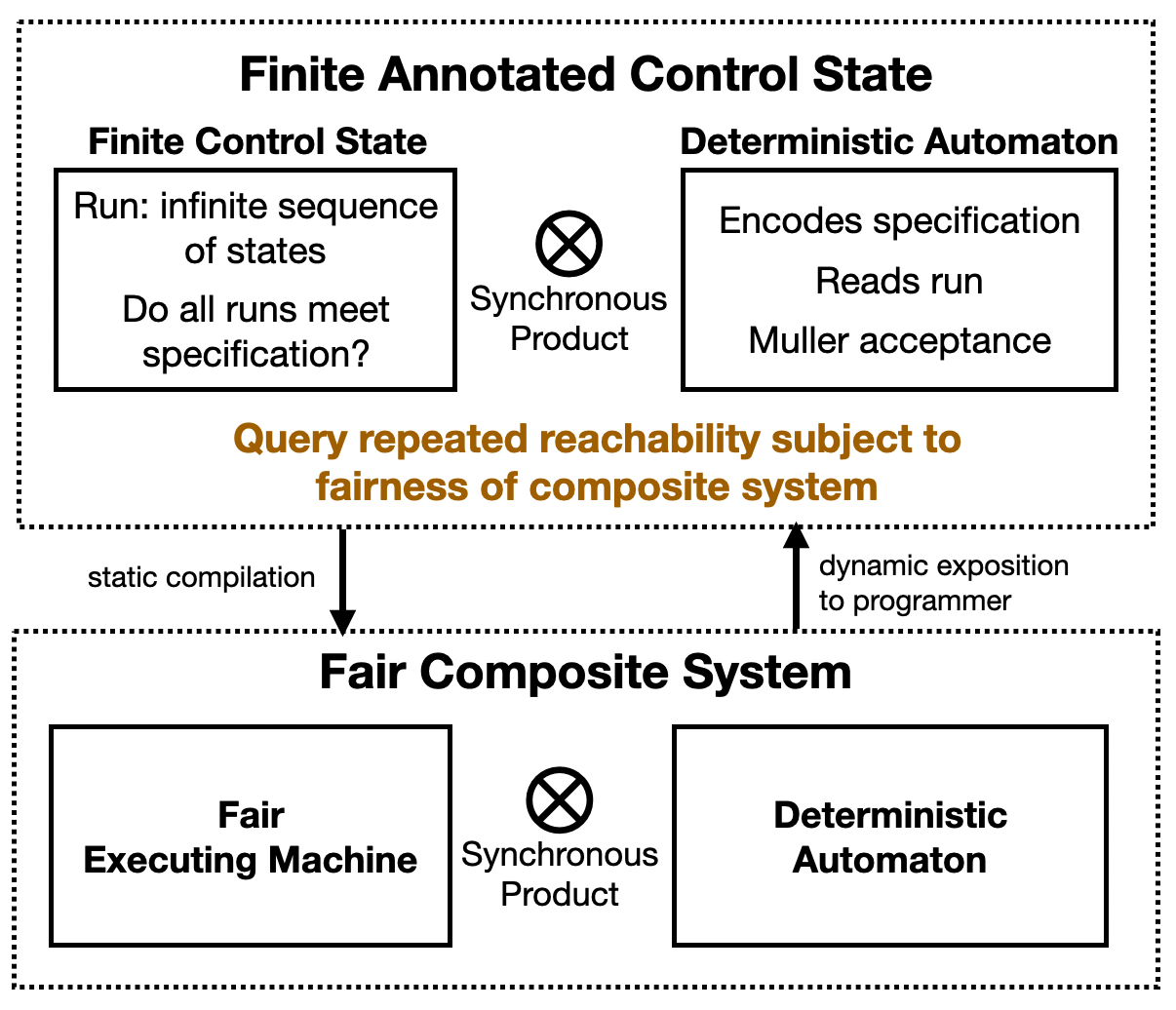
The image is a diagram illustrating the relationship between a Finite Control State and a Deterministic Automaton, culminating in a Fair Composite System. It depicts a process of compilation and execution, with a query regarding repeated reachability and fairness. The diagram uses boxes to represent components and arrows to indicate flow and relationships.
### Components/Axes
The diagram consists of the following components:
* **Header:** "Finite Annotated Control State"
* **Left Box:** "Finite Control State"
* Text within: "Run: infinite sequence of states", "Do all runs meet specification?"
* **Right Box:** "Deterministic Automaton"
* Text within: "Encodes specification", "Reads run", "Muller acceptance"
* **Central Connector:** A circled "X" symbol labeled "Synchronous Product" connecting the two boxes.
* **Middle Text:** "Query repeated reachability subject to fairness of composite system"
* **Bottom Box (Larger, Dotted Border):** "Fair Composite System"
* **Left Sub-Box:** "Fair Executing Machine"
* **Right Sub-Box:** "Deterministic Automaton"
* **Central Connector:** A circled "X" symbol labeled "Synchronous Product" connecting the two sub-boxes.
* **Arrows:**
* "static compilation" arrow pointing from the Finite Control State to the Fair Composite System.
* "dynamic exposition to programmer" arrow pointing from the Fair Composite System upwards.
### Detailed Analysis or Content Details
The diagram illustrates a system where a Finite Control State and a Deterministic Automaton are combined using a "Synchronous Product" operation. This combination results in a query regarding the repeated reachability and fairness of the resulting composite system. The composite system itself, labeled "Fair Composite System", is composed of a "Fair Executing Machine" and another "Deterministic Automaton", also connected via a "Synchronous Product".
The "static compilation" arrow indicates a process where the Finite Control State is compiled into the Fair Composite System. Conversely, the "dynamic exposition to programmer" arrow suggests that the Fair Composite System provides information or feedback to the programmer.
The text within the "Finite Control State" box defines its function as processing an infinite sequence of states and verifying if all possible runs meet a predefined specification. The "Deterministic Automaton" box describes its role in encoding specifications, reading runs, and performing Muller acceptance.
### Key Observations
The diagram emphasizes the concept of fairness within the composite system. The repeated mention of "fairness" and the inclusion of a "Fair Executing Machine" suggest that ensuring fairness is a critical aspect of the system's design. The use of the "Synchronous Product" operation twice indicates a consistent method for combining components. The dotted border around the "Fair Composite System" might indicate a higher level of abstraction or a distinct operational environment.
### Interpretation
This diagram likely represents a model-checking or verification process for a system with complex state transitions. The Finite Control State acts as a specification, while the Deterministic Automaton represents the system's behavior. The "Synchronous Product" operation combines these to create a composite system that can be analyzed for properties like reachability and fairness. The "Fair Composite System" then executes this combined model, and the results are exposed to the programmer.
The diagram suggests a formal verification approach, where the system's behavior is rigorously checked against its specification. The emphasis on fairness indicates that the system is designed to avoid situations where certain states or transitions are indefinitely postponed. The overall process appears to be a systematic way to ensure the correctness and reliability of a complex system.