## Diagram: Finite Annotated Control State and Fair Composite System Architecture
### Overview
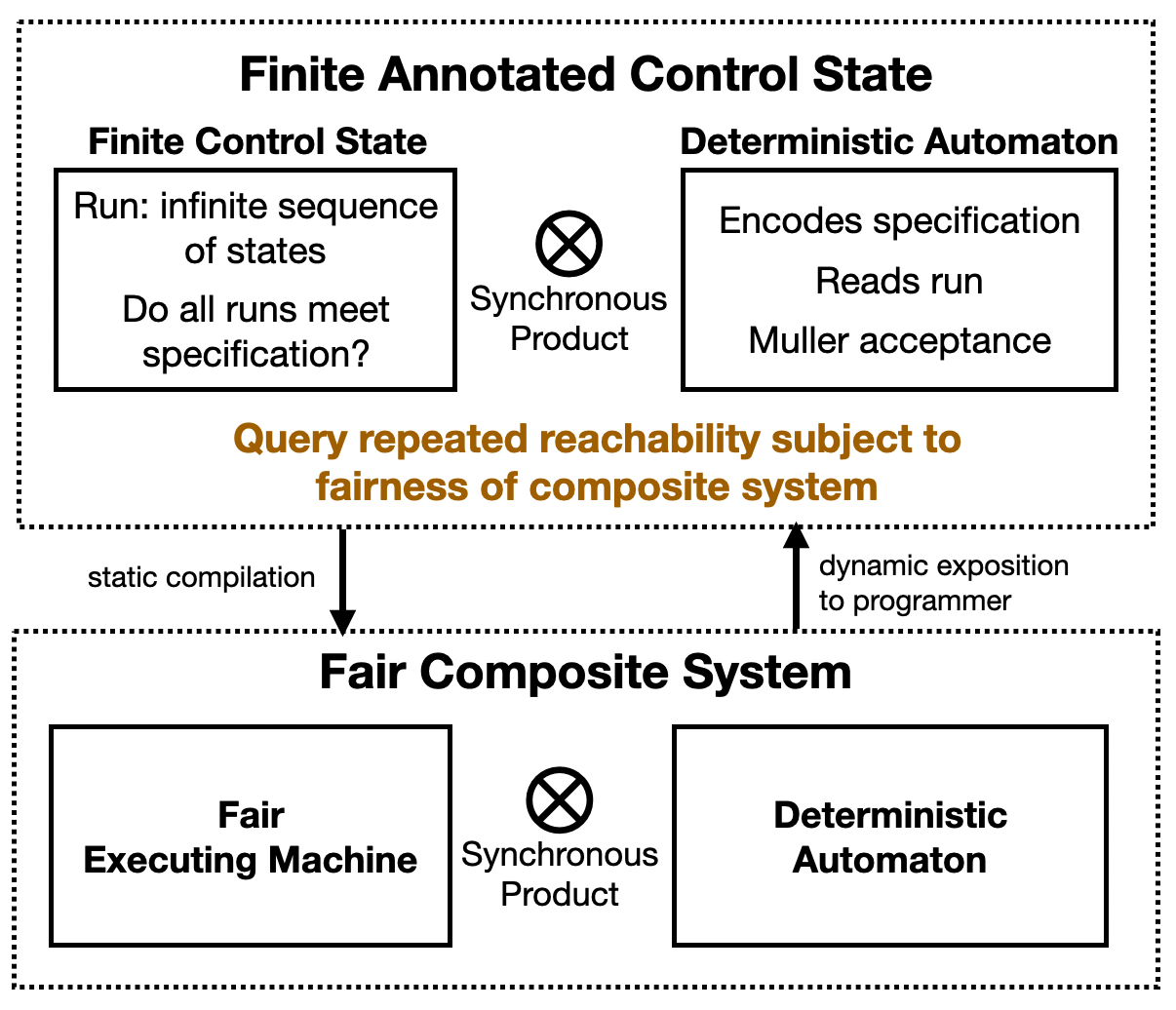
The diagram illustrates a technical architecture for a composite system involving control states, automata, and fairness mechanisms. It is divided into two primary sections:
1. **Finite Annotated Control State** (top)
2. **Fair Composite System** (bottom)
Connected via a central text block and synchronous product symbols (⊗).
---
### Components/Axes
#### Top Section: Finite Annotated Control State
- **Finite Control State**
- Label: "Run: infinite sequence of states"
- Sub-label: "Do all runs meet specification?"
- **Deterministic Automaton**
- Label: "Encodes specification"
- Sub-label: "Reads run"
- Sub-label: "Muller acceptance"
- **Connection**: Synchronous Product (⊗) between Finite Control State and Deterministic Automaton.
#### Bottom Section: Fair Composite System
- **Fair Executing Machine**
- Label: "Fair Executing Machine"
- **Deterministic Automaton**
- Label: "Deterministic Automaton"
- **Connection**: Synchronous Product (⊗) between Fair Executing Machine and Deterministic Automaton.
#### Central Text Block
- Text: "Query repeated reachability subject to fairness of composite system"
- Arrows:
- Left arrow labeled "static compilation" pointing to Finite Control State.
- Right arrow labeled "dynamic exposition to programmer" pointing to Deterministic Automaton.
---
### Detailed Analysis
1. **Top Section Workflow**:
- The Finite Control State represents an infinite sequence of states, with a query checking if all runs meet a specification.
- The Deterministic Automaton encodes the specification, reads the run, and applies Muller acceptance (a formal verification criterion).
- These components are combined via a Synchronous Product, implying coordinated execution.
2. **Bottom Section Workflow**:
- The Fair Executing Machine ensures fairness in the system's execution.
- The Deterministic Automaton (repeated from the top section) is reused here, suggesting modularity.
- Combined via Synchronous Product, emphasizing synchronized behavior.
3. **Central Text and Arrows**:
- The central text highlights the system's focus on **fairness** in repeated reachability queries.
- "Static compilation" implies compile-time guarantees for correctness.
- "Dynamic exposition to programmer" suggests runtime visibility for developers.
---
### Key Observations
- **Modularity**: The Deterministic Automaton appears in both sections, indicating reuse across control and fairness layers.
- **Synchronization**: Synchronous Product symbols (⊗) enforce strict coordination between components.
- **Fairness Emphasis**: The central text and bottom section prioritize fairness in system behavior.
- **Dual Perspectives**: Static (compile-time) and dynamic (runtime) aspects are explicitly separated via arrows.
---
### Interpretation
This diagram represents a formal verification framework for composite systems, where:
1. **Control States and Automata** (top) ensure correctness via specification encoding and Muller acceptance.
2. **Fairness Mechanisms** (bottom) guarantee equitable resource allocation or state transitions.
3. The **Synchronous Product** enforces that components interact in a time-coordinated manner, critical for systems requiring both correctness and fairness.
4. The **central text** bridges the two layers, emphasizing that fairness constraints are essential for repeated reachability queries (e.g., liveness properties in temporal logic).
The architecture suggests a layered approach: static compilation ensures foundational correctness, while dynamic exposition allows programmers to interact with the system's runtime behavior. The reuse of the Deterministic Automaton across sections implies a unified abstraction for specification and execution.