\n
## Diagram: Convolutional Layer Specification
### Overview
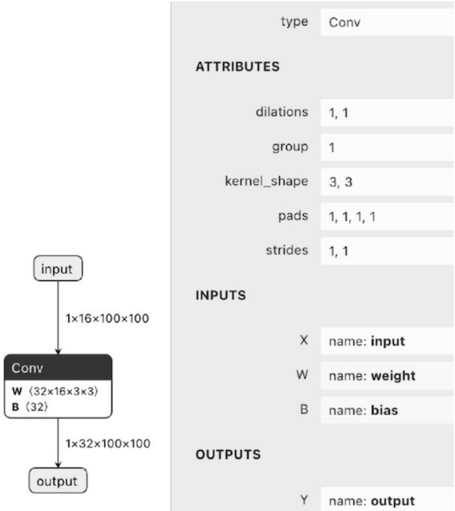
The image depicts a diagram representing a convolutional layer in a neural network. It shows the input and output tensors, along with the layer's attributes and input/output specifications. The diagram is split into two main sections: a visual representation of the layer's data flow on the left, and a textual description of its properties on the right.
### Components/Axes
The diagram consists of the following components:
* **Input Tensor:** Labeled "input", with dimensions 1x16x100x100.
* **Convolutional Layer:** Labeled "Conv", represented as a black rectangle. The weights (W) and bias (B) are indicated next to the "Conv" label.
* **Output Tensor:** Labeled "output", with dimensions 1x32x100x100.
* **Attributes:** A list of key-value pairs describing the convolutional layer's configuration.
* **Inputs:** A list specifying the input tensors and their names.
* **Outputs:** A list specifying the output tensors and their names.
### Detailed Analysis or Content Details
**Layer Attributes:**
* `type`: Conv (Convolutional)
* `dilations`: 1, 1
* `group`: 1
* `kernel_shape`: 3, 3
* `pads`: 1, 1, 1, 1
* `strides`: 1, 1
**Inputs:**
* `X`: name: input
* `W`: name: weight
* `B`: name: bias
**Outputs:**
* `Y`: name: output
**Tensor Dimensions:**
* Input: 1x16x100x100
* Output: 1x32x100x100
### Key Observations
The convolutional layer takes an input tensor of shape 1x16x100x100 and produces an output tensor of shape 1x32x100x100. The kernel size is 3x3, with padding of 1 on all sides and a stride of 1. The number of groups is 1, indicating a standard convolutional operation. The dilation is 1,1.
### Interpretation
This diagram describes a basic convolutional layer commonly used in image processing and computer vision tasks. The increase in the number of channels from 16 (input) to 32 (output) suggests that the layer is learning to extract more features from the input data. The padding ensures that the output tensor has the same spatial dimensions (100x100) as the input tensor. The stride of 1 indicates that the kernel moves one pixel at a time across the input. The attributes provide a precise specification of the layer's configuration, which is crucial for reproducing the same behavior in a neural network implementation. The diagram is a concise and informative representation of a fundamental building block of convolutional neural networks.