## Diagram: Travel Booking Intent Flow
### Overview
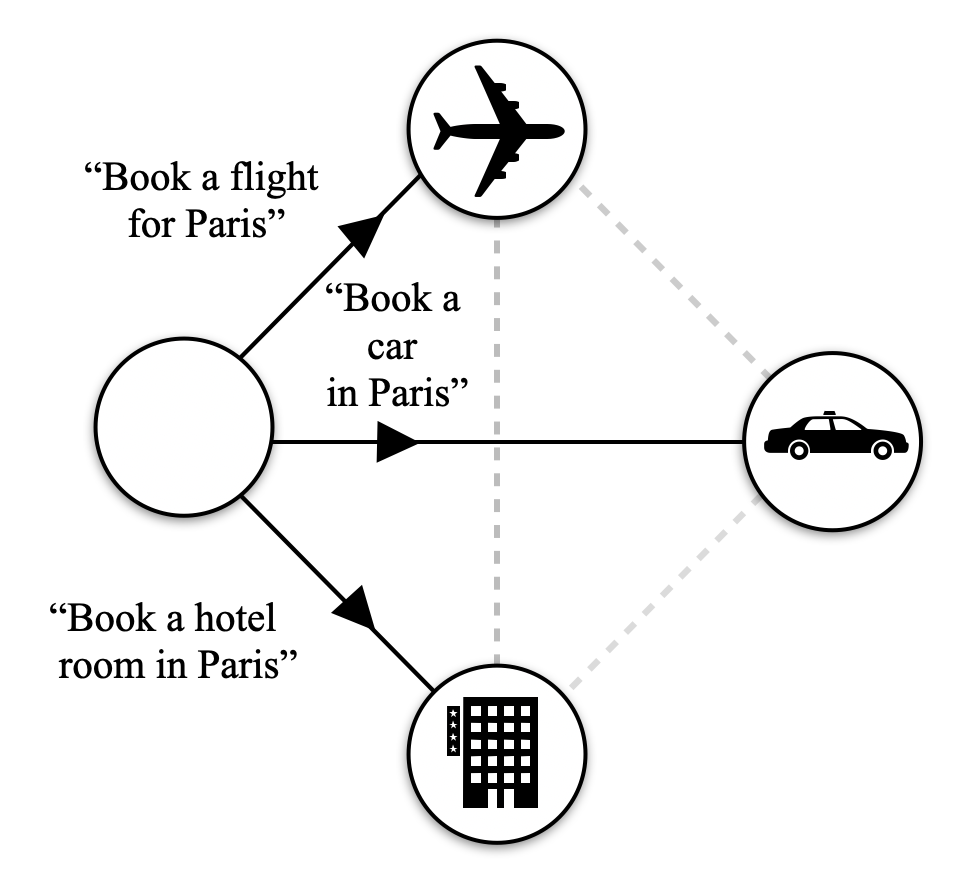
This diagram illustrates a potential flow of user intents related to booking travel services in Paris. It depicts a starting point (represented by a blank circle) from which different booking actions can be initiated, leading to specific travel service icons.
### Components/Axes
The diagram consists of:
* **A blank circle:** Located on the left side of the diagram. This likely represents an initial user state or a general query.
* **Three distinct icons within circles:**
* An **airplane icon**: Located in the top-right quadrant.
* A **car icon**: Located in the right-center of the diagram.
* A **building icon (representing a hotel)**: Located in the bottom-right quadrant.
* **Text labels with quotation marks:** These describe the specific intents or actions associated with the arrows.
* "Book a flight for Paris"
* "Book a car in Paris"
* "Book a hotel room in Paris"
* **Solid arrows:** These indicate a direct transition or a primary path from the initial state to a specific booking intent.
* **Dashed lines:** These connect the travel service icons, suggesting potential relationships or alternative paths between them, though they do not have explicit labels or directional arrows.
### Detailed Analysis or Content Details
The diagram shows the following connections:
1. **From the blank circle to the airplane icon:** A solid arrow originates from the blank circle and points towards the airplane icon. This arrow is labeled with the text "Book a flight for Paris".
2. **From the blank circle to the car icon:** A solid arrow originates from the blank circle and points towards the car icon. This arrow is labeled with the text "Book a car in Paris".
3. **From the blank circle to the hotel icon:** A solid arrow originates from the blank circle and points towards the hotel icon. This arrow is labeled with the text "Book a hotel room in Paris".
Additionally, there are dashed lines connecting:
* The airplane icon to the car icon.
* The airplane icon to the hotel icon.
* The car icon to the hotel icon.
These dashed lines suggest that once a user has expressed an intent for one service (e.g., booking a flight), they might subsequently consider or be presented with options for other services (e.g., booking a car or hotel).
### Key Observations
* The diagram clearly maps three distinct booking intents originating from a single, undefined starting point.
* The use of solid arrows for direct intents and dashed lines for potential secondary connections is a key visual distinction.
* All intents are explicitly tied to the location "Paris".
### Interpretation
This diagram appears to represent a simplified intent recognition or dialogue management system for a travel booking application. The blank circle could symbolize a user's initial, perhaps vague, request or a general entry point into the booking system. The solid arrows and their associated text labels indicate that the system can directly interpret and act upon specific user commands like "Book a flight for Paris," "Book a car in Paris," or "Book a hotel room in Paris."
The dashed lines suggest a potential for follow-on actions or related intents. For example, after a user expresses interest in booking a flight, the system might infer or suggest that they also need to book a hotel or a car. This could be part of a conversational flow where the system proactively offers related services to enhance the user experience and facilitate a complete travel plan. The lack of arrows on the dashed lines implies these are not necessarily sequential steps but rather related options or possibilities. The consistent mention of "Paris" across all intents highlights the geographical focus of this particular flow.