\n
## Diagram: Travel Booking Workflow
### Overview
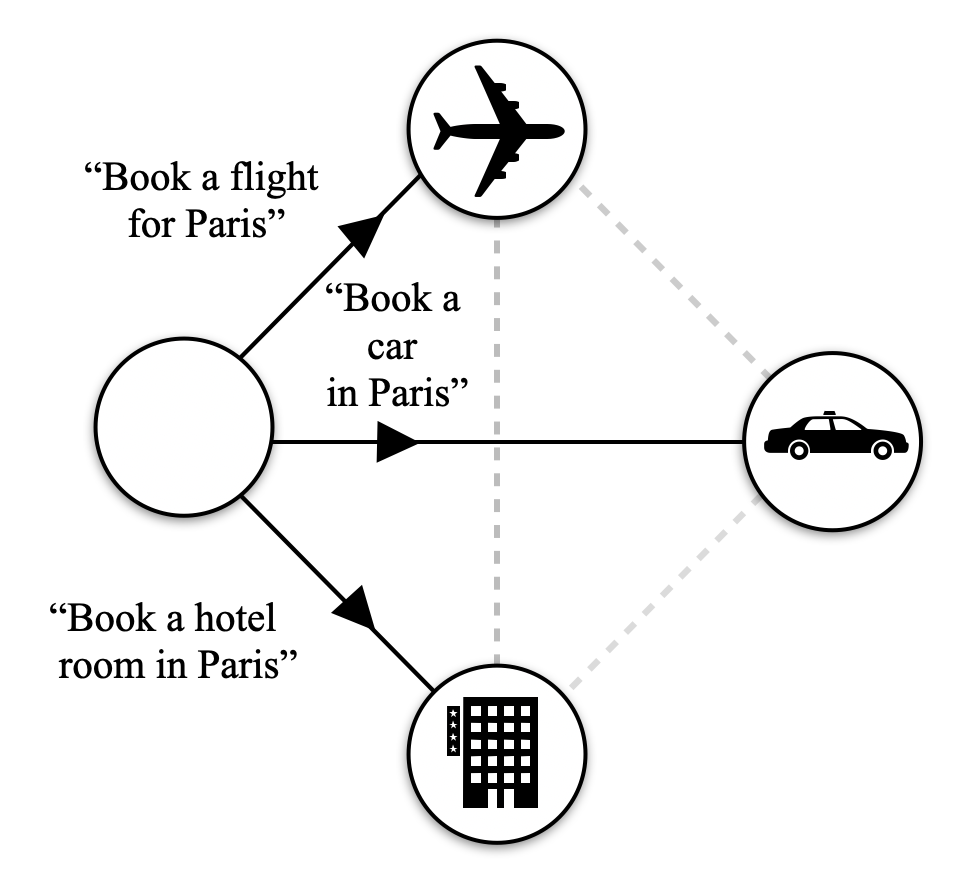
The image depicts a diagram illustrating a workflow for booking travel arrangements, specifically for a trip to Paris. It shows three main actions – booking a flight, booking a car, and booking a hotel – and their interrelationships. The diagram uses circles as nodes representing actions, arrows to indicate the flow or dependency between actions, and icons to visually represent each action.
### Components/Axes
The diagram consists of:
* **Three Circular Nodes:** Representing the actions of booking a flight, a car, and a hotel.
* **Arrows:** Indicating the flow between the nodes. These arrows are dashed.
* **Icons:** A plane for "Book a flight", a car for "Book a car", and a building for "Book a hotel".
* **Text Labels:** Associated with each arrow, describing the action or dependency.
### Detailed Analysis or Content Details
1. **Node 1 (Top):** Contains an icon of an airplane and the text "Book a flight for Paris".
2. **Node 2 (Left):** A circle with no icon, connected to Node 1 with a dashed arrow labeled "Book a car in Paris".
3. **Node 3 (Bottom):** Contains an icon of a building and the text "Book a hotel room in Paris".
4. **Node 4 (Right):** Contains an icon of a car.
5. **Arrow 1:** Originates from Node 1 ("Book a flight for Paris") and points to Node 2. The label on this arrow is "Book a car in Paris".
6. **Arrow 2:** Originates from Node 3 ("Book a hotel room in Paris") and points to Node 4. The label on this arrow is "Book a car in Paris".
7. **Arrow 3:** Originates from Node 2 and points to Node 4. The label on this arrow is "Book a car in Paris".
### Key Observations
* The diagram suggests that booking a flight is a prerequisite for booking a car.
* Booking a hotel is also a prerequisite for booking a car.
* The car booking action appears to be dependent on both flight and hotel bookings.
* The diagram does not indicate any specific order between booking a flight and a hotel.
### Interpretation
The diagram illustrates a simplified travel planning process. It highlights the dependencies between different booking actions. The fact that both flight and hotel bookings lead to car booking suggests that a car is often rented *after* the primary travel arrangements (flight and accommodation) are confirmed. The diagram doesn't provide any quantitative data or specific details about the booking process, but it effectively conveys the logical flow of actions. The use of icons makes the diagram easily understandable at a glance. The repetition of the label "Book a car in Paris" on multiple arrows is somewhat redundant and could be improved by using a more descriptive label that clarifies the relationship (e.g., "Arrange Transportation"). The diagram implies a user journey where the user first secures travel and lodging, then arranges local transportation.