## Diagram: Travel Booking Service Flow
### Overview
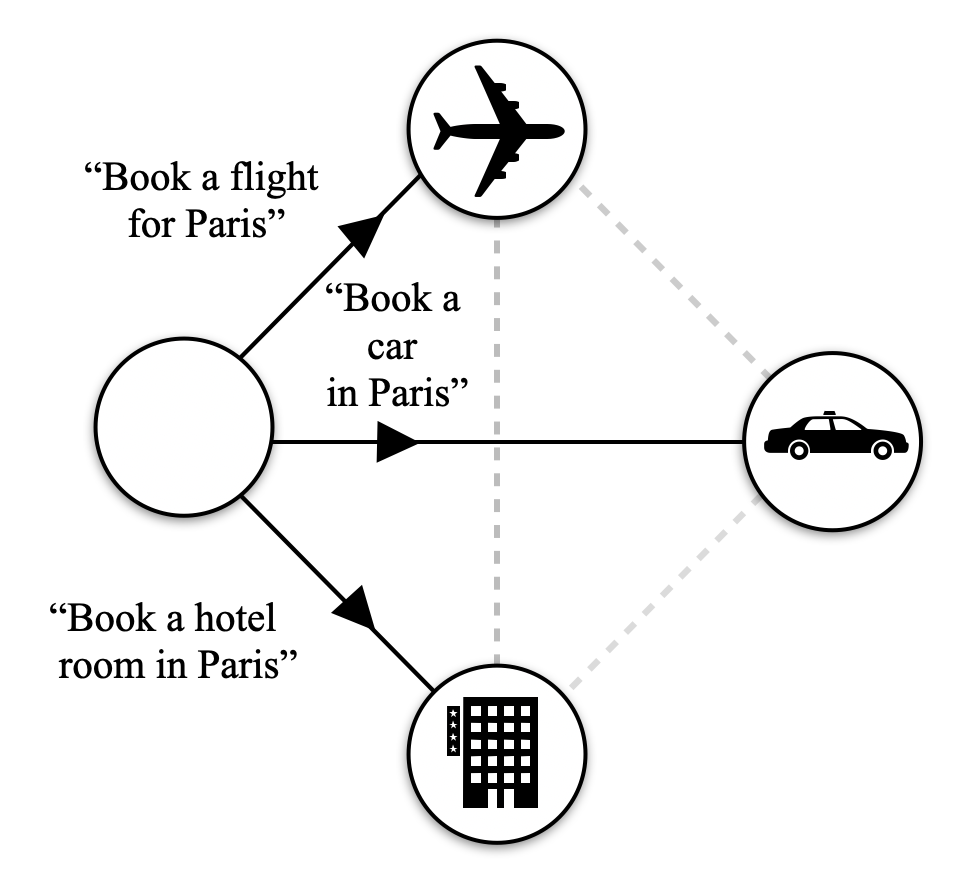
The image is a black-and-white schematic diagram illustrating a user interaction flow for booking travel-related services. It depicts a central user or system initiating three distinct booking actions, with implied connections between the resulting services. The diagram uses simple icons and directional arrows to show command flow and relationships.
### Components/Axes
The diagram consists of four primary circular nodes and connecting lines:
1. **Central Node (Left-Center):** An empty circle. This represents the origin point, likely a user or a central command interface.
2. **Action Nodes (Connected via Solid Arrows):**
* **Top-Center Node:** A circle containing a black silhouette icon of an airplane.
* **Right-Center Node:** A circle containing a black silhouette icon of a car (sedan/taxi style).
* **Bottom-Center Node:** A circle containing a black silhouette icon of a multi-story building (hotel).
3. **Connections:**
* **Solid Directed Arrows:** Three solid black arrows originate from the central node, each pointing to one of the action nodes. Each arrow is labeled with a specific command.
* **Dashed Lines:** Light gray dashed lines connect the three action nodes to each other, forming a triangle. These lines are undirected and suggest a relationship or dependency between the booked services.
### Detailed Analysis
**Textual Labels (Commands):**
The text labels are placed along the solid arrows, indicating the command or intent that triggers the action.
* Arrow to Airplane Node: `"Book a flight for Paris"`
* Arrow to Car Node: `"Book a car in Paris"`
* Arrow to Hotel Node: `"Book a hotel room in Paris"`
**Spatial Layout and Flow:**
* The flow is **divergent**, starting from a single point (central circle) and branching out to three separate service endpoints.
* The dashed lines create a **secondary, interconnected network** between the service endpoints (flight, car, hotel), implying that booking one service may be related to or affect the others (e.g., a flight booking informs the car pickup date, a hotel stay aligns with the flight dates).
### Key Observations
1. **Command Specificity:** Each command is specific to the destination "Paris," indicating a context-aware system.
2. **Iconography:** The icons are universal and unambiguous: airplane for flight, car for ground transportation, building for accommodation.
3. **Relationship Indication:** The dashed lines are a critical component. They transform the diagram from a simple one-to-many command list into a system where the outputs (booked services) are interrelated. This suggests a coordinated travel planning system rather than three independent bookings.
4. **Central Authority:** The empty central node implies a user or a master agent that orchestrates the entire process.
### Interpretation
This diagram models a **multi-service travel booking system** from a user's perspective. It demonstrates a common real-world scenario where a traveler needs to coordinate multiple services for a single trip.
* **What it suggests:** The system is designed to understand high-level, natural language commands ("Book a...") and decompose them into specific service bookings. The presence of the dashed lines is the most insightful element; it indicates that the system is not merely a dispatcher but likely maintains a **shared context** (the trip to Paris). This context allows for intelligent coordination—for example, ensuring the car rental period matches the flight arrival/departure times, or that the hotel check-in date aligns with the overall itinerary.
* **Why it matters:** This represents a move from siloed service bookings to an integrated travel assistant. The diagram visually argues for the value of a unified system that manages dependencies between services, reducing user effort and potential scheduling conflicts. The central node's emptiness could symbolize that the user's intent is the starting point, and the system handles the complex logistics represented by the interconnected nodes.
* **Underlying Pattern:** The structure follows a **hub-and-spoke model with peer-to-peer connections**. The hub (user) initiates actions, but the spokes (services) are also linked, creating a robust network for a cohesive travel product.