## Flowchart: Travel Booking Process for Paris
### Overview
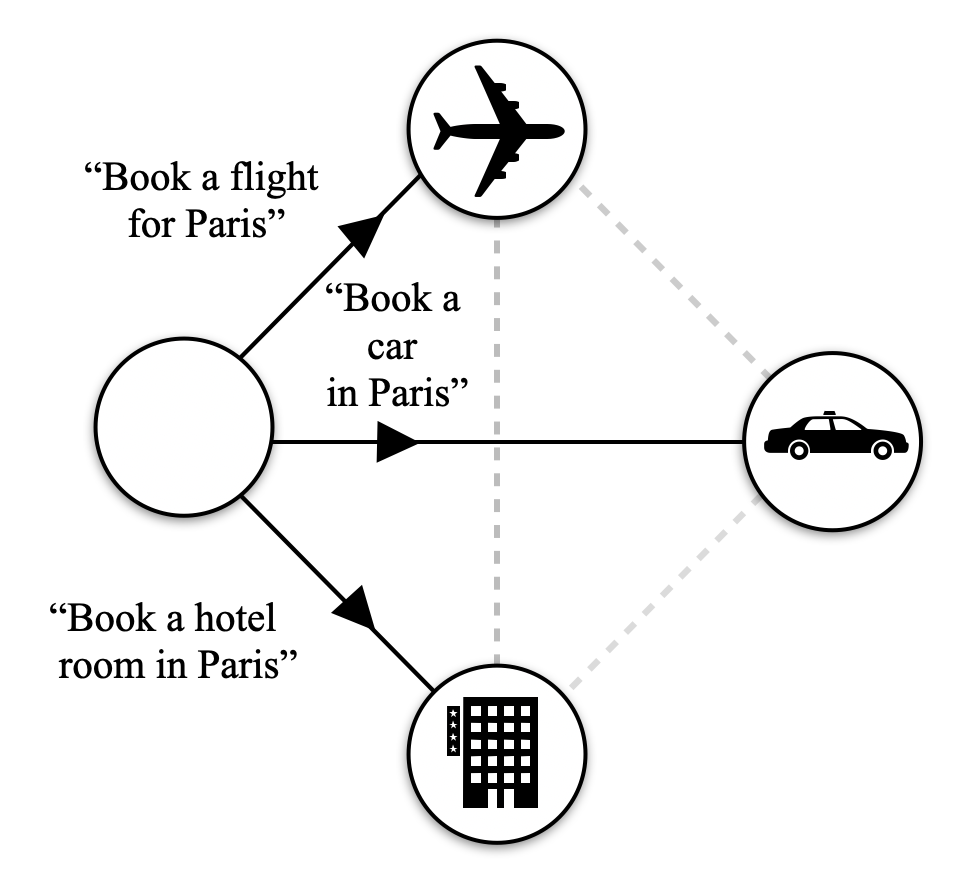
The image depicts a flowchart illustrating a travel booking process centered around Paris. It consists of three primary components connected to a central node, with directional arrows indicating sequential or conditional relationships. The flowchart uses icons to represent transportation and accommodation services.
### Components/Axes
1. **Central Node**: Unlabeled, acts as the origin point for all actions.
2. **Flight Booking**:
- Icon: Airplane
- Label: "Book a flight for Paris"
- Connection: Solid arrow from central node
3. **Car Rental**:
- Icon: Car
- Label: "Book a car in Paris"
- Connection: Solid arrow from central node
4. **Hotel Booking**:
- Icon: Building
- Label: "Book a hotel room in Paris"
- Connection: Solid arrow from central node
5. **Dashed Connection**: A dotted line links the car rental and hotel booking nodes, suggesting an optional or alternative pathway.
### Detailed Analysis
- **Textual Labels**: All actions are enclosed in quotation marks, indicating they are commands or steps within a process.
- **Spatial Relationships**:
- The central node is positioned at the geometric center of the diagram.
- Flight, car, and hotel nodes are arranged in a triangular formation around the central node.
- The dashed line between car and hotel nodes forms a secondary connection, creating a triangular sub-network.
### Key Observations
1. **Mandatory Pathways**: All three booking actions (flight, car, hotel) are directly connected to the central node via solid arrows, implying they are primary options.
2. **Optional Pathway**: The dashed line between car and hotel nodes suggests these two services may be conditionally linked (e.g., "If you book a car, you might also book a hotel").
3. **Iconography**:
- Airplane icon aligns with flight booking.
- Car icon aligns with car rental.
- Building icon (with window details) aligns with hotel accommodation.
### Interpretation
This flowchart represents a decision tree for organizing travel to Paris. The central node likely represents a user, travel agency, or booking system initiating the process. The solid arrows indicate core services that must be addressed, while the dashed line implies a secondary, possibly optional relationship between car rental and hotel booking. The use of quotation marks around each action emphasizes their role as discrete, executable steps within a larger workflow. The diagram does not include numerical data or probabilistic elements, focusing instead on structural relationships between travel components.