\n
## Line Chart: Maze - State Prediction Accuracy vs. Layer Index
### Overview
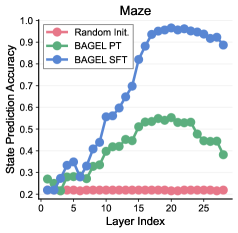
This line chart depicts the state prediction accuracy of three different initialization methods ("Random Init.", "BAGEL PT", and "BAGEL SFT") as a function of the layer index in a "Maze" environment. The chart visualizes how the accuracy changes as the network depth (layer index) increases.
### Components/Axes
* **Title:** Maze
* **X-axis:** Layer Index (ranging from approximately 0 to 28)
* **Y-axis:** State Prediction Accuracy (ranging from approximately 0.2 to 1.0)
* **Legend:** Located in the top-left corner.
* Random Init. (represented by a light red color)
* BAGEL PT (represented by a green color)
* BAGEL SFT (represented by a blue color)
### Detailed Analysis
The chart displays three distinct lines representing the accuracy of each initialization method.
* **Random Init. (Light Red):** The line is relatively flat and hovers around a state prediction accuracy of approximately 0.23 throughout the entire layer index range (0-28). There is minimal variation.
* **BAGEL PT (Green):** This line starts at approximately 0.28 at Layer Index 0. It exhibits an upward trend, increasing to a peak accuracy of approximately 0.55 around Layer Index 18. After this peak, the accuracy declines slightly, settling around 0.45 at Layer Index 28.
* **BAGEL SFT (Blue):** This line begins at approximately 0.27 at Layer Index 0. It shows a rapid and significant increase in accuracy, reaching approximately 0.95 around Layer Index 16. The accuracy remains high, fluctuating slightly between 0.92 and 0.96 for the remaining layer indices (16-28).
Specific data points (approximate):
| Layer Index | Random Init. | BAGEL PT | BAGEL SFT |
|---|---|---|---|
| 0 | 0.23 | 0.28 | 0.27 |
| 5 | 0.23 | 0.32 | 0.32 |
| 10 | 0.23 | 0.45 | 0.65 |
| 15 | 0.23 | 0.52 | 0.92 |
| 20 | 0.23 | 0.50 | 0.95 |
| 25 | 0.23 | 0.45 | 0.93 |
| 28 | 0.23 | 0.43 | 0.92 |
### Key Observations
* BAGEL SFT consistently outperforms both Random Init. and BAGEL PT in terms of state prediction accuracy, especially as the layer index increases.
* Random Init. demonstrates very low and stable accuracy, indicating it is not effective for this task.
* BAGEL PT shows improvement over Random Init., but its accuracy plateaus at a significantly lower level than BAGEL SFT.
* The rapid increase in accuracy for BAGEL SFT around Layer Index 10-16 suggests a critical point where the model begins to effectively learn the state representation.
### Interpretation
The data suggests that the BAGEL SFT initialization method is significantly more effective at training a neural network to predict states in the "Maze" environment compared to both Random Init. and BAGEL PT. The consistently high accuracy of BAGEL SFT indicates that it provides a better starting point for learning, allowing the network to quickly and effectively capture the underlying state representation. The flat line for Random Init. suggests that random initialization alone is insufficient for learning in this environment. The BAGEL PT method shows some improvement, but it does not reach the same level of performance as BAGEL SFT, indicating that the specific initialization strategy employed by BAGEL SFT is crucial for achieving high accuracy. The rapid increase in accuracy for BAGEL SFT around Layer Index 10-16 could be indicative of the network reaching a critical depth where it can effectively model the complexity of the maze environment.