## Text-Based Diagram: Abstract Hierarchical Structure
### Overview
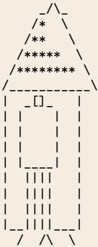
The image depicts a text-based diagram composed of ASCII characters. It features a triangular pyramid structure at the top, a rectangular block below it, and a smaller rectangular block with vertical lines beneath. No explicit textual labels, axis titles, or legends are present.
### Components/Axes
- **Top Section**:
- A pyramid-like triangle formed by `*` characters.
- Stars are arranged in rows:
- Row 1: 1 star
- Row 2: 2 stars
- Row 3: 3 stars
- Row 4: 4 stars
- Row 5: 5 stars
- Row 6: 4 stars
- Row 7: 3 stars
- Row 8: 2 stars
- Row 9: 1 star
- The triangle is bordered by dashed lines (`-`).
- **Middle Section**:
- A central rectangle (`[]`) with a smaller rectangle (`[]`) inside it.
- Vertical lines (`|`) extend downward from the central rectangle.
- **Bottom Section**:
- A horizontal line (`-`) at the base of the diagram.
- Two inverted V-shapes (`/\`) at the bottom corners, suggesting feet or a base.
### Detailed Analysis
- **Pyramid Structure**:
- The star arrangement forms a symmetrical pyramid, peaking at the center.
- No numerical values or labels are associated with the stars.
- **Rectangular Blocks**:
- The central rectangle and smaller inner rectangle lack annotations.
- Vertical lines (`|`) below the central rectangle may imply modular components or hierarchical layers.
- **Base Elements**:
- The inverted V-shapes (`/\`) at the bottom corners could represent stability or grounding.
### Key Observations
1. **Symmetry**: The pyramid and rectangular blocks are centrally aligned.
2. **Hierarchy**: The pyramid’s decreasing star count after the midpoint suggests a top-down structure.
3. **Modularity**: The vertical lines below the central rectangle imply interconnected components.
4. **Ambiguity**: No explicit textual context (e.g., labels, units) limits interpretability.
### Interpretation
The diagram likely represents an abstract hierarchical system:
- The **pyramid** could symbolize a leadership structure, data aggregation, or prioritization model.
- The **central rectangle** with vertical lines might denote a core process or system with dependent modules.
- The **base elements** suggest stability or foundational support.
**Notable Patterns**:
- The absence of text or numerical data makes quantitative analysis impossible.
- The symmetry and modular design imply intentional organization, possibly for conceptual representation (e.g., organizational charts, data flow).
**Uncertainties**:
- Without labels, the exact purpose of the diagram remains speculative.
- The relationship between the pyramid and rectangular blocks is unclear (e.g., cause-effect, parallel systems).
This diagram appears to prioritize visual hierarchy over explicit data, making it suitable for conceptual or architectural illustrations rather than quantitative analysis.