## Diagram: Processor Task Allocation Over Time
### Overview
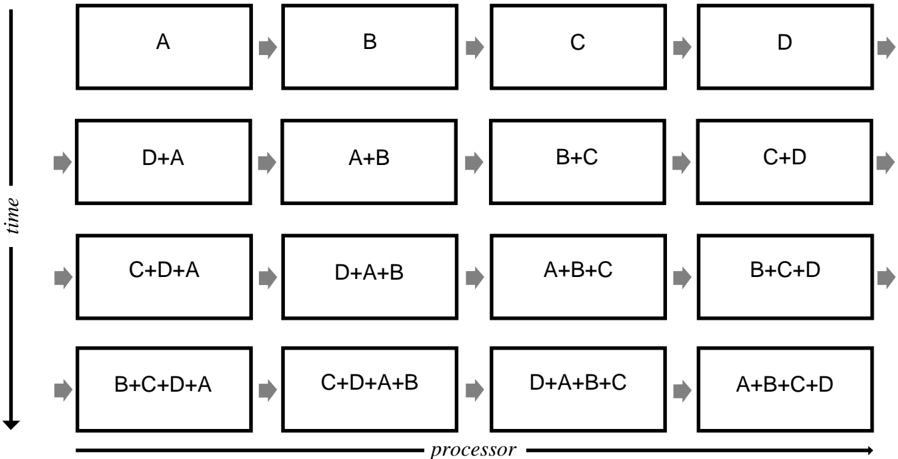
The diagram illustrates a sequential workflow across four processors (A, B, C, D) over four discrete time steps. Each row represents a time step, with rectangles showing active processor combinations and arrows indicating progression. The structure suggests a parallel processing system with overlapping task dependencies.
### Components/Axes
- **X-axis (horizontal)**: Labeled "processor," with four labeled nodes: A, B, C, D.
- **Y-axis (vertical)**: Labeled "time," with four rows representing sequential time steps.
- **Rectangles**: Each contains a combination of processor labels (e.g., "A," "D+A," "A+B+C").
- **Arrows**: Gray arrows connect rectangles horizontally, showing temporal flow.
### Detailed Analysis
#### Time Step 1 (Top Row)
- **A → B → C → D**: Single-processor tasks executed sequentially.
#### Time Step 2 (Second Row)
- **D+A → A+B → B+C → C+D**: Pairs of processors activated, overlapping with prior step (e.g., "D+A" includes D from previous step and new A).
#### Time Step 3 (Third Row)
- **C+D+A → D+A+B → A+B+C → B+C+D**: Triplets of processors, maintaining overlap (e.g., "C+D+A" adds C to prior "D+A").
#### Time Step 4 (Bottom Row)
- **B+C+D+A → C+D+A+B → D+A+B+C → A+B+C+D**: All four processors active in final step, cyclically shifted.
### Key Observations
1. **Progressive Complexity**: Each time step increases active processors by one, starting with single tasks and ending with full parallelism.
2. **Cyclic Dependency**: Processor activation follows a rotational pattern (A→B→C→D→A).
3. **Overlap Preservation**: Each step retains at least one processor from the prior step (e.g., "D+A" retains D from step 1).
### Interpretation
This diagram models a **parallel task scheduling system** where:
- Tasks are distributed across processors in a time-dependent, overlapping manner.
- The rotational pattern suggests load balancing or fault tolerance mechanisms.
- The final step’s full activation (A+B+C+D) implies a culmination phase requiring all resources.
The workflow emphasizes incremental task expansion while maintaining continuity between steps, likely optimizing for efficiency in distributed computing environments.