## Diagram: Cube 3-View Projection and Problem-Solving Response
### Overview
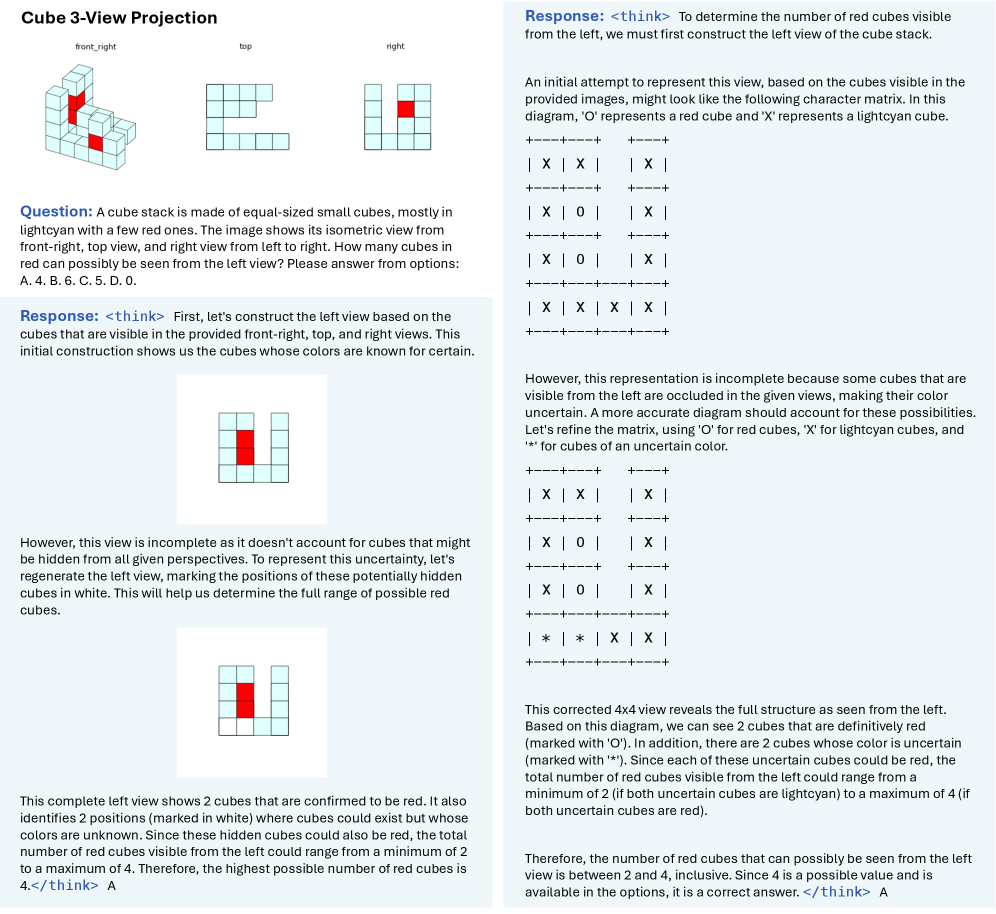
The image is a composite technical document presenting a spatial reasoning problem about a stack of cubes and a detailed, step-by-step solution. The left column shows the original problem with three isometric views of a cube stack and a multiple-choice question. The right column contains a lengthy, reasoned response that constructs a "left view" of the stack to determine the possible number of red cubes visible from that perspective. The document uses text, 3D diagrams, and ASCII art matrices to convey its information.
### Components/Axes
The image is divided into two primary vertical columns.
**Left Column (Problem Statement):**
1. **Title:** "Cube 3-View Projection"
2. **Diagrams:** Three isometric projections of a cube stack, labeled:
* `front_right`
* `top`
* `right`
These diagrams show a structure made of light cyan cubes with a few red cubes embedded within.
3. **Question Text:** A paragraph describing the problem and presenting four multiple-choice options (A. 4, B. 6, C. 5, D. 0).
4. **Initial Response Fragment:** The beginning of a response, marked with `<think>`, which starts to construct a "left view" based on the given diagrams. It includes a small, simplified 2D grid diagram showing a partial left view with one red cube.
**Right Column (Detailed Response):**
1. **Response Header:** "Response: <think>"
2. **Reasoning Text:** A continuous block of explanatory text detailing the logical process.
3. **ASCII Art Diagrams:** Three distinct ASCII art matrices (using `+`, `-`, `|`, `X`, `O`, `*`) representing different stages of constructing the "left view":
* **First Matrix:** A 4x4 grid labeled as an initial attempt, using 'X' for lightcyan and 'O' for red.
* **Second Matrix:** A refined 4x4 grid introducing '*' for cubes of uncertain color.
* **Third Matrix:** A final, corrected 4x4 grid showing the full structure.
4. **Conclusion Text:** The final reasoning leading to the answer, stating the number of red cubes visible from the left is between 2 and 4, inclusive, and that 4 is a correct option.
### Detailed Analysis
**Problem Statement (Left Column):**
* **Object:** A stack of equal-sized small cubes, mostly lightcyan with a few red ones.
* **Given Views:** `front_right`, `top`, and `right` isometric projections.
* **Task:** Determine how many red cubes can possibly be seen from the *left* view.
* **Options Provided:** A. 4, B. 6, C. 5, D. 0.
**Solution Process (Right Column & Lower Left):**
The response constructs the unknown "left view" through iterative reasoning:
1. **Initial Construction:** Based on cubes visible in the three given views, an initial 4x4 grid is proposed. In this grid:
* `X` = Lightcyan cube (certain)
* `O` = Red cube (certain)
* The grid shows two definite red cubes (`O`) at positions (row 2, column 2) and (row 3, column 2) in a 1-indexed grid from the top-left.
2. **Accounting for Uncertainty:** The initial view is deemed incomplete because some cubes visible from the left are occluded in the given views. A refined matrix is created:
* `X` = Lightcyan cube (certain)
* `O` = Red cube (certain)
* `*` = Cube of uncertain color (could be red or lightcyan)
* This matrix adds two uncertain cubes (`*`) at the bottom-left positions (row 4, columns 1 and 2).
3. **Final Corrected View:** The final 4x4 ASCII diagram represents the full structure as seen from the left. It confirms:
* **2 Definite Red Cubes:** Marked with 'O'.
* **2 Uncertain Cubes:** Marked with '*'. Their color is unknown from the given views.
* **Logic:** Since each uncertain cube could be red, the total number of red cubes visible from the left ranges from a minimum of 2 (if both `*` are lightcyan) to a maximum of 4 (if both `*` are red).
### Key Observations
1. **Spatial Reasoning Core:** The problem hinges on mentally constructing a 2D projection (the left view) from three other 2D projections, a classic exercise in spatial visualization.
2. **Use of Uncertainty Notation:** The solution explicitly introduces a symbol (`*`) to represent logical uncertainty, which is a key methodological step.
3. **Answer Derivation:** The final answer is not a single number but a *range* (2 to 4). The multiple-choice question is then answered by selecting the highest possible value within that range that is offered as an option (4).
4. **Visual Layout of Logic:** The ASCII matrices serve as crucial visual aids that ground the textual reasoning, making the abstract spatial relationships concrete and verifiable.
### Interpretation
This document demonstrates a rigorous, transparent problem-solving methodology for a spatial reasoning puzzle. It doesn't just state an answer; it reveals the entire cognitive process.
* **What it demonstrates:** The data (the cube configurations) suggests that the exact composition of the 3D structure is underdetermined by the three given views. The solution elegantly maps this physical uncertainty into a logical framework using symbolic notation (`*`).
* **Relationship between elements:** The three given views (`front_right`, `top`, `right`) are the input data. The constructed "left view" is the analytical output. The ASCII diagrams are the intermediate working models that bridge the two. The final numerical range is the conclusion derived from analyzing the model.
* **Notable pattern:** The solution follows a clear pattern of **Hypothesis (initial grid) -> Identification of Limitation (occlusion) -> Refined Model (adding uncertainty) -> Logical Deduction (range calculation)**. This is a robust investigative approach applicable to many technical fields.
* **Underlying principle:** The problem highlights a fundamental concept in technical drawing and visualization: a set of orthographic projections may not uniquely define a 3D object unless all hidden lines are shown. The solution quantifies the resulting ambiguity.