\n
## Diagram: Cube 3-View Projection & Red Cube Count Determination
### Overview
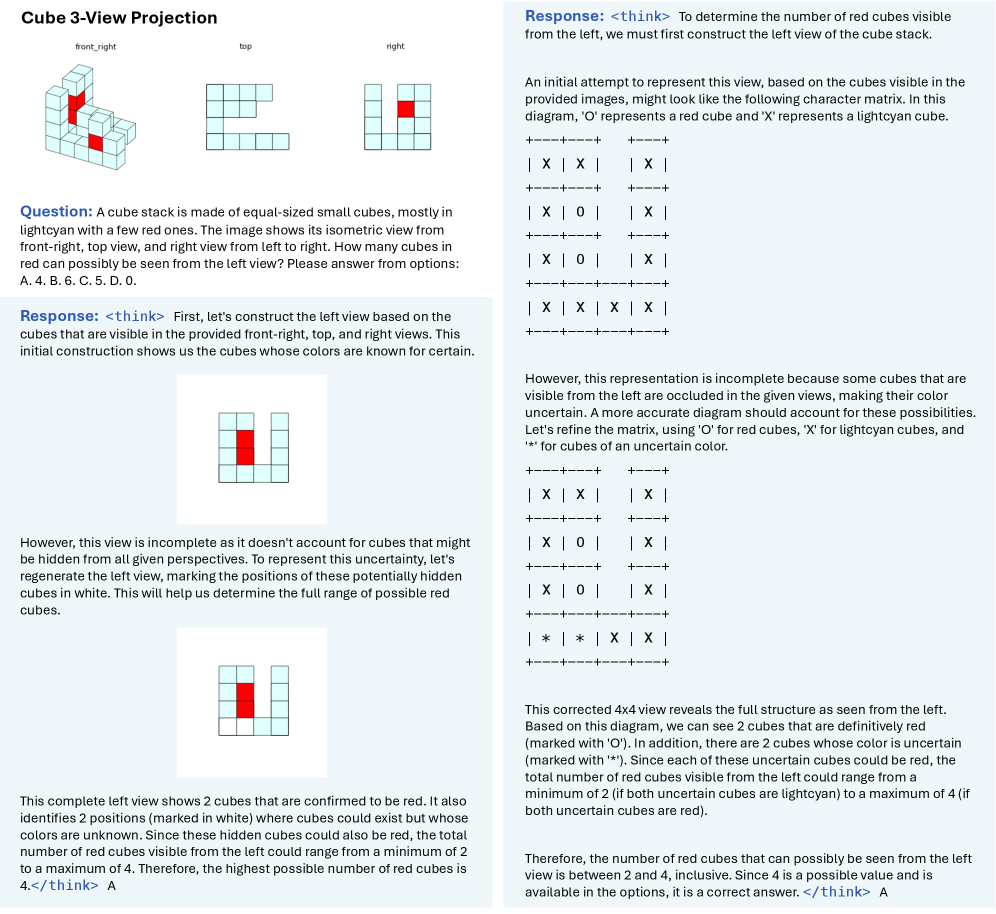
The image presents a problem involving a cube stack composed of red and light cyan cubes. The task is to determine the number of red cubes visible from the left view, given isometric views from the front, top, and right. The image details the reasoning process to solve this problem, starting with an initial attempt at representing the cube stack and refining it to account for hidden cubes and uncertainty. The solution is presented with a matrix representation of the cube stack.
### Components/Axes
The image consists of:
* **Cube Views:** Isometric projections of the cube stack from the front, top, and right.
* **Question Text:** A textual problem statement asking for the number of red cubes visible from the left.
* **Response Text:** A step-by-step explanation of the solution process.
* **Matrix Representations:** Several 4x4 matrices representing the cube stack, with 'X' denoting a red cube, 'O' denoting a light cyan cube, '*' denoting an uncertain cube, and '|' representing the cube boundaries.
* **Answer Options:** A list of possible answers (A. 4, B. 6, C. 5, D. 6, E. 5, F. 4).
### Detailed Analysis or Content Details
**Initial Attempt:**
The initial representation of the cube stack is a 4x4 matrix:
```
| X | X | | X |
|---|---|---|---|
| X | O | | X |
|---|---|---|---|
| X | O | | X |
|---|---|---|---|
| X | X | X | X |
```
**Refined Representation:**
The refined representation introduces '*' to denote uncertain cubes:
```
| X | X | | X |
|---|---|---|---|
| X | O | | X |
|---|---|---|---|
| X | O | | X |
|---|---|---|---|
| * | * | X | X |
```
**Final Corrected Representation:**
The final corrected 4x4 matrix is:
```
| X | X | | X |
|---|---|---|---|
| X | O | | X |
|---|---|---|---|
| X | O | | X |
|---|---|---|---|
| * | * | X | X |
```
**Solution:**
Based on the final matrix, the number of definitively red cubes is 2 (marked with 'X'). There are 2 cubes whose color is uncertain (marked with '*'). Since each of these uncertain cubes could be red, the total number of red cubes visible from the left could range from a minimum of 2 (if both uncertain cubes are light cyan) to a maximum of 4 (if both uncertain cubes are red).
The answer is therefore 4.
### Key Observations
* The problem requires spatial reasoning and the ability to visualize a 3D structure from 2D projections.
* The solution process involves iterative refinement of the cube stack representation to account for hidden cubes and uncertainty.
* The use of a matrix representation simplifies the visualization and analysis of the cube stack.
* The final answer is not a single value but a range, reflecting the uncertainty in the color of some cubes.
### Interpretation
The image demonstrates a problem-solving approach to a spatial reasoning task. The initial attempt to represent the cube stack is incomplete, as it doesn't account for hidden cubes. The refinement process, using the '*' symbol to denote uncertainty, is crucial for arriving at a correct solution. The matrix representation is a powerful tool for visualizing and analyzing the cube stack, allowing for a systematic approach to counting the red cubes. The final answer of 4 acknowledges the uncertainty in the color of some cubes, highlighting the importance of considering all possibilities. The problem showcases the application of logical deduction and spatial visualization skills. The use of the "think" notation suggests a thought process being documented, similar to a "rubber duck debugging" approach. The problem is designed to test the ability to infer information from limited data and to handle ambiguity. The solution is presented in a clear and concise manner, making it easy to follow the reasoning process. The problem is a good example of a visual-spatial reasoning question that could be used in an aptitude test or interview.