## Code Snippet: Lemma Definition
### Overview
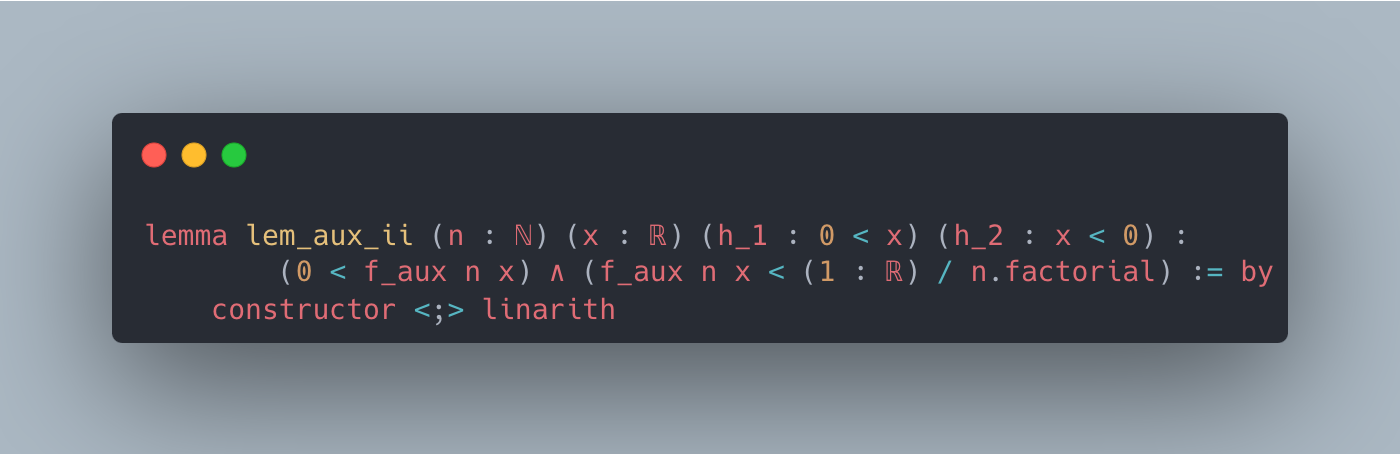
The image is a screenshot of a code snippet, likely from a formal verification system like Coq or Lean. It defines a lemma named `lem_aux_ii` with several input parameters and a logical statement to be proven. The proof strategy is indicated as using the `constructor` tactic followed by the `linarith` tactic.
### Components/Axes
The code snippet includes the following elements:
* **Lemma Declaration:** `lemma lem_aux_ii`
* **Input Parameters:**
* `n : N` (n is a natural number)
* `x : R` (x is a real number)
* `h_1 : 0 < x` (hypothesis 1: 0 is less than x)
* `h_2 : x < 0` (hypothesis 2: x is less than 0)
* **Logical Statement:** `(0 < f_aux n x) ^ (f_aux n x < (1 : R) / n.factorial)`
* `f_aux n x` represents some function of `n` and `x`.
* `^` represents the logical "and" operator.
* `(1 : R)` indicates that 1 is being treated as a real number.
* `n.factorial` represents the factorial of `n`.
* **Proof Strategy:** `:= by constructor <;> linarith`
* `:= by` indicates the start of the proof.
* `constructor` is a tactic that attempts to prove the statement by applying the appropriate constructor.
* `<;>` is a tactic combinator.
* `linarith` is a tactic that attempts to prove the statement using linear arithmetic.
### Detailed Analysis or ### Content Details
The lemma `lem_aux_ii` takes a natural number `n` and a real number `x` as input, along with two hypotheses: `0 < x` and `x < 0`. The lemma states that under these conditions, `0 < f_aux n x` and `f_aux n x < (1 : R) / n.factorial` are both true. The proof strategy involves first using the `constructor` tactic and then the `linarith` tactic.
### Key Observations
The hypotheses `0 < x` and `x < 0` are contradictory. This suggests that the lemma is either intended to be proven under contradictory assumptions (which would make the conclusion trivially true), or there is an error in the hypotheses.
### Interpretation
The code snippet defines a lemma that appears to be attempting to prove a statement about a function `f_aux` under certain conditions. However, the contradictory hypotheses `0 < x` and `x < 0` raise questions about the validity or purpose of the lemma. It is possible that the lemma is intended to demonstrate a proof technique under contradictory assumptions, or that there is an error in the hypotheses that needs to be corrected. The proof strategy suggests an attempt to construct a proof and then use linear arithmetic to complete it.