\n
## Screenshot: Code Snippet with Indicators
### Overview
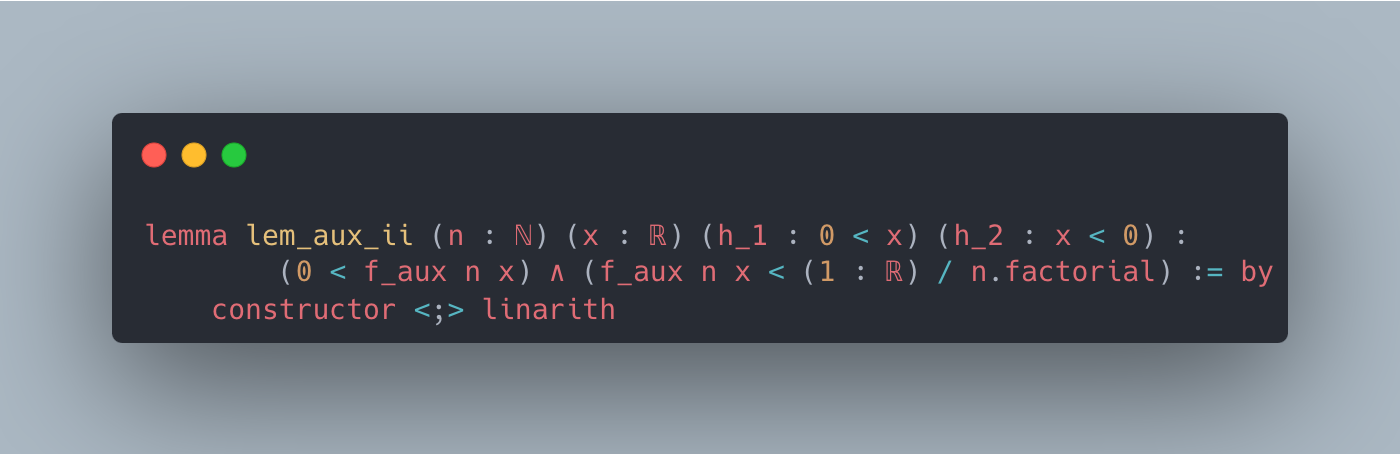
The image is a screenshot of a dark-themed code editor or terminal window. It displays a line of code, likely from a formal verification or mathematical software environment (possibly Coq or Isabelle). Above the code, there are three colored dots, acting as visual indicators.
### Components/Axes
There are no axes or traditional chart components. The key elements are:
* **Red Dot:** Top-leftmost indicator.
* **Orange Dot:** Middle indicator.
* **Green Dot:** Rightmost indicator.
* **Code:** A single line of code, which is the primary content.
### Detailed Analysis or Content Details
The code snippet is:
```
lemma lem_aux_ii (n : ℕ) (x : ℝ) (h_1 : 0 < x) (h_2 : x < 0) :
(0 < f_aux n x) ∧ (f_aux n x < (1 : ℝ) / n.factorial) := by
constructor <>; linarith
```
Let's break down the code:
* `lemma lem_aux_ii`: This declares a lemma named `lem_aux_ii`. Lemmas are proven statements in formal verification.
* `(n : ℕ) (x : ℝ)`: This defines the arguments to the lemma: `n` is a natural number (ℕ), and `x` is a real number (ℝ).
* `(h_1 : 0 < x) (h_2 : x < 0)`: These are hypotheses or assumptions. `h_1` states that `x` is greater than 0, and `h_2` states that `x` is less than 0. This is a contradiction.
* `:`: This separates the arguments and hypotheses from the statement to be proven.
* `(0 < f_aux n x) ∧ (f_aux n x < (1 : ℝ) / n.factorial)`: This is the statement to be proven. It asserts that `f_aux n x` is greater than 0 and less than `1/n!`. The `∧` symbol represents logical conjunction ("and").
* `:= by`: This indicates the start of the proof.
* `constructor <>; linarith`: This is the proof tactic. `constructor` likely introduces cases, and `linarith` is an automated tactic for solving linear arithmetic inequalities.
The presence of contradictory hypotheses `0 < x` and `x < 0` suggests this code might be part of a proof by contradiction, or an attempt to demonstrate a flaw in a system.
### Key Observations
* The contradictory hypotheses `h_1` and `h_2` are a significant observation.
* The code uses mathematical notation common in formal verification systems.
* The colored dots at the top of the screen likely indicate the status of the code or the proof process (e.g., compilation status, test results).
### Interpretation
The code snippet represents a formal statement (a lemma) and a proof attempt within a formal verification environment. The contradictory hypotheses suggest a potential issue or a deliberate attempt to prove a statement by contradiction. The colored dots likely provide visual feedback on the code's status, but their specific meaning is unknown without further context. The use of `linarith` suggests the proof relies on solving inequalities. The overall purpose is to formally verify a mathematical property related to the function `f_aux` and the factorial of `n`.