## Diagram: Privacy Layer Architecture for LLM/Gen AI Interaction
### Overview
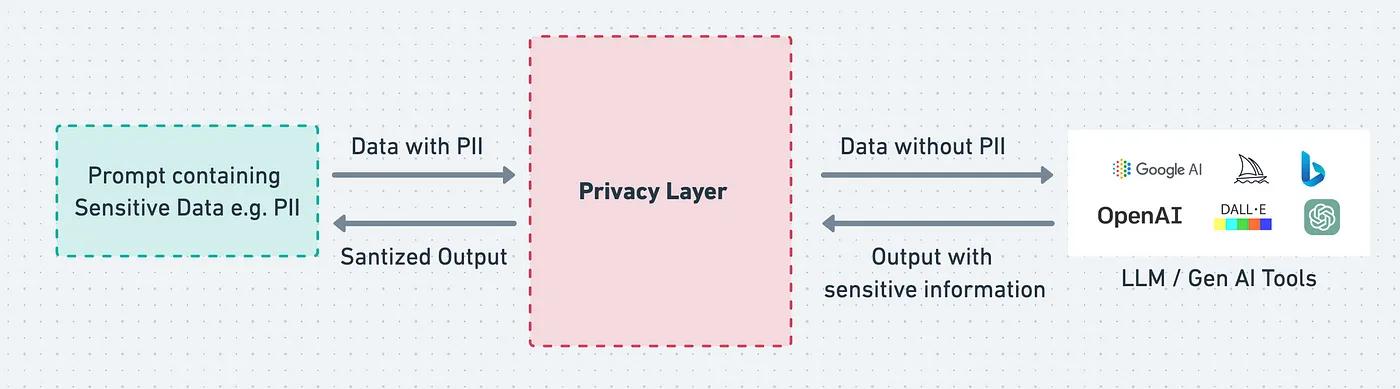
This diagram illustrates a data flow architecture designed to protect Personally Identifiable Information (PII) when interacting with Large Language Models (LLMs) and Generative AI tools. The diagram depicts a "Privacy Layer" acting as a middleware proxy between a user prompt (containing sensitive data) and external AI services.
### Components/Axes
The diagram is organized horizontally from left to right:
* **Left Component (User/Input Source):** A light blue box with a dashed border.
* **Text:** "Prompt containing Sensitive Data e.g. PII"
* **Center Component (Middleware):** A light red/pink box with a dashed red border.
* **Text:** "Privacy Layer"
* **Right Component (AI Services):** A white box containing text and various industry logos.
* **Text:** "LLM / Gen AI Tools"
* **Logos:**
* Google AI (multicolored dots)
* DALL-E (sailboat icon)
* Bing (blue 'b' logo)
* OpenAI (text)
* ChatGPT (green/white chat bubble logo)
### Detailed Analysis
#### Data Flow and Directionality
The diagram utilizes bidirectional arrows to represent the communication loop between the three components.
1. **Left to Center (Outbound):**
* **Label:** "Data with PII"
* **Direction:** Points from the "Prompt" box to the "Privacy Layer" box.
2. **Center to Left (Inbound):**
* **Label:** "Sanitized Output"
* **Direction:** Points from the "Privacy Layer" box to the "Prompt" box.
* *Note:* The original source image contained a typographical error ("Santized"); this has been corrected to "Sanitized" for clarity.
3. **Center to Right (Outbound):**
* **Label:** "Data without PII"
* **Direction:** Points from the "Privacy Layer" box to the "LLM / Gen AI Tools" box.
4. **Right to Center (Inbound):**
* **Label:** "Output with sensitive information"
* **Direction:** Points from the "LLM / Gen AI Tools" box to the "Privacy Layer" box.
### Key Observations
* **The Gatekeeper Role:** The "Privacy Layer" is positioned as the central authority. It is the only component that communicates with both the user and the AI tools.
* **Data Transformation:** The diagram explicitly shows a transformation process:
* Input: PII is removed before the data reaches the LLM.
* Output: The LLM returns data that may contain sensitive information, which is then processed by the Privacy Layer before being returned to the user as "Sanitized Output."
### Interpretation
This diagram represents a standard **PII Redaction/Masking Proxy** pattern.
* **Functionality:** The architecture assumes that the LLM/Gen AI tools are untrusted or require strict data governance. By stripping PII before the prompt reaches the model, the organization ensures that sensitive data is not used for model training or stored in the AI provider's logs.
* **The Return Path:** The inclusion of the "Output with sensitive information" arrow returning to the Privacy Layer suggests that the system is designed to handle cases where the LLM might generate sensitive data (e.g., hallucinated PII or data derived from the context) or where the Privacy Layer must re-identify/re-map tokens before the user sees the final result.
* **Strategic Implication:** This architecture is critical for enterprises operating in regulated industries (e.g., Healthcare, Finance) that wish to leverage public LLMs (like those listed: OpenAI, Google, Bing) without violating data privacy compliance standards (such as GDPR or HIPAA). The "Privacy Layer" is the single point of failure and the single point of trust in this system.