## Math Problem: Finding a Vector with Smallest Magnitude
### Overview
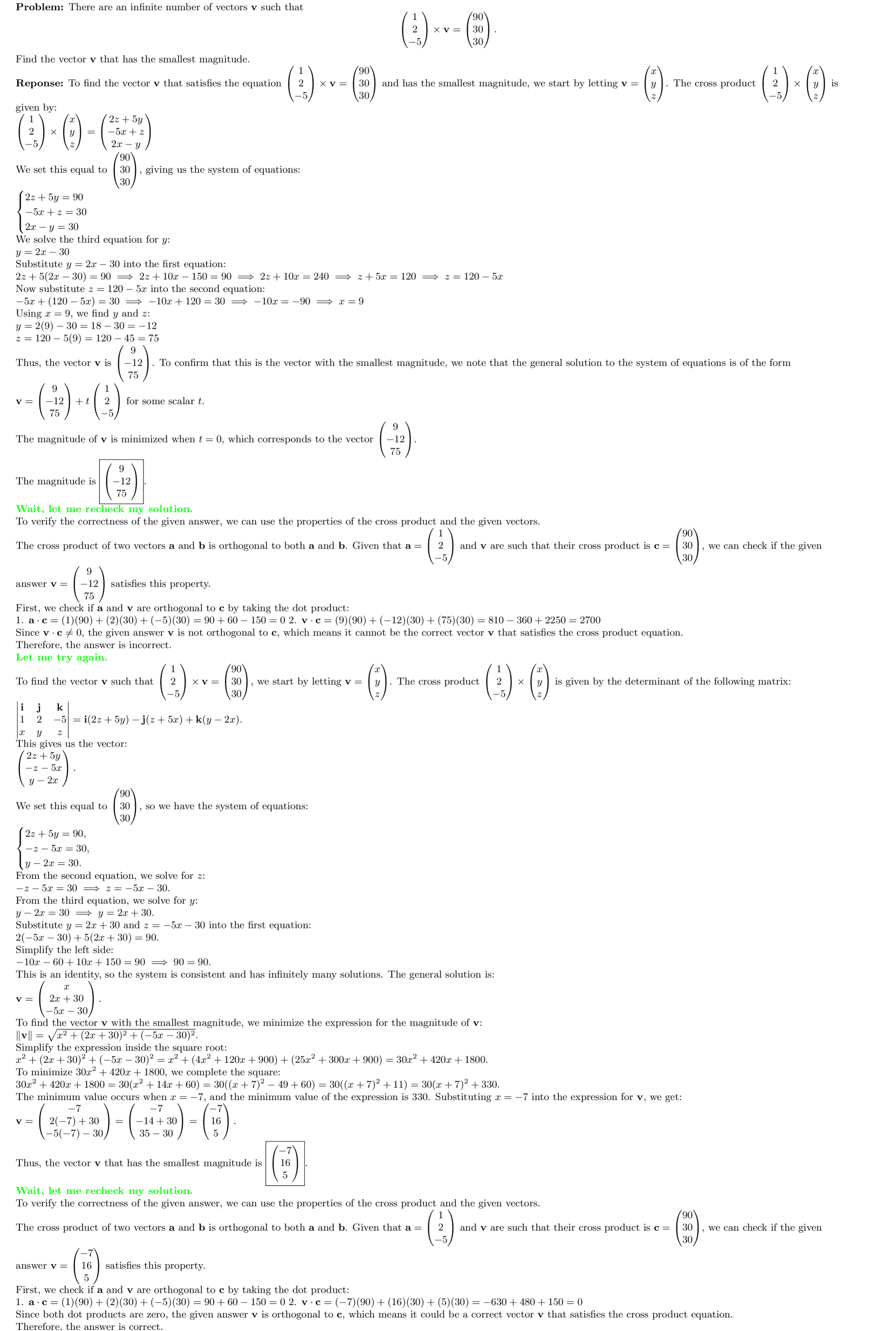
The image presents a math problem focused on finding a vector **v** that satisfies a cross-product equation and has the smallest magnitude. The problem is solved twice, with the first attempt resulting in an incorrect answer and the second attempt resulting in a correct answer. The solution involves setting up a system of equations, solving for the components of **v**, and minimizing the magnitude of **v**.
### Components/Axes
The problem involves vectors, cross products, systems of equations, and magnitude minimization.
### Detailed Analysis or ### Content Details
**Problem Statement:**
* There are an infinite number of vectors **v** such that (1, 2, -5) x **v** = (90, 30, 30).
* Find the vector **v** that has the smallest magnitude.
**First Attempt (Incorrect):**
1. **Setup:** Let **v** = (x, y, z). The cross product (1, 2, -5) x (x, y, z) is calculated as (2z + 5y, -5x + z, 2x - y).
2. **System of Equations:**
* 2z + 5y = 90
* -5x + z = 30
* 2x - y = 30
3. **Solving for y:** y = 2x - 30
4. **Substitution:** Substituting y = 2x - 30 into the first equation: 2z + 5(2x - 30) = 90 => 2z + 10x = 240 => z + 5x = 120 => z = 120 - 5x
5. **Substitution:** Substituting z = 120 - 5x into the second equation: -5x + (120 - 5x) = 30 => -10x = -90 => x = 9
6. **Finding y and z:**
* y = 2(9) - 30 = -12
* z = 120 - 5(9) = 75
7. **Result:** **v** = (9, -12, 75)
8. **General Solution:** **v** = (9, -12, 75) + t(1, 2, -5) for some scalar t.
9. **Magnitude Minimization:** The magnitude of **v** is minimized when t = 0, which corresponds to the vector (9, -12, 75).
10. **Recheck:** The solution is rechecked by verifying if **a** and **v** are orthogonal to **c** by taking the dot product.
* **a** · **c** = (1)(90) + (2)(30) + (-5)(30) = 90 + 60 - 150 = 0
* **v** · **c** = (9)(90) + (-12)(30) + (75)(30) = 810 - 360 + 2250 = 2700
11. **Conclusion:** Since **v** · **c** ≠ 0, the answer is incorrect.
**Second Attempt (Correct):**
1. **Setup:** Let **v** = (x, y, z). The cross product (1, 2, -5) x (x, y, z) is calculated using the determinant method, resulting in the vector (2z + 5y, -(z + 5x), y - 2x).
2. **System of Equations:**
* 2z + 5y = 90
* -z - 5x = 30
* y - 2x = 30
3. **Solving for z:** z = -5x - 30
4. **Solving for y:** y = 2x + 30
5. **Substitution:** Substituting y = 2x + 30 and z = -5x - 30 into the first equation: 2(-5x - 30) + 5(2x + 30) = 90 => -10x - 60 + 10x + 150 = 90 => 90 = 90.
6. **General Solution:** **v** = (x, 2x + 30, -5x - 30)
7. **Magnitude Minimization:** The magnitude of **v** is ||**v**|| = sqrt(x² + (2x + 30)² + (-5x - 30)²).
8. **Simplification:** x² + (2x + 30)² + (-5x - 30)² = 30x² + 420x + 1800
9. **Completing the Square:** 30x² + 420x + 1800 = 30((x + 7)² + 11) = 30(x + 7)² + 330
10. **Minimum Value:** The minimum value occurs when x = -7.
11. **Result:** Substituting x = -7 into the expression for **v**:
* x = -7
* y = 2(-7) + 30 = 16
* z = -5(-7) - 30 = 5
* **v** = (-7, 16, 5)
12. **Recheck:** The solution is rechecked by verifying if **a** and **v** are orthogonal to **c** by taking the dot product.
* **a** · **c** = (1)(90) + (2)(30) + (-5)(30) = 90 + 60 - 150 = 0
* **v** · **c** = (-7)(90) + (16)(30) + (5)(30) = -630 + 480 + 150 = 0
13. **Conclusion:** Since both dot products are zero, the answer is correct.
### Key Observations
* The first attempt fails because the dot product of the calculated vector **v** and the vector **c** (90, 30, 30) is not zero, indicating that **v** is not orthogonal to **c**.
* The second attempt correctly finds a vector **v** that is orthogonal to both **a** and **c**, satisfying the conditions of the problem.
* The magnitude minimization involves completing the square to find the value of x that minimizes the expression.
### Interpretation
The problem demonstrates the process of finding a vector that satisfies a cross-product equation and has the smallest magnitude. The initial incorrect attempt highlights the importance of verifying the solution by checking orthogonality. The correct solution involves a more rigorous approach, including the use of the determinant method for calculating the cross product and completing the square for magnitude minimization. The problem emphasizes the application of vector algebra and calculus concepts to solve geometric problems.