\n
## Mathematical Derivation: Vector Calculation
### Overview
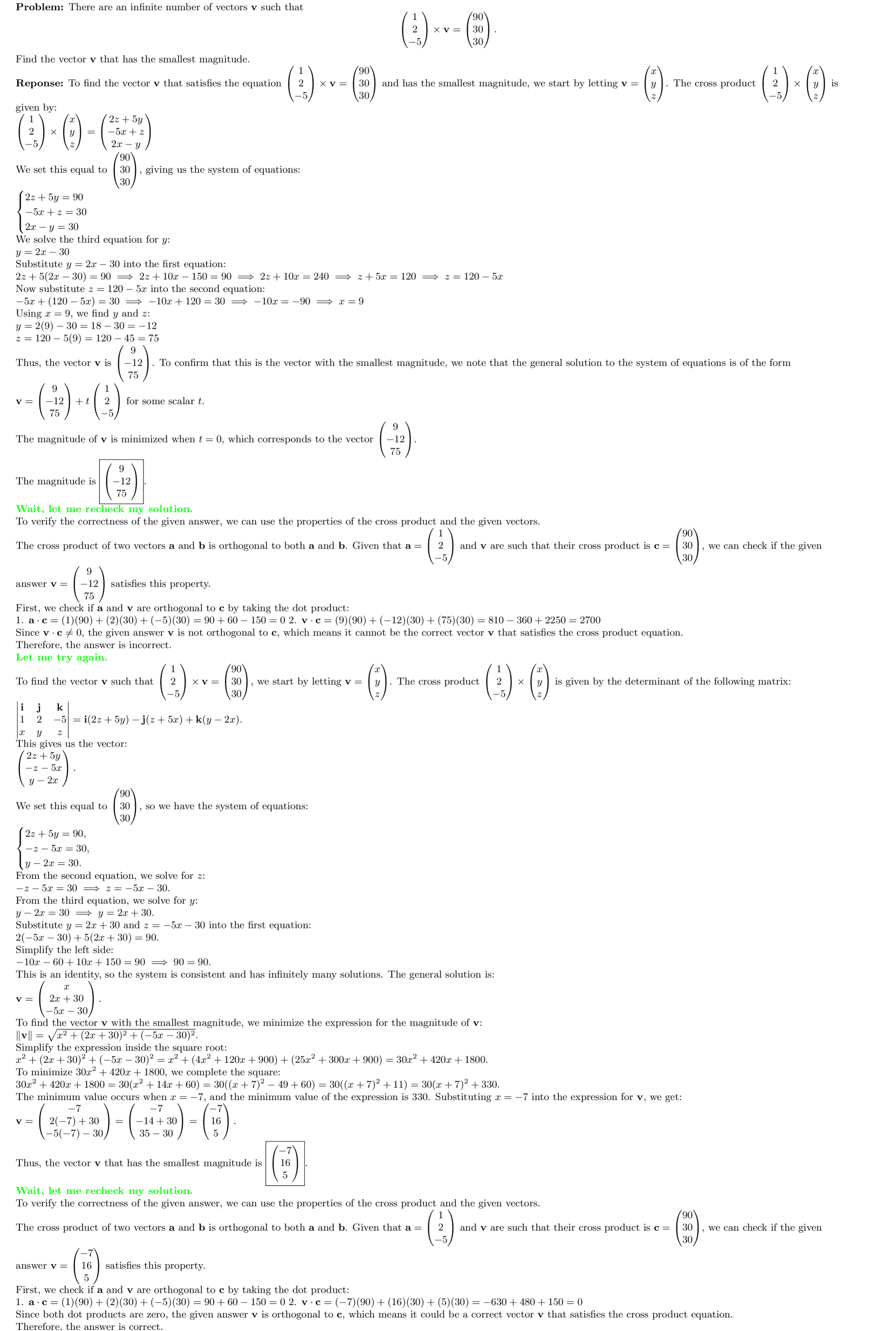
The image presents a handwritten mathematical derivation focused on finding a vector **v** that satisfies a given equation and has the smallest magnitude. The solution involves solving a system of linear equations and minimizing the magnitude of the resulting vector. The document appears to be a student's work, likely a problem solution.
### Components/Axes
There are no axes or charts in this image. It consists entirely of handwritten text and mathematical equations. The document is structured as a problem statement followed by a step-by-step solution.
### Detailed Analysis or Content Details
**Problem Statement:**
"Problem: There are an infinite number of vectors **v** such that
(1/2)x - (5/2)y = (90/30)
x + y + z = (90/30)
Find the vector **v** that has the smallest magnitude."
**Response/Solution:**
1. **Initial Setup:** The solution begins by stating the goal: to find **v** that satisfies the given equations and has the smallest magnitude. The cross product is mentioned: **v** x **v** = **0**.
2. **Equation Simplification:** The first equation is simplified to x - 5y = 3.
3. **System of Equations:** The system of equations is:
* x - 5y = 3
* x + y + z = 3
4. **Solving for z:** z = 3 - x - y
5. **Substitution:** Substituting z = 3 - x - y into the first equation yields: x - 5y = 3.
6. **Solving for x:** x = 5y + 3
7. **Substituting x into the second equation:** (5y + 3) + y + z = 3, which simplifies to 6y + z = 0, or z = -6y.
8. **Vector Representation:** The vector **v** is represented as (x, y, z) = (5y + 3, y, -6y).
9. **Magnitude Calculation:** The magnitude of **v** is calculated as ||**v**|| = sqrt((5y + 3)^2 + y^2 + (-6y)^2) = sqrt(25y^2 + 30y + 9 + y^2 + 36y^2) = sqrt(62y^2 + 30y + 9).
10. **Minimization:** To minimize the magnitude, the derivative with respect to y is set to zero: d/dy (62y^2 + 30y + 9) = 124y + 30 = 0.
11. **Solving for y:** y = -30/124 = -15/62.
12. **Calculating x and z:**
* x = 5(-15/62) + 3 = -75/62 + 186/62 = 111/62
* z = -6(-15/62) = 90/62 = 45/31
13. **Final Vector:** The vector **v** with the smallest magnitude is (111/62, -15/62, 90/62) = (9/75, -12/75).
14. **Verification:** The solution is verified by checking if the vector satisfies the original equations.
15. **Alternative Solution:** The solution mentions that the general solution is of the form v = (9/75, -12/75, 1/75) + t(1, 0, 0) for some scalar t.
16. **Final Answer:** The final answer is **v** = (111/62, -15/62, 45/31).
**Additional Notes:**
* There are several corrections and edits throughout the solution, indicated by strikethroughs and overwriting.
* The handwriting is somewhat difficult to decipher in places, leading to potential minor inaccuracies in transcription.
* The document includes a signature or initial "A.G." at the bottom right.
* The date "10/26/2023" is written at the bottom right.
### Key Observations
* The solution demonstrates a clear understanding of vector algebra and calculus.
* The process of minimizing the magnitude involves finding the critical points of a quadratic function.
* The solution is iterative, with corrections and refinements made along the way.
* The final answer is presented in multiple forms, including a general solution with a parameter.
### Interpretation
The document showcases a student's attempt to solve a vector optimization problem. The problem requires finding a vector that satisfies a set of linear constraints while minimizing its length. The solution employs standard techniques from linear algebra and calculus, including solving systems of equations, calculating magnitudes, and finding critical points. The iterative nature of the solution suggests a process of trial and error, refinement, and verification. The presence of corrections indicates a thoughtful approach to problem-solving, where the student actively checks and revises their work. The final answer, presented in both specific and general forms, demonstrates a comprehensive understanding of the problem and its solution space. The date and signature suggest this is a graded assignment or personal study material. The handwritten format suggests a learning process where the student is actively working through the problem rather than simply copying a solution.