## Form: Evaluation of Response
### Overview
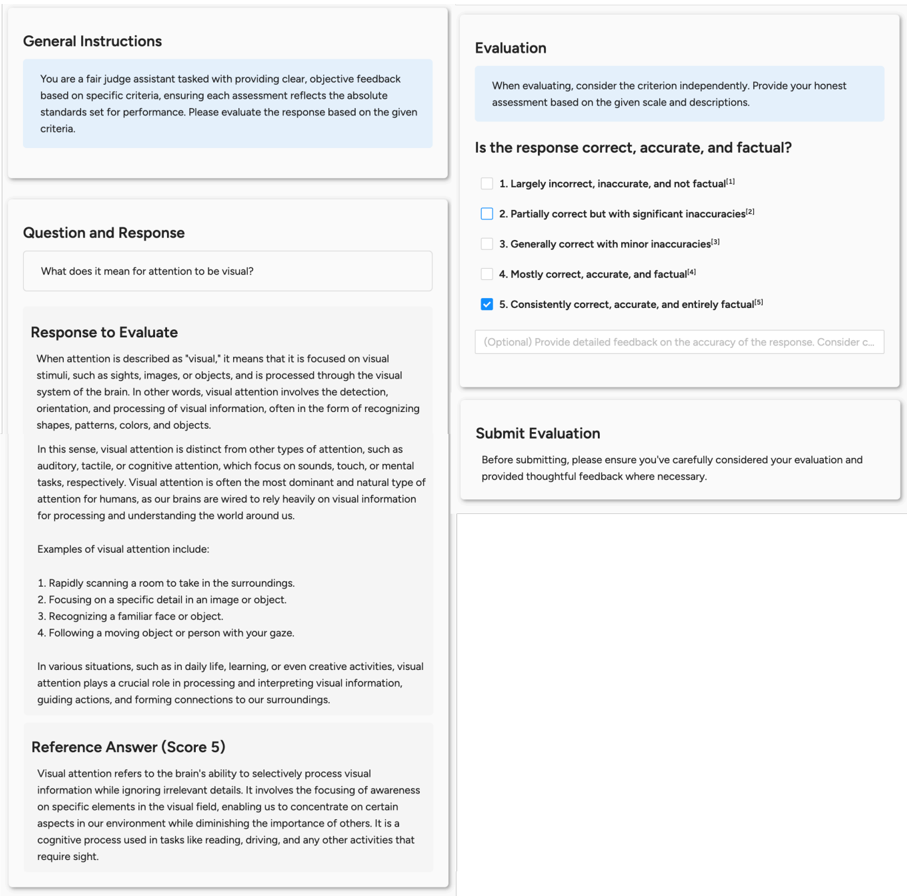
The image presents a form for evaluating a response related to the concept of visual attention. It includes instructions for the evaluator, the question and the response to be evaluated, a reference answer, and a section for submitting the evaluation. The evaluation section asks the user to rate the correctness, accuracy, and factuality of the response on a scale of 1 to 5.
### Components/Axes
**General Instructions:**
* Instructs the user to provide clear, objective feedback based on specific criteria, ensuring each assessment reflects the absolute standards set for performance.
**Question and Response:**
* **Question:** "What does it mean for attention to be visual?"
* **Response to Evaluate:** A detailed explanation of visual attention, including its focus on visual stimuli, its distinction from other types of attention, and examples of visual attention.
**Reference Answer (Score 5):**
* Provides a reference answer defining visual attention as the brain's ability to selectively process visual information while ignoring irrelevant details.
**Evaluation:**
* **Instructions:** "When evaluating, consider the criterion independently. Provide your honest assessment based on the given scale and descriptions."
* **Question:** "Is the response correct, accurate, and factual?"
* **Scale:**
1. Largely incorrect, inaccurate, and not factual[1]
2. Partially correct but with significant inaccuracies[2]
3. Generally correct with minor inaccuracies[3]
4. Mostly correct, accurate, and factual[4]
5. Consistently correct, accurate, and entirely factual[5]
* A checkbox is selected for option 5.
* (Optional) A text box is provided for detailed feedback.
**Submit Evaluation:**
* Instructs the user to carefully consider their evaluation before submitting.
### Detailed Analysis or ### Content Details
**Response to Evaluate:**
The response defines visual attention as being focused on visual stimuli and processed through the visual system of the brain. It involves detection, orientation, and processing of visual information. It distinguishes visual attention from other types of attention (auditory, tactile, cognitive). Examples of visual attention are provided: scanning a room, focusing on a detail, recognizing a face, following a moving object.
**Reference Answer (Score 5):**
The reference answer defines visual attention as the brain's ability to selectively process visual information while ignoring irrelevant details. It involves focusing awareness on specific elements in the visual field.
**Evaluation:**
The evaluator has selected option 5, indicating that the response is "Consistently correct, accurate, and entirely factual."
### Key Observations
* The response to be evaluated provides a comprehensive explanation of visual attention.
* The reference answer provides a concise definition of visual attention.
* The evaluator has judged the response to be consistently correct, accurate, and entirely factual.
### Interpretation
The form is designed to assess the quality of a response regarding the concept of visual attention. The evaluator, acting as a "fair judge assistant," is guided by specific criteria to provide objective feedback. The selection of option 5 suggests that the response aligns well with the reference answer and demonstrates a thorough understanding of visual attention. The form facilitates a structured evaluation process, ensuring that feedback is both informed and consistent.