## Chart: Difference in MUSHRA Scores vs. Intended Angle
### Overview
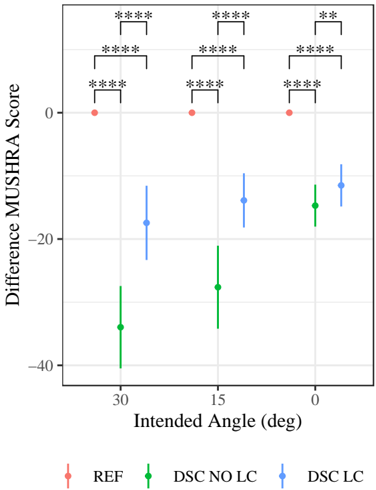
The image is a scatter plot with error bars, comparing the difference in MUSHRA scores for three conditions (REF, DSC NO LC, and DSC LC) at three different intended angles (30, 15, and 0 degrees). Statistical significance is indicated with asterisks above each condition at each angle.
### Components/Axes
* **X-axis:** Intended Angle (deg), with values 30, 15, and 0.
* **Y-axis:** Difference MUSHRA Score, ranging from -40 to 0.
* **Legend (bottom):**
* Red: REF
* Green: DSC NO LC
* Blue: DSC LC
* **Statistical Significance:** Asterisks above each condition at each angle indicate statistical significance. "****" indicates a high level of significance, while "**" indicates a lower level.
### Detailed Analysis
**REF (Red)**
* The REF condition consistently scores around 0 at all angles (30, 15, and 0 degrees).
* The error bars for REF are very small, indicating low variance.
* Statistical significance: "****" at all angles (30, 15, and 0 degrees) when compared to other conditions.
**DSC NO LC (Green)**
* At 30 degrees, the DSC NO LC score is approximately -33, with an error bar extending from approximately -25 to -40.
* At 15 degrees, the DSC NO LC score is approximately -32, with an error bar extending from approximately -23 to -40.
* At 0 degrees, the DSC NO LC score is approximately -17, with an error bar extending from approximately -10 to -23.
* Trend: The DSC NO LC score increases (becomes less negative) as the intended angle decreases.
* Statistical significance: "****" at 30 and 15 degrees, and "****" at 0 degrees when compared to REF.
**DSC LC (Blue)**
* At 30 degrees, the DSC LC score is approximately -17, with an error bar extending from approximately -10 to -24.
* At 15 degrees, the DSC LC score is approximately -14, with an error bar extending from approximately -7 to -21.
* At 0 degrees, the DSC LC score is approximately -12, with an error bar extending from approximately -5 to -19.
* Trend: The DSC LC score increases (becomes less negative) as the intended angle decreases.
* Statistical significance: "****" at 30 and 15 degrees, and "**" at 0 degrees when compared to REF.
### Key Observations
* The REF condition consistently scores near 0, serving as a baseline.
* Both DSC NO LC and DSC LC conditions have negative scores, indicating a perceived difference compared to the REF.
* The DSC NO LC condition generally has lower (more negative) scores than the DSC LC condition.
* The scores for both DSC NO LC and DSC LC increase as the intended angle decreases.
* The statistical significance is generally high ("****") when comparing the DSC conditions to the REF, but lower ("**") for DSC LC at 0 degrees.
### Interpretation
The data suggests that both DSC NO LC and DSC LC conditions are perceived differently from the reference (REF). The DSC NO LC condition is perceived more negatively than the DSC LC condition. The intended angle has an impact on the perceived difference, with smaller angles resulting in higher (less negative) scores for both DSC conditions. The high statistical significance indicates that these differences are likely not due to chance. The lower significance for DSC LC at 0 degrees suggests that the perceived difference between DSC LC and REF is less pronounced at that angle.