## Textual Analysis: Training Manuals Comparison
### Overview
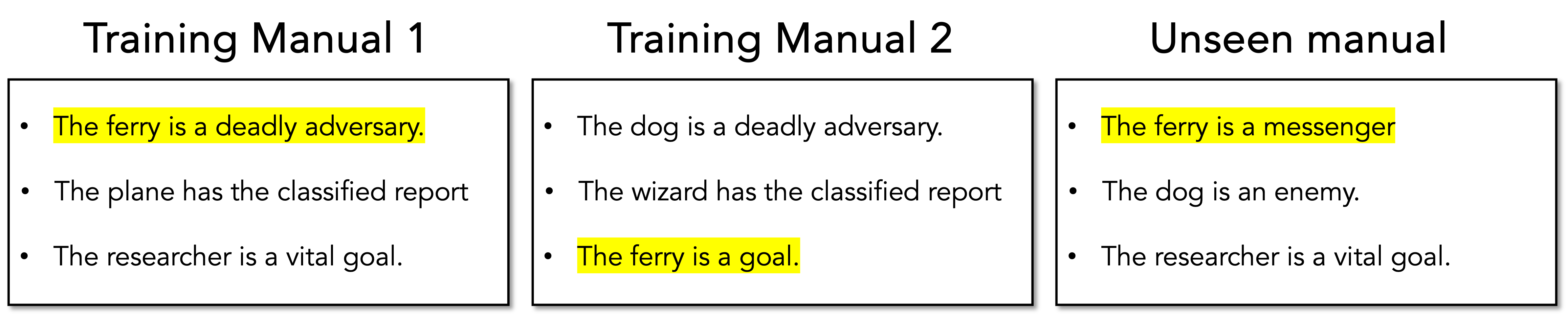
The image presents three side-by-side textual blocks labeled "Training Manual 1," "Training Manual 2," and "Unseen manual." Each block contains three bullet-point statements, with specific phrases highlighted in yellow to emphasize key terms. The content appears to describe adversarial relationships, goals, and roles of entities (e.g., ferry, dog, researcher) across different training scenarios.
### Components/Axes
- **Training Manual 1**:
- "The ferry is a deadly adversary." (highlighted)
- "The plane has the classified report."
- "The researcher is a vital goal."
- **Training Manual 2**:
- "The dog is a deadly adversary."
- "The wizard has the classified report."
- "The ferry is a goal." (highlighted)
- **Unseen manual**:
- "The ferry is a messenger." (highlighted)
- "The dog is an enemy."
- "The researcher is a vital goal."
### Detailed Analysis
1. **Training Manual 1**:
- The ferry is explicitly labeled a "deadly adversary," contrasting with its role as a "goal" in Manual 2.
- The plane is associated with a "classified report," while the researcher is a "vital goal."
2. **Training Manual 2**:
- The dog replaces the ferry as the "deadly adversary," and the wizard holds the "classified report."
- The ferry is redefined as a "goal," conflicting with its adversarial role in Manual 1.
3. **Unseen manual**:
- The ferry is described as a "messenger," introducing a new role not seen in the training manuals.
- The dog is labeled an "enemy," aligning thematically with the adversarial roles in the training manuals.
- The researcher remains a "vital goal" across all manuals, suggesting consistency in this objective.
### Key Observations
- **Ferry Role Conflict**: The ferry’s role shifts dramatically between manuals (adversary → goal → messenger), indicating potential contradictions or evolving scenarios.
- **Adversarial Entities**: The "deadly adversary" label applies to the ferry (Manual 1) and dog (Manual 2), while the Unseen manual introduces the dog as an "enemy."
- **Consistency in Researcher**: The researcher is universally a "vital goal," emphasizing its importance across all scenarios.
- **Classified Reports**: The plane (Manual 1) and wizard (Manual 2) hold classified reports, but no such entity is mentioned in the Unseen manual.
### Interpretation
The manuals appear to simulate adversarial environments with conflicting objectives:
- **Training Manuals 1 and 2** establish a framework where entities (ferry, dog) are adversaries, and goals (researcher) are prioritized.
- The **Unseen manual** introduces ambiguity by redefining the ferry as a "messenger" and the dog as an "enemy," suggesting a shift in context or a test of adaptability.
- The recurring "vital goal" for the researcher implies it is a constant objective, while other roles (ferry, dog) are context-dependent.
- The highlighted phrases ("deadly adversary," "goal," "messenger") may represent critical decision points or keywords for training algorithms to prioritize.
This structure highlights inconsistencies in entity roles, potentially testing how systems resolve conflicting information or adapt to new scenarios (e.g., the Unseen manual’s "messenger" role for the ferry). The adversarial relationships and goal prioritization could reflect a simulation of dynamic threat assessment or resource allocation in a technical or operational context.