\n
## Diagram: Binary Search Illustration
### Overview
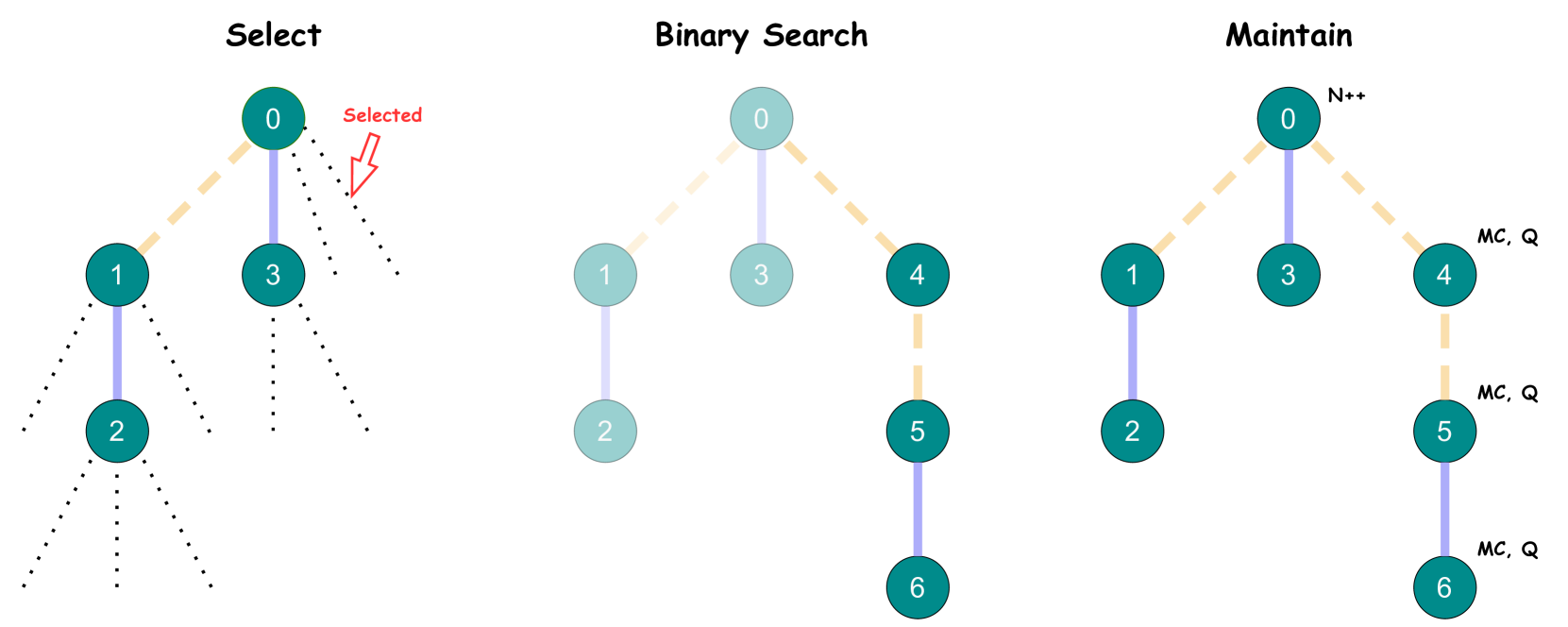
The image presents a visual comparison of three approaches related to binary search: "Select", "Binary Search", and "Maintain". Each approach is depicted as a tree-like structure with numbered nodes (0-6) connected by lines. The diagram illustrates how each method navigates a sorted dataset.
### Components/Axes
The diagram consists of three distinct sections, labeled "Select", "Binary Search", and "Maintain" positioned horizontally across the top. Each section represents a different method. Within each section, nodes are represented by teal circles with numbers 0 through 6. Lines connect the nodes, indicating relationships or search paths. The "Select" section has a red arrow pointing from node 0 to a cluster of nodes, labeled "Selected". The "Maintain" section has annotations "N++" and "MC, Q" next to nodes 0 and 5/6 respectively.
### Detailed Analysis or Content Details
**Select:**
* Node 0 is at the top, connected to nodes 1 and 3.
* Node 1 is connected to node 2.
* Node 3 is connected to a series of smaller nodes (represented by dots), indicating a larger dataset.
* A red arrow originates from node 0 and points towards the cluster of smaller nodes, labeled "Selected".
**Binary Search:**
* Node 0 is at the top, connected to nodes 1 and 3.
* Node 1 is connected to node 2.
* Node 3 is connected to nodes 4 and 5.
* Node 4 is connected to node 6.
* Node 5 is connected to node 6.
**Maintain:**
* Node 0 is at the top, labeled "N++", connected to nodes 1 and 3.
* Node 1 is connected to node 2.
* Node 3 is connected to nodes 4 and 5.
* Node 4 is connected to node 6, labeled "MC, Q".
* Node 5 is connected to node 6, labeled "MC, Q".
### Key Observations
* The "Select" method appears to directly choose a subset of the data (represented by the "Selected" label).
* The "Binary Search" method follows a standard binary search tree structure, dividing the dataset in half at each step.
* The "Maintain" method is similar to "Binary Search" but includes additional annotations ("N++", "MC, Q") suggesting some form of maintenance or tracking of data characteristics.
* The annotations "MC, Q" appear twice in the "Maintain" section, suggesting they relate to nodes 5 and 6.
* "N++" appears to be an increment operation.
### Interpretation
The diagram illustrates different strategies for searching or managing data within a sorted structure. The "Select" method represents a direct selection process, potentially based on some criteria. The "Binary Search" method demonstrates the classic divide-and-conquer approach for efficient searching. The "Maintain" method builds upon binary search, adding elements related to data maintenance, potentially tracking metadata ("MC") and query status ("Q"). The "N++" annotation suggests a counter or index is being incremented.
The diagram doesn't provide specific data values or performance metrics, but it visually conveys the conceptual differences between these three approaches. The "Maintain" method appears to be an enhanced version of "Binary Search", incorporating additional functionality for data management. The annotations suggest a more complex system where the search process is integrated with other operations.