TECHNICAL ASSET FINGERPRINT
8dd90f73b8f43342dad091a8
Click to view fullscreen
Press ESC or click to close
FOUND IN PAPERS
EXPERT: healer-alpha-free VERSION 1
RUNTIME: free/openrouter/healer-alpha
INTEL_VERIFIED
## Diagram: Three-Phase Tree Algorithm Illustration
### Overview
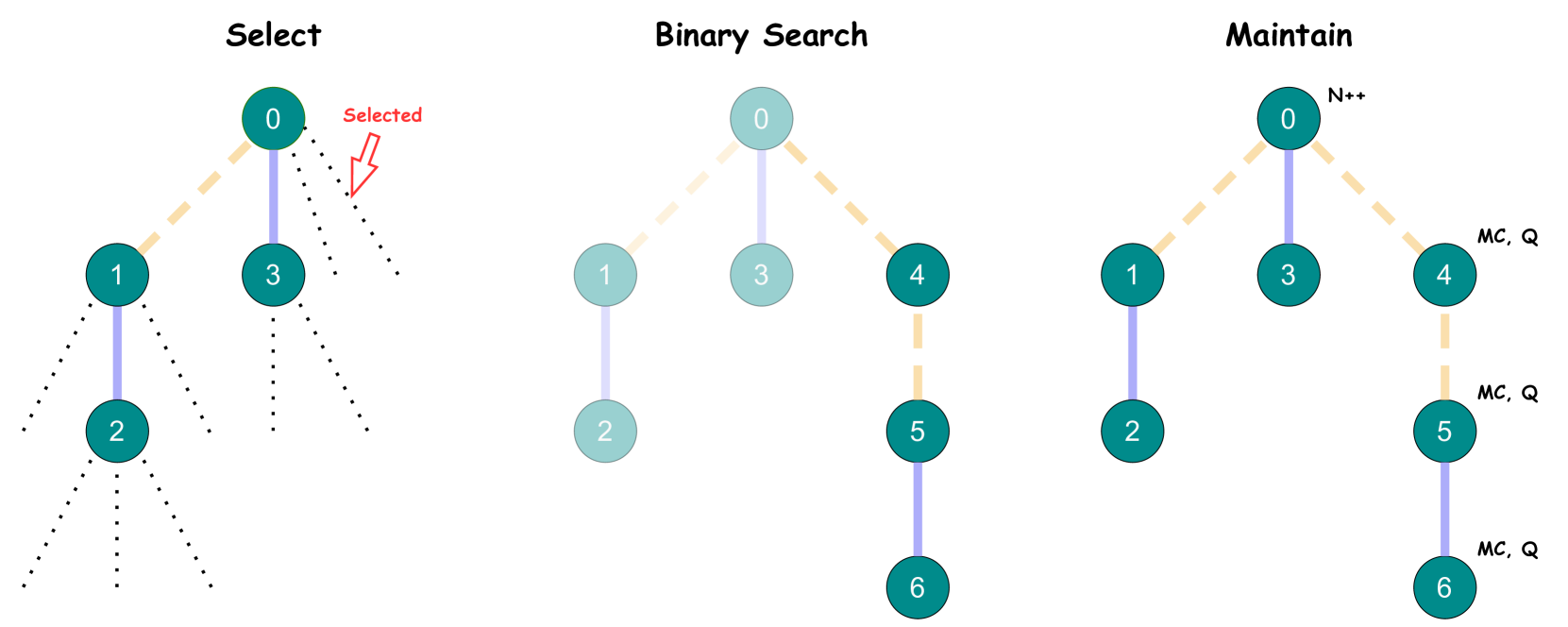
The image is a technical diagram illustrating three sequential or related operations on a tree data structure. The operations are labeled "Select", "Binary Search", and "Maintain", each depicted as a separate tree diagram arranged horizontally from left to right. The diagram uses visual cues like node color, edge style, and annotations to convey the state and actions at each phase.
### Components/Axes
The diagram consists of three distinct tree structures, each with the following common components:
* **Nodes:** Represented as circles containing numerical identifiers (0, 1, 2, 3, 4, 5, 6).
* **Edges:** Lines connecting nodes, with different styles indicating different relationships or states.
* **Labels:** Textual annotations describing the operation phase and specific node states.
* **Color Coding:** Nodes are colored in two shades of teal/green. A darker teal is used for "active" or "selected" nodes in the first and third diagrams, while a lighter teal is used for nodes in the middle diagram.
**Legend (Inferred from visual patterns):**
* **Node Fill Color:**
* Dark Teal: Active/Selected node (Diagrams 1 & 3).
* Light Teal: Inactive/Unselected node (Diagram 2).
* **Edge Style:**
* Solid Purple Line: Primary or confirmed parent-child connection.
* Dashed Yellow Line: Secondary or potential connection.
* Dotted Black Line: Potential future paths or unexplored branches (only in Diagram 1).
* **Text Annotations:**
* Red Text ("Selected"): Highlights the chosen node in Diagram 1.
* Black Text ("N++", "MC, Q"): Indicates operations or properties associated with nodes in Diagram 3.
### Detailed Analysis
#### **Diagram 1: "Select" (Left)**
* **Title:** "Select" (centered above the tree).
* **Tree Structure:** A root node (0) with two children (1 and 3). Node 1 has a child (2). Dotted lines extend from nodes 0, 1, 2, and 3, suggesting potential but unexplored branches.
* **Key Action:** Node 0 is filled with dark teal. A red arrow points to it with the label **"Selected"** in red text, positioned to the upper-right of node 0.
* **Spatial Grounding:** The "Selected" annotation is in the top-right quadrant of this sub-diagram. The dotted lines radiate downwards and outwards from the existing nodes.
#### **Diagram 2: "Binary Search" (Center)**
* **Title:** "Binary Search" (centered above the tree).
* **Tree Structure:** The same underlying tree topology as Diagram 1, but with different node states and a highlighted path.
* **Node States:** All nodes (0, 1, 2, 3, 4, 5, 6) are filled with light teal, indicating they are not the primary focus of selection.
* **Highlighted Path:** A specific path is emphasized:
* From root **0** to child **4** via a **dashed yellow line**.
* From node **4** to child **5** via a **dashed yellow line**.
* From node **5** to child **6** via a **solid purple line**.
* **Trend Verification:** The visual trend shows a search path descending from the root (0) down the rightmost branch (0 -> 4 -> 5 -> 6), with the final connection being solid.
#### **Diagram 3: "Maintain" (Right)**
* **Title:** "Maintain" (centered above the tree).
* **Tree Structure:** Identical topology to the previous diagrams.
* **Node States:** Nodes 0, 1, 2, 3, 4, 5, and 6 are all filled with dark teal, indicating they are all active or have been updated.
* **Annotations:**
* To the right of root node **0**: The text **"N++"**.
* To the right of node **4**: The text **"MC, Q"**.
* To the right of node **5**: The text **"MC, Q"**.
* To the right of node **6**: The text **"MC, Q"**.
* **Edge Styles:** The edge from 0 to 4 is dashed yellow. The edge from 4 to 5 is dashed yellow. The edge from 5 to 6 is solid purple. The edge from 0 to 1 is dashed yellow. The edge from 1 to 2 is solid purple. The edge from 0 to 3 is dashed yellow.
### Key Observations
1. **Consistent Topology:** The underlying tree structure (parent-child relationships) is identical across all three diagrams, showing the same set of nodes and connections.
2. **State Progression:** The diagrams show a clear progression: a node is **selected** (Diagram 1), a **search path** is executed (Diagram 2), and then the tree is **updated/maintained** (Diagram 3), with annotations suggesting increments ("N++") and other operations ("MC, Q").
3. **Path Consistency:** The path highlighted in the "Binary Search" phase (0->4->5->6) corresponds to the rightmost branch of the tree. The "Maintain" phase shows this same path (0->4->5->6) with consistent edge styles, but now all nodes are active.
4. **Annotation Specificity:** The "MC, Q" annotation is applied only to nodes 4, 5, and 6—the nodes along the search path from the "Binary Search" phase. The "N++" annotation is applied only to the root node (0).
### Interpretation
This diagram illustrates a three-step algorithm for operating on a tree, likely related to **dynamic tree data structures** (e.g., Link/Cut Trees, Euler Tour Trees) used in advanced algorithms for network flow, connectivity, or dynamic graph problems.
* **"Select" Phase:** Represents choosing a specific node (node 0) as the root of a preferred path or the entry point for an operation. The dotted lines suggest the algorithm considers potential paths from this node.
* **"Binary Search" Phase:** Depicts a search or access operation along a specific path in the tree (0->4->5->6). The use of "Binary Search" as a label is metaphorical, implying a hierarchical search process within the tree structure rather than a literal binary search on a sorted array. The path is likely a "preferred path" in the data structure.
* **"Maintain" Phase:** Shows the state after the operation, where the tree's metadata is updated. "N++" at the root suggests an increment of a size or counter property for the entire tree. "MC, Q" on the nodes of the accessed path (4, 5, 6) likely stands for updating properties like **M**ax **C**apacity, **Q**ueue information, or other aggregate values that must be maintained along the path after an access or modification.
**Overall Purpose:** The diagram visually explains how an operation (starting with selection) triggers a search along a specific path, which in turn necessitates updates to node and path metadata to maintain the invariants of the data structure. It emphasizes the link between path access and the maintenance of aggregated information in tree-based algorithms.
DECODING INTELLIGENCE...