## Diagram: Audio Processing System with Dual MLMs and Transformer Encoder
### Overview
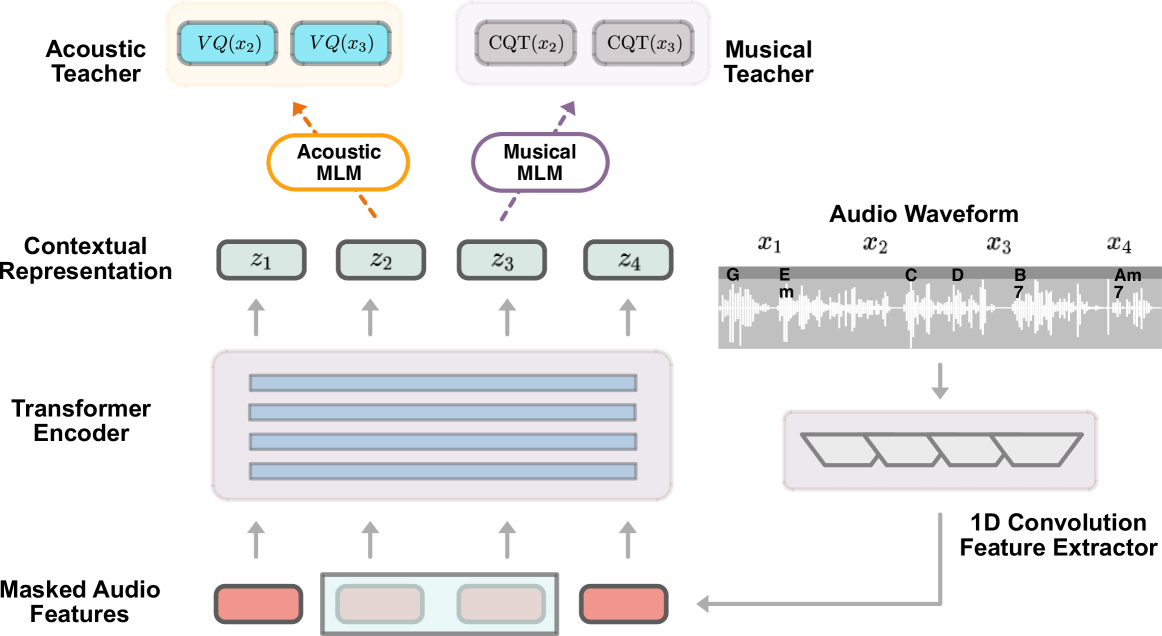
The diagram illustrates a multi-modal audio processing system that integrates acoustic and musical features using two separate Masked Language Models (MLMs) and a Transformer Encoder. The system processes raw audio waveforms through a 1D convolution feature extractor, generates contextual representations, and employs teacher-student learning for both acoustic and musical domains.
### Components/Axes
1. **Input Path**:
- **Audio Waveform**: Raw audio signal (x₁–x₄) with labeled segments (G, E, m, C, D, B, 7, Am, 7).
- **1D Convolution Feature Extractor**: Converts audio waveforms into masked audio features.
2. **Core Processing**:
- **Transformer Encoder**: Processes masked audio features to produce contextual representations (z₁–z₄).
- **Acoustic MLM**: Receives contextual representations (z₁–z₄) and input from the Acoustic Teacher (VQ(x₂), VQ(x₃)).
- **Musical MLM**: Receives contextual representations (z₁–z₄) and input from the Musical Teacher (CQT(x₂), CQT(x₃)).
3. **Teachers**:
- **Acoustic Teacher**: Provides VQ(x₂), VQ(x₃) to the Acoustic MLM.
- **Musical Teacher**: Provides CQT(x₂), CQT(x₃) to the Musical MLM.
### Detailed Analysis
- **Audio Waveform**: The input signal is segmented into labeled regions (e.g., "G," "E," "m," "C," "D," "B," "Am," "7"), suggesting a focus on musical notation or phonetic analysis.
- **Feature Extraction**: The 1D convolution layer extracts masked audio features, likely emphasizing temporal patterns while suppressing certain frequencies or time intervals.
- **Transformer Encoder**: Generates four contextual representations (z₁–z₄), which serve as shared inputs for both MLMs.
- **Dual MLMs**:
- The **Acoustic MLM** integrates acoustic features (VQ(x₂), VQ(x₃)) with contextual representations.
- The **Musical MLM** integrates musical features (CQT(x₂), CQT(x₃)) with contextual representations.
- **Teachers**: The Acoustic and Musical Teachers act as auxiliary models, providing domain-specific guidance (e.g., VQ for vector quantization, CQT for chroma-based features).
### Key Observations
1. **Modular Design**: The system separates acoustic and musical processing streams while sharing contextual representations, enabling cross-modal learning.
2. **Teacher-Student Dynamics**: The teachers likely refine the MLMs through contrastive learning or knowledge distillation, improving generalization.
3. **Masked Features**: The use of masked audio features suggests a self-supervised learning approach, similar to BERT for audio.
### Interpretation
This architecture demonstrates a hybrid approach to audio understanding, combining:
- **Acoustic Analysis**: Focused on raw sound properties (e.g., timbre, amplitude).
- **Musical Context**: Leveraging chroma features (CQT) for pitch and harmony recognition.
- **Transformer-Based Context**: Capturing long-range dependencies in audio sequences.
The dual MLM design allows the system to handle tasks requiring both sound-level and music-level understanding, such as:
- Music transcription (converting audio to sheet music).
- Emotion recognition in music.
- Speech-to-music generation.
The teachers’ roles highlight the importance of domain-specific priors in improving model robustness. For example, the Acoustic Teacher might enforce consistency in low-level features, while the Musical Teacher ensures alignment with harmonic structures.