## Diagram Type: Flowchart
### Overview
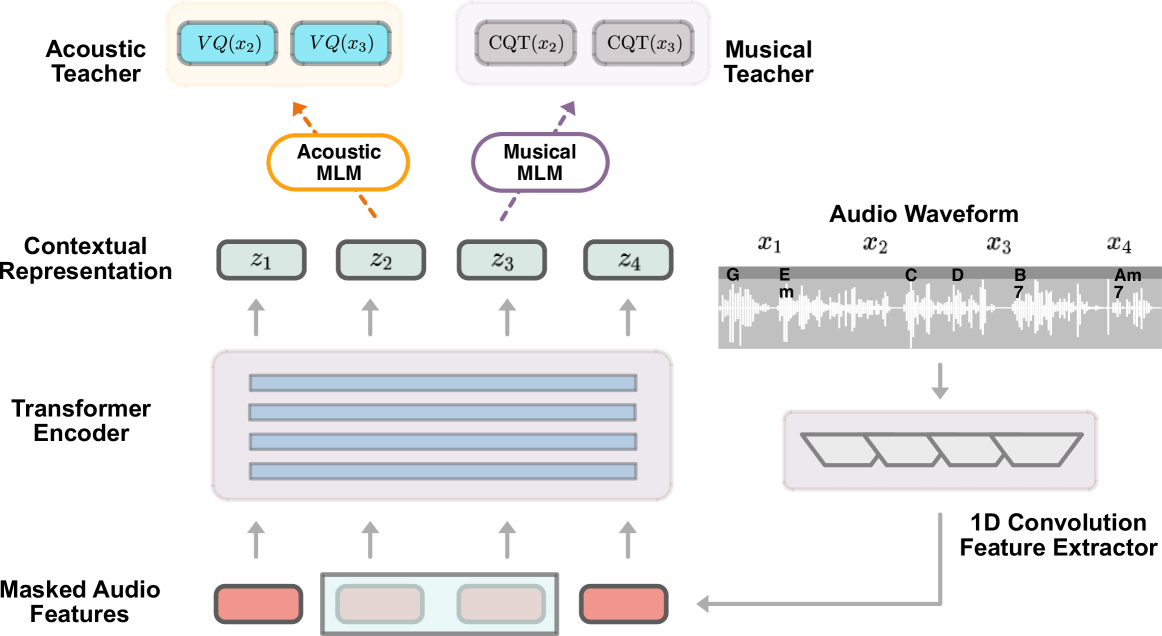
The image is a flowchart that illustrates the process of audio feature extraction and representation using a combination of acoustic and musical models. The chart is divided into several sections, each representing a different step in the process.
### Components/Axes
- **Acoustic Teacher**: This section represents the acoustic model, which is used to extract features from audio signals.
- **Musical Teacher**: This section represents the musical model, which is used to extract features from musical signals.
- **Contextual Representation**: This section represents the process of combining the features extracted from the acoustic and musical models to create a contextual representation of the audio signal.
- **Transformer Encoder**: This section represents the use of a transformer encoder to process the contextual representation.
- **Masked Audio Features**: This section represents the process of masking audio features to protect the privacy of the data.
- **1D Convolution Feature Extractor**: This section represents the use of a 1D convolution feature extractor to extract features from the masked audio features.
### Detailed Analysis
- The acoustic model uses a masked audio feature extractor to extract features from the audio signal.
- The musical model uses a masked audio feature extractor to extract features from the musical signal.
- The contextual representation is created by combining the features extracted from the acoustic and musical models.
- The transformer encoder processes the contextual representation to create a final output.
- The output is a 1D convolution feature extractor that extracts features from the masked audio features.
### Key Observations
- The flowchart shows the process of audio feature extraction and representation using a combination of acoustic and musical models.
- The use of a transformer encoder and a 1D convolution feature extractor suggests that the process is designed to be efficient and accurate.
- The masking of audio features suggests that the process is designed to protect the privacy of the data.
### Interpretation
The flowchart illustrates the process of audio feature extraction and representation using a combination of acoustic and musical models. The use of a transformer encoder and a 1D convolution feature extractor suggests that the process is designed to be efficient and accurate. The masking of audio features suggests that the process is designed to protect the privacy of the data. The contextual representation created by combining the features extracted from the acoustic and musical models suggests that the process is designed to capture the nuances of the audio signal. Overall, the flowchart provides a clear and concise overview of the process of audio feature extraction and representation.