## Diagram: BDR Module Process Flow
### Overview
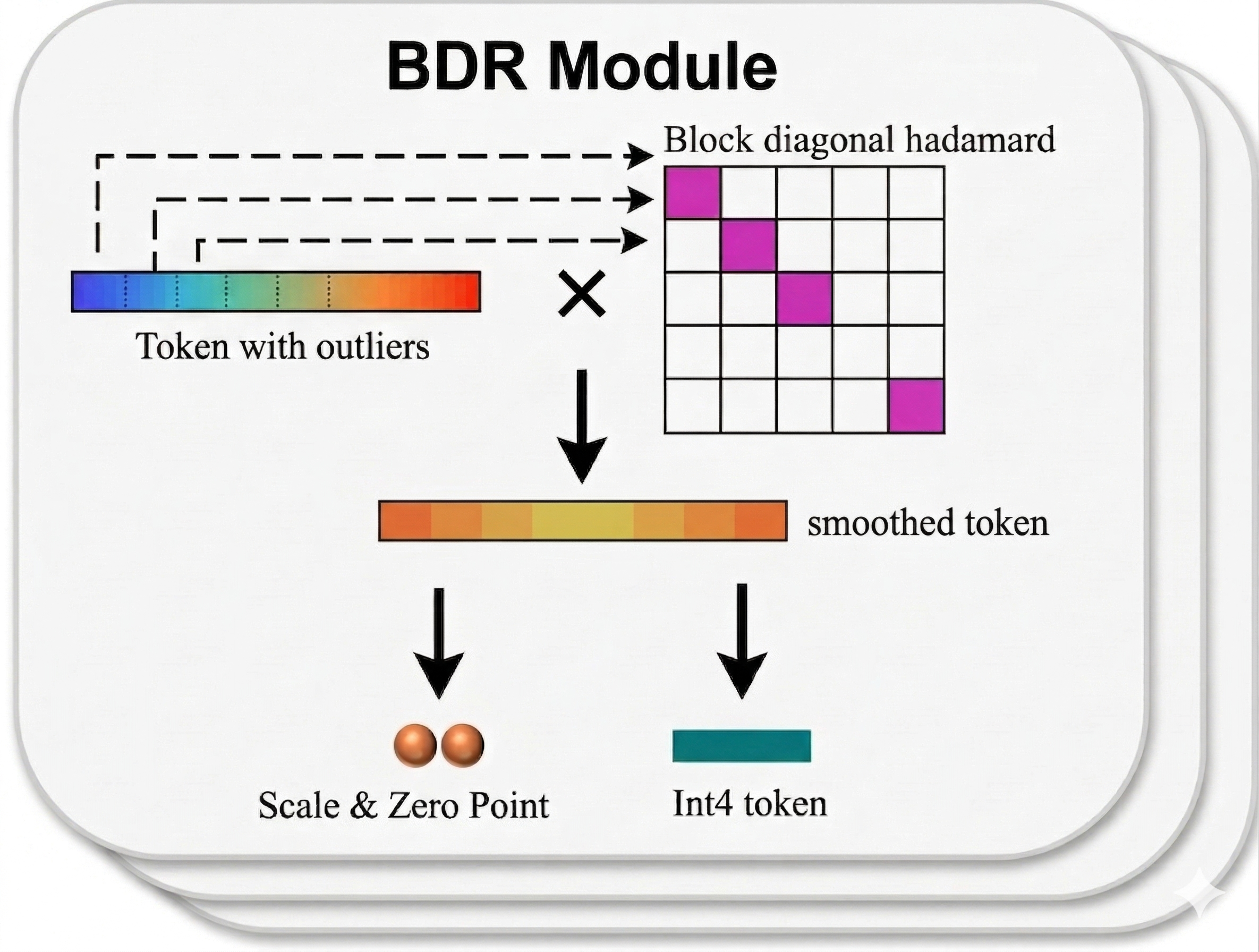
The diagram illustrates a technical process flow within a BDR (Block Diagonal Hadamard) Module. It depicts the transformation of a "Token with outliers" through a series of operations, including matrix manipulation and quantization, resulting in two outputs: "Scale & Zero Point" and "Int4 token." The process involves color-coded gradients, matrix operations, and symbolic representations.
---
### Components/Axes
1. **Header**:
- Title: "BDR Module" (centered at the top).
2. **Input Section**:
- **Token with outliers**:
- A horizontal gradient bar transitioning from blue (left) to red (right).
- Labeled "Token with outliers" (left of the bar).
- **Block diagonal hadamard**:
- A 5x5 grid matrix with purple squares on the main diagonal (top-left to bottom-right).
- Labeled "Block diagonal hadamard" (above the matrix).
3. **Intermediate Step**:
- **Smoothed token**:
- A horizontal gradient bar transitioning from orange (left) to yellow (right).
- Labeled "smoothed token" (right of the bar).
4. **Output Section**:
- **Scale & Zero Point**:
- Two orange spheres connected by a horizontal line.
- Labeled "Scale & Zero Point" (below the spheres).
- **Int4 token**:
- A solid teal bar.
- Labeled "Int4 token" (below the bar).
---
### Detailed Analysis
1. **Token with outliers**:
- The input token is represented by a color gradient (blue → red), likely indicating outlier magnitudes or distributions.
2. **Block diagonal hadamard**:
- The matrix operation (purple diagonal squares) suggests a transformation to reduce dimensionality or sparsity.
3. **Smoothed token**:
- The gradient (orange → yellow) implies a normalization or smoothing process applied to the input token.
4. **Outputs**:
- **Scale & Zero Point**: Symbolized by two spheres, possibly representing scaling factors and reference points.
- **Int4 token**: A teal bar, likely indicating a quantized or compressed representation (Int4 = 4-bit integer).
---
### Key Observations
1. **Flow Direction**:
- Arrows indicate a sequential process:
`Token with outliers` → `Block diagonal hadamard` → `Smoothed token` → `Scale & Zero Point` / `Int4 token`.
2. **Color Coding**:
- Gradients (blue→red, orange→yellow) visually differentiate input and intermediate stages.
- Purple squares in the matrix highlight the block diagonal structure.
3. **Matrix Structure**:
- The 5x5 block diagonal hadamard matrix has non-zero elements only on the main diagonal, consistent with Hadamard matrix properties.
4. **Output Representation**:
- "Scale & Zero Point" uses symbolic spheres, while "Int4 token" uses a solid bar, suggesting different data types (scalar vs. quantized).
---
### Interpretation
1. **Process Purpose**:
- The BDR Module appears to handle outlier tokens by applying a block diagonal Hadamard transform to sparsify the data, followed by smoothing and quantization.
2. **Outlier Handling**:
- The "Token with outliers" gradient suggests the input contains variable magnitudes, which are mitigated by the matrix operation.
3. **Quantization**:
- The "Int4 token" output implies compression for efficient storage or transmission, typical in machine learning or signal processing.
4. **Symbolic Outputs**:
- "Scale & Zero Point" likely represents parameters for further processing (e.g., normalization in neural networks).
---
### Notable Patterns
- The use of block diagonal matrices suggests a focus on preserving local structure while reducing complexity.
- The transition from a gradient input to a solid-colored output indicates a lossy compression or simplification step.
- The separation of "Scale & Zero Point" and "Int4 token" implies modular design for downstream tasks.