## Histogram with Overlaid Probability Density Curve
### Overview
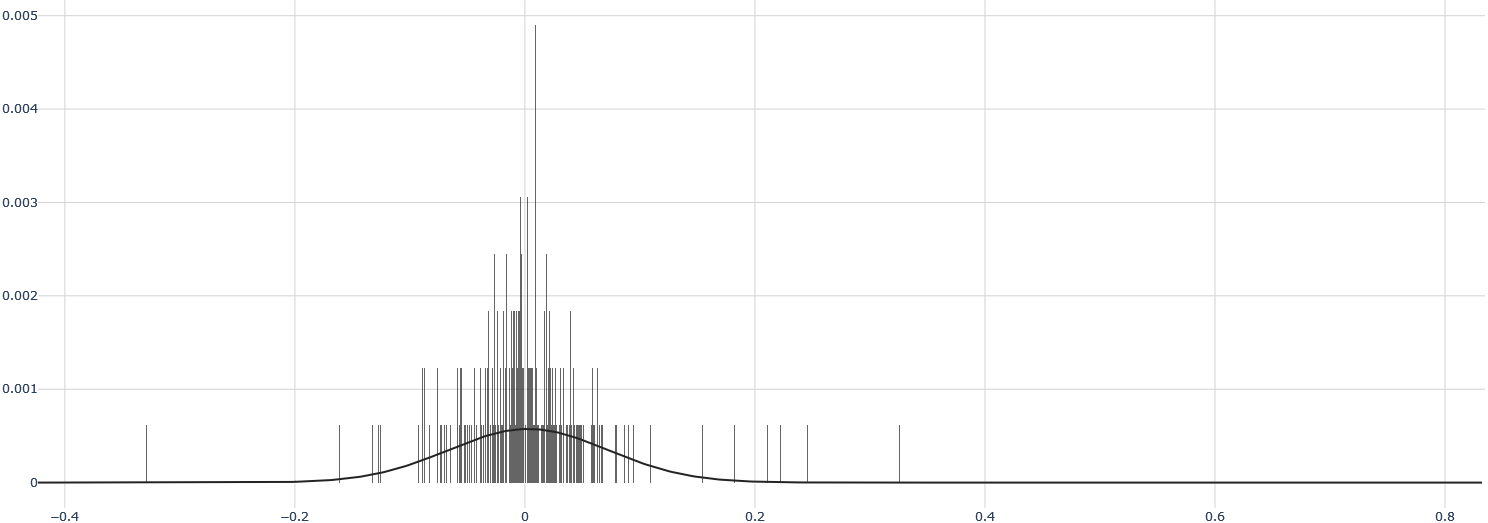
The image displays a statistical chart consisting of a histogram (vertical bars) overlaid with a smooth probability density function (PDF) curve. The chart visualizes the distribution of a dataset. There are no explicit titles, axis labels, or legends present in the image.
### Components/Axes
* **X-Axis (Horizontal):** A numerical scale ranging from approximately -0.4 to 0.8. Major tick marks are visible at intervals of 0.2 (e.g., -0.4, -0.2, 0, 0.2, 0.4, 0.6, 0.8). The axis line itself is solid black.
* **Y-Axis (Vertical):** A numerical scale representing frequency density, ranging from 0 to 0.005. Major tick marks are present at intervals of 0.001 (e.g., 0, 0.001, 0.002, 0.003, 0.004, 0.005).
* **Histogram Bars:** Numerous thin, vertical gray bars. Their height corresponds to the frequency density of data points within specific bins along the x-axis.
* **Probability Density Curve:** A single, smooth, solid black line overlaid on the histogram. It represents a theoretical or fitted distribution model for the data.
* **Grid:** A faint, light-gray grid is present in the background, with lines corresponding to the major ticks on both axes.
### Detailed Analysis
* **Data Distribution (Histogram):**
* The histogram bars are densely clustered around the x-axis value of 0.
* The highest bar (peak frequency density) is located at or very near x=0, reaching a y-value of approximately 0.0049.
* The distribution appears roughly symmetric around 0.
* The spread (width) of the histogram is relatively narrow. The vast majority of bars are contained between x = -0.1 and x = 0.1.
* There are a few sparse, very short bars extending further out, with the leftmost visible bar near x = -0.35 and the rightmost near x = 0.35. These represent potential outliers or the tails of the distribution.
* **Probability Density Curve:**
* The curve is unimodal (single-peaked) and bell-shaped, characteristic of a normal (Gaussian) or similar symmetric distribution.
* The peak of the curve aligns closely with x=0, matching the histogram's mode.
* The peak height of the curve is approximately 0.0006 on the y-axis, which is significantly lower than the peak of the histogram bars. This suggests the curve may represent a smoothed estimate or a different normalization.
* The curve tapers off smoothly towards zero on both sides, becoming negligible beyond approximately x = -0.2 and x = 0.2.
### Key Observations
1. **Central Tendency:** The data is strongly centered around zero.
2. **Low Variance/High Precision:** The data has a very narrow spread, indicating low variance or high precision in the measured variable.
3. **Symmetry:** The distribution is visually symmetric.
4. **Outliers:** A few data points exist in the tails (e.g., near -0.35 and +0.35), but they are extremely rare compared to the central cluster.
5. **Model Fit:** The overlaid smooth curve captures the general symmetric, bell-shaped nature of the data but does not match the extreme peakedness (kurtosis) of the histogram. The histogram is more "spiky" or leptokurtic than the fitted curve.
### Interpretation
This chart demonstrates a dataset where the measured values are highly concentrated around a mean of zero, with very small deviations. This pattern is typical of:
* **Residuals from a well-fitting statistical model,** where most errors are near zero.
* **Measurement noise** from a high-precision instrument.
* **Returns of a very stable financial asset** over a short period.
* **Differences between matched pairs** in a controlled experiment showing minimal effect.
The discrepancy between the sharp histogram peak and the smoother, lower curve suggests the underlying data distribution may have heavier tails or a sharper peak than the theoretical model (e.g., a normal distribution) used to generate the curve. The presence of sparse bars in the tails (-0.35 to 0.35) confirms that while extreme values are possible, they are highly improbable compared to values near zero. The lack of axis labels prevents definitive identification of the variable being measured, but the statistical behavior is clearly one of high central tendency and low dispersion.