## Photograph: Three Objects on a Neutral Surface
### Overview
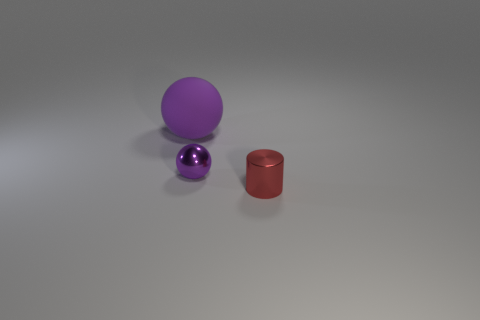
The image depicts three distinct 3D objects arranged on a flat, neutral gray surface. The composition includes two spheres and one cylinder, varying in size, color, and material properties. Lighting is soft and diffused, casting subtle shadows to emphasize depth and texture. No textual elements, labels, or annotations are present.
### Components/Axes
- **Objects**:
1. **Large Purple Sphere**: Positioned at the top-left relative to the other objects. Matte finish, uniform color.
2. **Small Shiny Purple Sphere**: Located near the center, slightly below and to the right of the large sphere. Reflective surface with specular highlights.
3. **Red Cylinder**: Positioned at the bottom-right, aligned horizontally. Glossy finish with visible reflections.
- **Background**: Uniform gray with no patterns or textures.
- **Lighting**: Soft, even illumination from above, creating faint shadows beneath each object.
### Detailed Analysis
- **Large Purple Sphere**:
- Size: Approximately 2.5x the diameter of the small sphere.
- Material: Non-reflective, matte surface.
- Position: Top-left quadrant of the image.
- **Small Shiny Purple Sphere**:
- Size: Approximately 1/3 the diameter of the large sphere.
- Material: Highly reflective, metallic-like surface.
- Position: Centered horizontally, slightly lower than the large sphere.
- **Red Cylinder**:
- Size: Height and diameter roughly equal to the small sphere’s diameter.
- Material: Glossy, with visible light reflections on its curved surface.
- Position: Bottom-right quadrant, aligned parallel to the image’s horizontal axis.
### Key Observations
1. **Material Contrast**: The matte purple sphere contrasts with the reflective purple and red objects, suggesting a study in surface properties.
2. **Color Harmony**: Two purple objects (matte and shiny) paired with a red cylinder create a balanced yet dynamic color palette.
3. **Spatial Arrangement**: Objects are evenly spaced, avoiding visual clutter. The red cylinder anchors the composition in the lower-right.
4. **Absence of Data**: No numerical values, labels, or contextual text are present, indicating the image may serve as a visual study rather than a data-driven chart.
### Interpretation
This image likely serves as a reference for 3D rendering, material studies, or lighting experiments. The deliberate placement of objects with varying reflectivity and color highlights how light interacts with different surfaces. The lack of textual elements suggests the focus is purely on visual composition and material properties. The soft lighting and neutral background minimize distractions, emphasizing the objects’ forms and textures.
**Note**: No factual or numerical data is extractable from this image. It functions as a static visual study rather than a data visualization.