## Diagram: Grid of Small Multiples Plots
### Overview
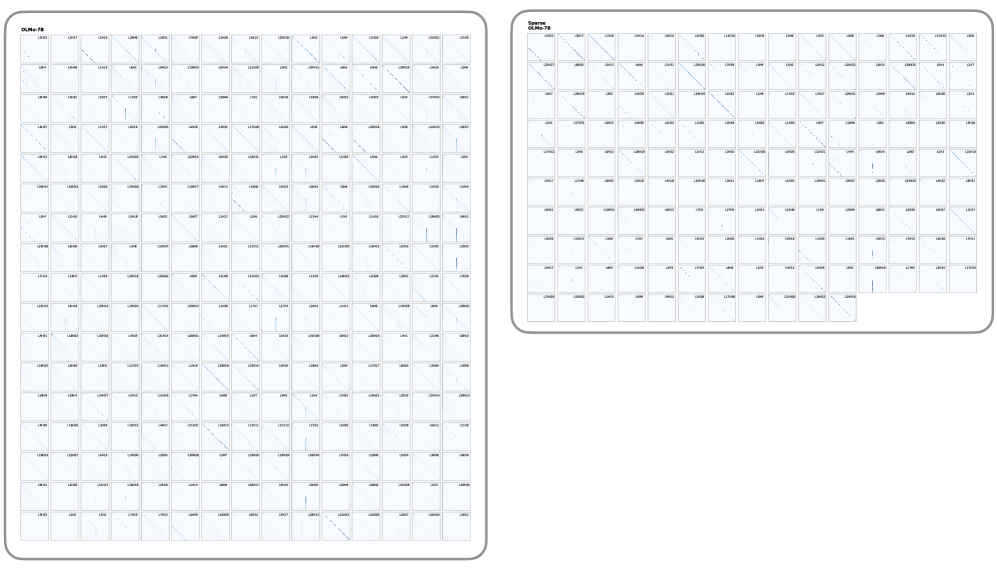
The image displays two separate panels, each containing a grid of small, square plots arranged in rows and columns. The panels are presented side-by-side on a white background. The left panel is larger and contains a denser grid, while the right panel is smaller with a less dense grid. Each individual plot within the grids appears to be a simple line graph or scatter plot, but the data points and lines are extremely faint and not legible at this image resolution. The primary visible information consists of alphanumeric labels in the top-left corner of each small plot.
### Components/Axes
* **Panel Layout:** Two distinct rectangular panels with rounded corners and a thin black border.
* **Left Panel:** Titled "SLN-78" in the top-left corner. Contains a grid of 16 rows by 12 columns (192 total plots).
* **Right Panel:** Titled "Spectra 10-19" in the top-left corner. Contains a grid of 10 rows by 10 columns (100 total plots).
* **Plot Labels:** Each small plot has a unique alphanumeric identifier in its top-left corner. The labels follow a consistent pattern.
* **Left Panel (SLN-78) Label Pattern:** Labels begin with "L04" followed by a two-digit number, starting from "L0401" in the top-left plot. The numbering appears to proceed sequentially row by row, from left to right. The final visible label in the bottom-right plot is "L0496". The sequence suggests there are 96 plots in this grid (8 rows x 12 columns), not 192 as the visual grid suggests. This indicates the grid may be 8 rows of 12, with each "plot" being a pair of sub-plots, or the labels repeat in a pattern not fully discernible.
* **Right Panel (Spectra 10-19) Label Pattern:** Labels begin with "L04" followed by a two-digit number, starting from "L0401" in the top-left plot. The numbering proceeds sequentially. The final visible label in the bottom-right plot is "L0410". This suggests a 10-plot sequence, possibly corresponding to the title "Spectra 10-19". The grid is 10x10, but only the first 10 labels are unique, implying the same set of 10 plots may be repeated across the grid for comparison or that the labels are placeholders.
### Detailed Analysis
* **Plot Content:** The graphical content within each small square is not interpretable. Faint, light-blue lines or dots are visible, suggesting each plot contains a simple chart (e.g., a line graph, a scatter plot with a trend line, or a spectrum). However, no axes, scales, data points, or line shapes can be reliably extracted.
* **Data Table Reconstruction:** Not possible. The image does not contain a structured data table with readable values.
* **Legend:** There is no visible legend within the image to explain the meaning of the lines or data points in the small plots.
### Key Observations
1. **High-Level Organization:** The image is a composite of two "small multiples" displays, a technique used to compare many similar charts side-by-side.
2. **Labeling System:** A clear, sequential labeling system ("L04xx") is used, suggesting these are samples, experiments, or spectra from a larger series.
3. **Visual Data Inaccessibility:** The critical data—the trends, values, and patterns within each small plot—is lost due to the image's resolution and compression. The plots serve as placeholders or indices rather than as sources of quantitative information.
4. **Discrepancy in Left Panel:** The visual grid (16x12) does not match the label sequence (which ends at L0496, implying 96 items). This could mean the grid is 8 rows of 12 paired plots, or the labels are not unique to each visual cell.
### Interpretation
This image appears to be a **summary index or catalog page** from a technical report, likely in fields like spectroscopy, materials science, or experimental physics/chemistry. Its primary function is not to present detailed data but to provide an organized overview of a large set of measurements or samples.
* **Purpose:** The "SLN-78" and "Spectra 10-19" titles suggest these are two different datasets or experimental runs. The grids allow a researcher to quickly locate a specific sample (by its "L04xx" ID) and see a thumbnail of its corresponding data (the faint plot).
* **Relationship Between Elements:** The title defines the dataset, the grid organizes the samples within it, and the label provides a unique key. The actual data for each label would be found elsewhere in the full document.
* **Notable Anomaly:** The mismatch between the visual grid size and the label count in the "SLN-78" panel is a significant observation. It implies either a specific grouping structure (e.g., each labeled item has two associated plots) or a potential error in the figure's construction.
* **Limitation:** As a standalone image, its informational value is low because the core data is illegible. Its value is purely structural and organizational. To extract facts or data, one would need the higher-resolution source document or the accompanying data files referenced by these labels.
**Conclusion:** This image is a **table of contents for graphical data**, not the data itself. It successfully conveys the scale and organization of an experiment (hundreds of samples) but fails to convey any specific results due to the illegibility of the embedded plots.