## Photograph Collage: Social Interaction Scenarios with Annotated Relationships
### Overview
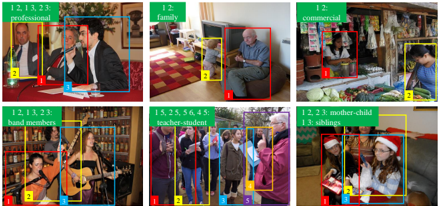
The image is a collage of six photographs depicting various social interaction scenarios. Each photo contains labeled bounding boxes with numerical annotations and color-coded labels indicating relationships or roles. The scenarios include professional meetings, family interactions, commercial settings, band performances, educational environments, and familial gatherings.
### Components/Axes
- **Labels**:
- Top-left: "professional" (green box)
- Top-middle: "family" (green box)
- Top-right: "commercial" (green box)
- Middle-left: "band members" (green box)
- Middle-center: "teacher-student" (green box)
- Middle-right: "mother-child 1: siblings" (green box)
- **Annotations**:
- Numerical labels (e.g., "1, 2, 13, 23") within bounding boxes, likely identifying individuals or roles.
- Color-coded bounding boxes (red, blue, yellow, purple) to differentiate entities within each scenario.
### Detailed Analysis
1. **Top-left (Professional)**:
- Three individuals in formal attire.
- Bounding boxes:
- Red box labeled "1" (leftmost person).
- Blue box labeled "2" (center person).
- Red box labeled "3" (rightmost person).
- Text: "1, 2, 13, 23: professional".
2. **Top-middle (Family)**:
- Two individuals (adult and child) in a living room.
- Bounding boxes:
- Red box labeled "1" (adult).
- Blue box labeled "2" (child).
- Text: "1, 2: family".
3. **Top-right (Commercial)**:
- Two individuals in a market setting.
- Bounding boxes:
- Red box labeled "1" (vendor).
- Blue box labeled "2" (customer).
- Text: "1, 2: commercial".
4. **Middle-left (Band Members)**:
- Three musicians with instruments.
- Bounding boxes:
- Red box labeled "1" (guitarist).
- Blue box labeled "2" (vocalist).
- Yellow box labeled "3" (bassist).
- Text: "1, 2, 3: band members".
5. **Middle-center (Teacher-Student)**:
- Group of five individuals (likely students and a teacher).
- Bounding boxes:
- Red box labeled "1" (teacher).
- Blue box labeled "2" (student 1).
- Yellow box labeled "3" (student 2).
- Purple box labeled "4" (student 3).
- Green box labeled "5" (student 4).
- Text: "1, 2, 3, 4, 5: teacher-student".
6. **Middle-right (Mother-Child 1: Siblings)**:
- Two children with Santa hats.
- Bounding boxes:
- Red box labeled "1" (mother).
- Blue box labeled "2" (child 1).
- Yellow box labeled "3" (child 2).
- Text: "1, 2, 3: mother-child 1: siblings".
### Key Observations
- **Numerical Annotations**: Numbers within boxes likely correspond to unique identifiers for individuals or roles (e.g., "1" as a primary subject, "2" as a secondary subject).
- **Color Coding**: Distinct colors (red, blue, yellow, purple) differentiate entities within each scenario, aiding visual separation.
- **Scenario Diversity**: The collage covers professional, familial, commercial, artistic, educational, and holiday-related interactions.
- **Relationship Indicators**: Labels like "mother-child" and "siblings" suggest hierarchical or familial relationships, while "teacher-student" implies educational dynamics.
### Interpretation
The annotations and color-coded boxes suggest a systematic approach to categorizing social interactions, possibly for a study on group dynamics, role identification, or relationship mapping. The numerical labels may represent participant IDs or roles (e.g., "1" as a leader, "2" as a follower). The diversity of scenarios highlights the adaptability of this annotation system across contexts. The use of color and numbers implies a focus on clarity and scalability, enabling researchers to track interactions in complex group settings. The inclusion of holiday-themed imagery (Santa hats) adds a cultural dimension, potentially indicating seasonal or contextual variations in social behavior.