\n
## Image Analysis: Scene Categorization with Bounding Boxes
### Overview
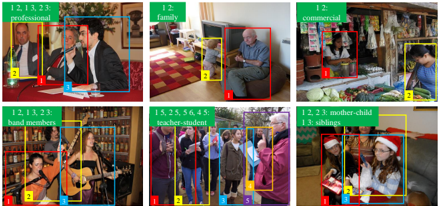
The image presents a 2x3 grid of photographs, each depicting a different scene. Each photograph has bounding boxes drawn around individuals, and each box is labeled with a number (1, 2, 3, etc.). Above each image is a textual label describing the scene category. The purpose appears to be demonstrating scene categorization and object detection/identification within those scenes.
### Components/Axes
The image does not contain axes or charts. It consists of:
* **Scene Labels:** "professional", "family", "commercial", "band members", "teacher-student", "mother-child siblings". These are positioned above each corresponding image.
* **Bounding Boxes:** Rectangular boxes around people in each image, numbered sequentially.
* **Images:** Six distinct photographs representing different scenes.
### Detailed Analysis or Content Details
**Image 1: "professional"**
* Bounding Box 1 (Red): Person speaking into a microphone.
* Bounding Box 2 (Yellow): Person standing next to the speaker.
* Bounding Box 3 (Blue): Another person, partially visible.
**Image 2: "family"**
* Bounding Box 1 (Red): Elderly man sitting on an ottoman.
* Bounding Box 2 (Yellow): Child playing near the television.
**Image 3: "commercial"**
* Bounding Box 1 (Yellow): People inside a shop.
* Bounding Box 2 (Green): Person looking at produce.
**Image 4: "band members"**
* Bounding Box 1 (Red): Woman playing guitar.
* Bounding Box 2 (Yellow): Another band member.
* Bounding Box 3 (Blue): Additional band member.
**Image 5: "teacher-student"**
* Bounding Box 1 (Red): Teacher.
* Bounding Box 2 (Yellow): Student.
* Bounding Box 3 (Blue): Student.
* Bounding Box 4 (Pink): Student.
* Bounding Box 5 (Orange): Student.
**Image 6: "mother-child siblings"**
* Bounding Box 1 (Red): Mother.
* Bounding Box 2 (Yellow): Child.
* Bounding Box 3 (Green): Sibling.
### Key Observations
* The bounding box numbers are sequential within each image, but do not carry over between images.
* The scene labels are descriptive and provide context for the image content.
* The number of bounding boxes varies between images, reflecting the number of people present in each scene.
* The bounding boxes are not necessarily tightly fitted around the individuals, suggesting a potentially imperfect object detection algorithm.
### Interpretation
The image demonstrates a scene categorization task, likely for evaluating computer vision algorithms. The algorithm appears to be able to identify different scene types (professional, family, etc.) and detect people within those scenes using bounding boxes. The bounding box numbers suggest an attempt to identify individual instances of people within each scene. The variation in the number of bounding boxes and the imperfect fit around individuals indicate that the algorithm is not perfect, but it is capable of performing these tasks to some degree. The image serves as a visual example of the output of such an algorithm, allowing for qualitative assessment of its performance. The image does not provide quantitative data, but rather a visual representation of the results.