\n
## Diagram: Reasoning Skill Selection Process
### Overview
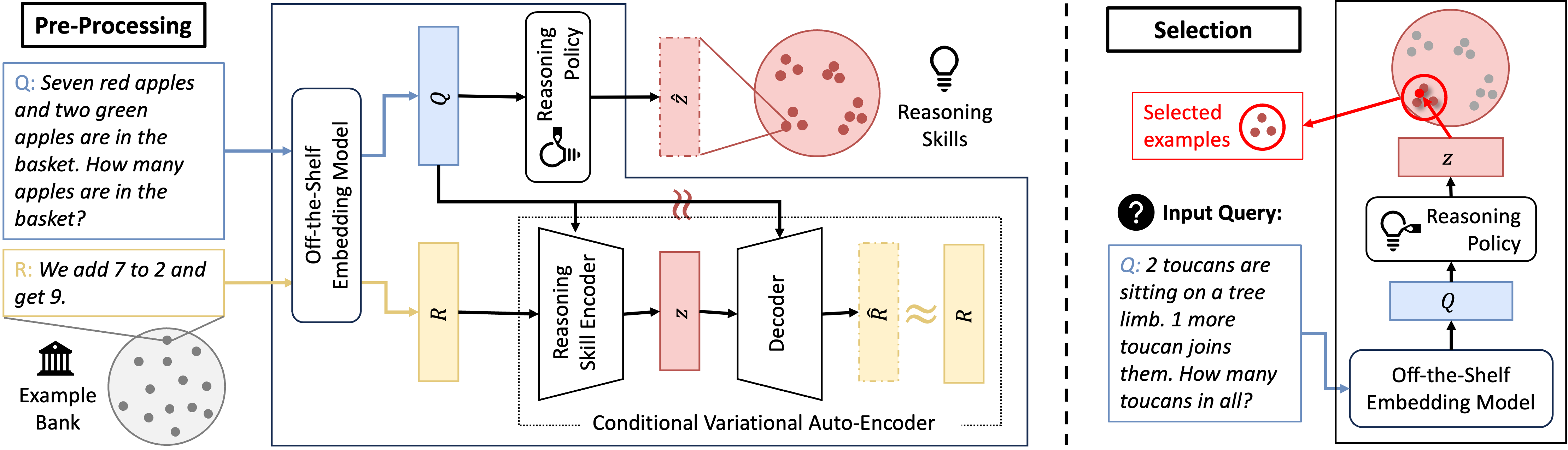
This diagram illustrates a process for selecting reasoning skills from an example bank, utilizing a Conditional Variational Auto-Encoder (CVAE) and a reasoning policy. The process involves pre-processing a query, encoding it with an off-the-shelf embedding model and a reasoning skill encoder, decoding to generate reasoning skills, and then selecting relevant examples based on a reasoning policy. The diagram is segmented into four main areas: Pre-Processing, Conditional Variational Auto-Encoder, and Selection.
### Components/Axes
The diagram contains the following components:
* **Pre-Processing:** Includes an "Example Bank", "Off-the-Shelf Embedding Model", and example question/answer pairs (Q & R).
* **Conditional Variational Auto-Encoder:** Composed of a "Reasoning Skill Encoder", a "Decoder", and labeled with "z" (latent variable) and "R" (reasoning skill).
* **Selection:** Includes a "Reasoning Policy", "Reasoning Skills", and "Selected Examples".
* **Input Query:** A separate query example (Q & R) used for the selection process.
* **Labels:** "Pre-Processing", "Conditional Variational Auto-Encoder", "Selection", "Q", "R", "z", "R".
* **Arrows:** Indicate the flow of information between components.
* **Shapes:** Rectangles represent processes/models, circles represent data points/skills, and a dashed line separates the CVAE from the Selection process.
### Detailed Analysis or Content Details
The diagram details the following flow:
1. **Pre-Processing:**
* An "Example Bank" (represented by a stack of books) provides examples.
* A question "Q: Seven red apples and two green apples are in the basket. How many apples are in the basket?" is input.
* The corresponding answer "R: We add 7 to 2 and get 9." is provided.
* Both Q and R are fed into an "Off-the-Shelf Embedding Model" (yellow rectangle).
2. **Conditional Variational Auto-Encoder:**
* The output of the embedding model (Q) is passed to a "Reasoning Skill Encoder" (yellow rectangle).
* The encoder generates a latent variable "z".
* "z" and "R" are fed into a "Decoder" (yellow rectangle).
* The decoder outputs a set of "Reasoning Skills" (represented by purple dots within a circle).
3. **Selection:**
* A new "Input Query" is presented: "Q: 2 toucans are sitting on a tree limb. 1 more toucan joins them. How many toucans in all?".
* This query (Q) is also processed by the "Off-the-Shelf Embedding Model".
* The output is fed into a "Reasoning Policy" (yellow rectangle).
* The reasoning policy, along with the "Reasoning Skills" generated by the CVAE, selects "Selected Examples" (represented by red dots within a circle).
* The selected examples are then fed back into the reasoning policy and the embedding model, creating a feedback loop.
### Key Observations
* The CVAE is central to generating a diverse set of reasoning skills.
* The reasoning policy acts as a filter, selecting the most relevant skills for a given query.
* The feedback loop in the selection process suggests an iterative refinement of skill selection.
* The diagram highlights the separation between the skill generation (CVAE) and the skill selection (Reasoning Policy).
### Interpretation
The diagram illustrates a system for automated reasoning skill acquisition and application. The CVAE learns to represent reasoning skills in a latent space, allowing for the generation of diverse skills. The reasoning policy then leverages these skills to solve new problems by selecting the most appropriate ones. The feedback loop suggests a mechanism for adapting and improving the skill selection process over time. The use of an "Off-the-Shelf Embedding Model" indicates a reliance on pre-trained language models for representing the input queries and answers. The overall architecture suggests a modular approach to reasoning, where skill generation and selection are treated as separate but interconnected components. The diagram doesn't provide specific data or numerical values, but rather a conceptual framework for a reasoning system. It demonstrates a process for learning and applying reasoning skills, potentially enabling machines to solve complex problems that require more than just pattern recognition.