## Diagram: Technical Architecture for Reasoning-Based Question Answering System
### Overview
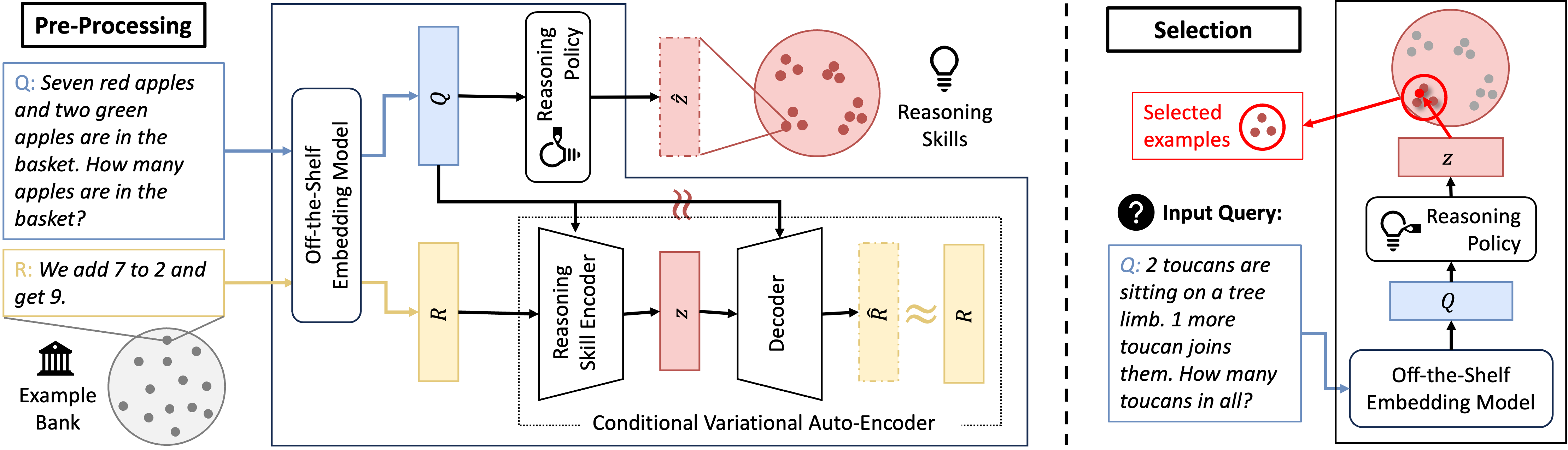
The diagram illustrates a two-stage technical architecture for processing and answering reasoning-based questions. It combines off-the-shelf embedding models with custom reasoning components, featuring explicit example selection and conditional variational auto-encoder (CVAE) components. The system processes natural language queries through multiple stages of encoding, reasoning, and decoding.
### Components/Axes
1. **Pre-Processing Section (Left Side)**
- Input Query Box: Contains sample questions (e.g., "Seven red apples...")
- Off-the-Shelf Embedding Model: Standard NLP model for initial text representation
- Reasoning Policy: Decision-making component for reasoning strategy
- Example Bank: Repository of solved examples (shown with apple/toucan illustrations)
- Reasoning Encoder/Decoder: CVAE components for structured reasoning
2. **Selection Section (Right Side)**
- Input Query Box: Contains second sample question ("2 toucans...")
- Selected Examples Highlight: Visual indicator of retrieved examples
- Reasoning Skills Visualization: Circular diagram with colored dots representing reasoning steps
- Reasoning Policy: Same component as in pre-processing section
- CVAE Components: Mirroring the left section's encoder/decoder structure
3. **Connecting Elements**
- Arrows showing data flow between components
- Mathematical notation (Q for queries, R for responses, Z for latent representations)
- Example Bank icon (classical building symbol)
- Reasoning Skills icon (lightbulb)
### Detailed Analysis
1. **Pre-Processing Flow**
- Input queries are first processed by an off-the-shelf embedding model
- The reasoning policy determines how to handle the query
- The system either generates a direct answer (R) or stores it in the example bank
- The CVAE components (Reasoning Encoder/Decoder) process the query through latent space (Z)
2. **Selection Mechanism**
- New queries trigger example retrieval from the bank
- Selected examples are highlighted in red
- The reasoning skills visualization shows step-by-step problem decomposition
- The same CVAE architecture processes both direct and example-based reasoning
3. **Mathematical Notation**
- Q: Represents input queries (e.g., "How many apples...")
- R: Denotes system responses (e.g., "We add 7 to 2...")
- Z: Latent space representation in the CVAE architecture
### Key Observations
1. The system uses both direct reasoning and example-based reasoning
2. The reasoning policy acts as a central decision-making component
3. The example bank serves as a knowledge repository for similar problems
4. The CVAE architecture enables structured reasoning through latent space manipulation
5. Visual elements (colors, icons) help distinguish different components
### Interpretation
This architecture demonstrates a hybrid approach to question answering that combines:
1. **Pre-trained Language Models**: For initial text understanding
2. **Custom Reasoning Components**: For problem-solving logic
3. **Example-Based Learning**: Through the example bank mechanism
4. **Probabilistic Reasoning**: Via the conditional variational auto-encoder
The system appears designed to handle arithmetic and simple logical reasoning tasks by:
- First determining the appropriate reasoning strategy
- Either generating a direct answer or retrieving similar examples
- Processing through a structured reasoning pipeline
- Maintaining consistency between direct and example-based reasoning paths
The use of CVAE suggests the system can handle uncertainty in reasoning steps while maintaining coherent problem-solving trajectories. The explicit example selection mechanism indicates an emphasis on leveraging past solutions for new problems.