## Diagram: Audio Processing Pipeline
### Overview
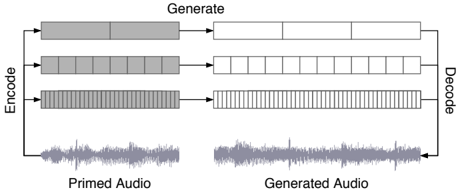
The diagram illustrates a two-stage audio processing workflow: **Encode** (left) and **Decode** (right). Each stage contains three sub-components labeled "Generate" and "Decode," with arrows indicating data flow. At the bottom, waveforms labeled "Primed Audio" (input) and "Generated Audio" (output) are shown.
### Components/Axes
- **Left Section (Encode)**:
- Three horizontal blocks labeled "Encode" (top to bottom).
- Arrows point from "Primed Audio" to the first "Encode" block, then sequentially through the three blocks.
- Final arrow from the last "Encode" block to the "Generate" section.
- **Right Section (Decode)**:
- Three horizontal blocks labeled "Decode" (top to bottom).
- Arrows flow from the "Generate" section to the first "Decode" block, then sequentially through the three blocks.
- Final arrow from the last "Decode" block to "Generated Audio."
- **Waveforms**:
- "Primed Audio" (left waveform) and "Generated Audio" (right waveform) are depicted as noisy, time-domain signals.
### Detailed Analysis
- **Textual Labels**:
- "Encode," "Decode," "Generate," "Primed Audio," and "Generated Audio" are explicitly labeled.
- No numerical values, scales, or legends are present.
- **Flow Direction**:
- Data flows left-to-right: Primed Audio → Encode stages → Generate → Decode stages → Generated Audio.
- **Component Structure**:
- Each "Encode" and "Decode" block is uniformly sized, suggesting equal processing steps.
- The "Generate" block bridges the Encode and Decode sections, acting as a transformation stage.
### Key Observations
1. The diagram emphasizes a sequential, modular pipeline for audio processing.
2. The "Generate" stage is central, implying it synthesizes or transforms encoded data before decoding.
3. No explicit numerical or categorical data is provided; the focus is on structural relationships.
### Interpretation
This diagram represents a conceptual model of audio signal processing, likely for tasks like speech synthesis or noise reduction. The "Primed Audio" serves as input, which is encoded into a compressed or transformed representation through three stages. The "Generate" block may introduce synthetic elements or refine the encoded data, which is then decoded to produce the final "Generated Audio." The absence of numerical data suggests this is a high-level architectural diagram rather than a quantitative analysis. The uniformity of block sizes implies equal computational effort per stage, though real-world implementations might vary. The waveform visuals reinforce the idea of time-domain signal transformation.