## Line Chart: Decoding Throughput
### Overview
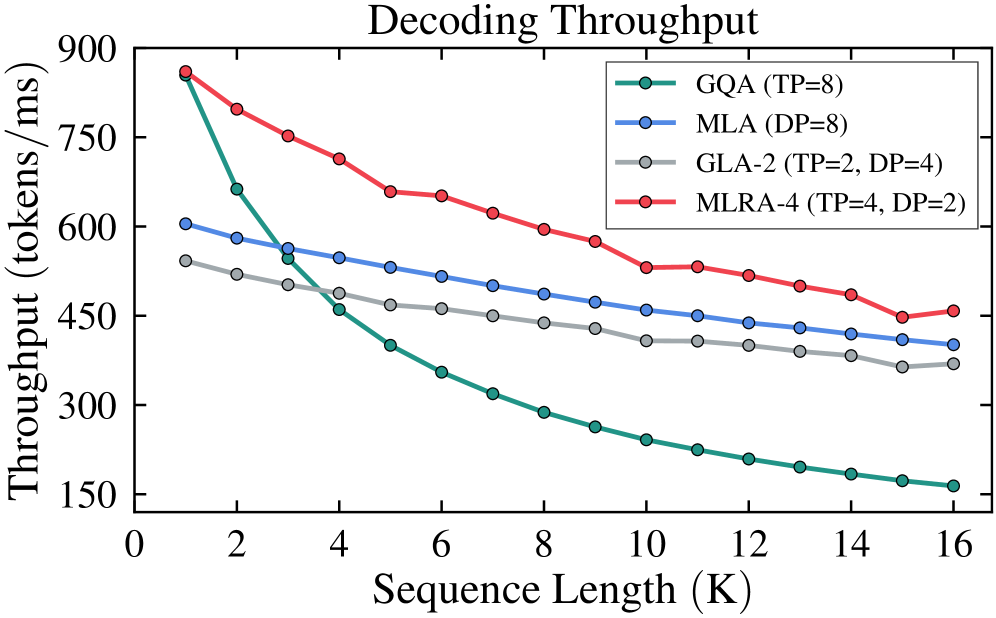
The chart compares the decoding throughput (tokens/ms) of four algorithms (GQA, MLA, GLA-2, MLRA-4) across sequence lengths (0–16K). Throughput decreases for all algorithms as sequence length increases, with varying rates of decline.
### Components/Axes
- **X-axis**: Sequence Length (K), ranging from 0 to 16 in increments of 2.
- **Y-axis**: Throughput (tokens/ms), ranging from 150 to 900 in increments of 150.
- **Legend**: Located in the top-right corner, mapping colors/markers to algorithms:
- Green circles: GQA (TP=8)
- Blue circles: MLA (DP=8)
- Gray circles: GLA-2 (TP=2, DP=4)
- Red circles: MLRA-4 (TP=4, DP=2)
### Detailed Analysis
1. **GQA (TP=8)**:
- Starts at ~850 tokens/ms at sequence length 0.
- Drops sharply to ~600 tokens/ms at sequence length 2.
- Continues declining steeply, reaching ~150 tokens/ms at sequence length 16.
- **Trend**: Steepest decline among all algorithms.
2. **MLA (DP=8)**:
- Begins at ~600 tokens/ms at sequence length 0.
- Declines gradually to ~400 tokens/ms at sequence length 16.
- **Trend**: Moderate, linear decrease.
3. **GLA-2 (TP=2, DP=4)**:
- Starts at ~550 tokens/ms at sequence length 0.
- Declines slowly to ~350 tokens/ms at sequence length 16.
- **Trend**: Gradual, near-linear decrease.
4. **MLRA-4 (TP=4, DP=2)**:
- Begins at ~800 tokens/ms at sequence length 0.
- Drops to ~450 tokens/ms at sequence length 10.
- Stabilizes slightly before declining to ~400 tokens/ms at sequence length 16.
- **Trend**: Initial sharp drop, then gradual decline.
### Key Observations
- **GQA** exhibits the most significant throughput degradation with increasing sequence length.
- **MLRA-4** maintains higher throughput than other algorithms after the initial drop, suggesting better scalability.
- **MLA** and **GLA-2** show similar performance patterns but with MLA starting slightly higher.
- No lines intersect after sequence length 2, indicating stable performance hierarchies.
### Interpretation
The data suggests that algorithm efficiency varies with sequence length and parameter configurations (TP/DP). GQA’s steep decline implies high computational overhead for longer sequences, while MLRA-4’s resilience indicates optimized handling of extended contexts. Parameters like TP (token processing) and DP (depth) likely influence scalability differently across architectures. The chart highlights trade-offs between algorithm design and performance under varying workloads.