## Line Chart: CIFAR-10 Test Accuracy vs. d1 Parameter
### Overview
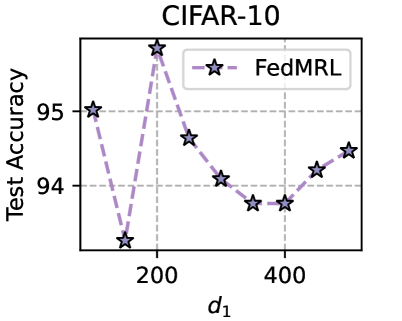
The chart illustrates the relationship between the hyperparameter `d1` and test accuracy for the FedMRL algorithm on the CIFAR-10 dataset. Test accuracy is plotted on the y-axis (93–95 range), while `d1` values (200, 400) are on the x-axis. The data shows a non-linear trend with a pronounced dip and recovery.
### Components/Axes
- **Title**: "CIFAR-10" (top-center)
- **Y-Axis**: "Test Accuracy" (93–95, increments of 1)
- **X-Axis**: "d1" (200, 400, increments of 200)
- **Legend**: "FedMRL" (purple dashed line with star markers, top-right)
- **Data Series**: Single line with star markers (purple, dashed)
### Detailed Analysis
- **Data Points**:
- At `d1 = 200`: Test accuracy ≈ 93.5 (lowest point, marked with a star)
- At `d1 = 400`: Test accuracy ≈ 94.5 (recovery phase, marked with a star)
- **Trend**:
- The line starts at 95 (unlabeled `d1`), drops sharply to 93.5 at `d1 = 200`, then rises to 94.5 at `d1 = 400`. The pattern suggests a V-shaped curve with a trough at `d1 = 200`.
### Key Observations
1. **Performance Dip**: Test accuracy decreases significantly at `d1 = 200`, indicating suboptimal performance at this hyperparameter value.
2. **Recovery**: Accuracy improves at `d1 = 400`, suggesting a potential optimal range beyond `d1 = 200`.
3. **Non-Linearity**: The relationship between `d1` and accuracy is not monotonic, highlighting sensitivity to hyperparameter tuning.
### Interpretation
The chart demonstrates that FedMRL's performance on CIFAR-10 is highly dependent on the `d1` hyperparameter. The sharp drop at `d1 = 200` implies that this value may represent a critical threshold where model stability or learning dynamics degrade. The subsequent recovery at `d1 = 400` suggests that larger values of `d1` could mitigate this issue, though further exploration beyond `d1 = 400` would be needed to confirm an optimal range. This sensitivity underscores the importance of hyperparameter optimization in federated learning frameworks for image classification tasks.